
If you are British and trying to explain the word to a non-Brit the answer is surprisingly difficult. In America, it is a simple answer: a dessert. We all use pudding to mean dessert or afters, but then there are types of dessert that are true puddings. The true puddings are those that are boiled or steamed. Christmas puddings, suet puddings and sponge puddings fit into this category. In fact, anything boiled or steamed in a basin, cloth or handy piece of intestinal tract is a pudding: black pudding, white pudding, steak & kidney pudding, pease pudding and haggis are the ones that immediately spring to mind. So far, so good. However, there is the odd miscellaneous pudding: Yorkshire puddings aren’t boiled, they are baked beneath the roast beef in the oven.
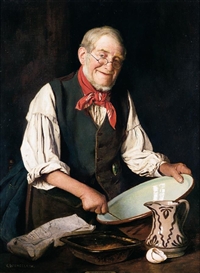
‘Mixing the Pudding’
So, a pudding is any dessert, or the name for the dessert course. Aside from the proper puddings mentioned above, there are some that go under a false name: bread and butter pudding, sticky toffee pudding and Eve’s pudding are examples of this. Why are these puddings and, say, an apple pie not called an apple pie pudding?
I only realised just how complicated a question ‘What is a pudding?’ is when talking about food with my American friends. All these diverse puddings (whether by my own classification true ones or not) must have some common ancestor. What was the first pudding? To answer this question I needed to hit the historical cookbooks.
I had mentioned in a previous post on the subject of dumplings a little while back that the pudding is a descendant of the dumpling. This was the claim made in 1726 by Thomas Gordon and Henry Carey. They said that dumplings became larger and larger that they had to tied up in a cloth, thus creating the pudding. However, I am not too sure about this claim. Elizabeth Raffald gives plenty of recipes for dumplings in her book from 1769 that are large and therefore require a cloth, but she calls them dumplings (a recipe for sparrow dumplings is in this post). Was the word pudding around a long time before this?
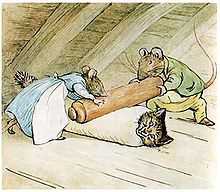
Mr Samuel Whiskers and Anna-Marie stitch Tom Kitten up a treat in
The Roly-Poly by Beatrix Potter
If you like the blogs and podcast I produce, please consider treating me to a virtual coffee or pint, or even a £3 monthly subscription: follow this link for more information.
Going back almost 200 years I have found recipes for puddings that take two distinct forms. In The Good Housewife’s Jewel from 1596, Thomas Dalton gives recipes for familiar puddings like black pudding and haggis, but he also gives recipes for puddings that are baked, such as the ‘pudding of a calves chaldron’ or the ‘pudding in a pot’. He also makes reference to making puddings in the bellies of animals such as coney and carp. It is interesting that none of the puddings are desserts, though they do contain many spices such as cloves, mace and ginger as well as dried fruits such as currants, plus sugar. They must have been very expensive to make in the late sixteenth century – to give some perspective in 1596 Elizabeth I was on the throne and the first production of The Merchant of Venice was put on at The Globe theatre. Back in the day there was no such thing as a first course, a second course and so on, at least how we know them; everything was just sent out together. So having sweetly spiced meat puddings would not have seemed strange. We don’t eat food like that anymore, except for the single survivor of this branch of the puddings – the Christmas Pudding.
[See this future post, however, for a correction]
The earliest description of the word pudding I could find is in the Bibliotheca scholastica from 1589. There is no real definition here, but examples of puddings and things associated with them. They all seem to be the kind made by stuffing intestines with various fillings. There are some interesting terms though: there was a pudding only eaten at funerals called a murtatum that was flavoured with myrtle berries, and a pudding-maker was called a silicernium.
In fact the earliest puddings do seem to be essentially sausages, so it seems our friends Messrs Gordon and Carey were probably incorrect. Though they were right about one thing: the pudding is certainly a British invention that was developed from the sausages the Romans brought into the country in the first century BC. The word pudding comes from the Latin word botellus, which means literally sausage; the French word boudin has the same root.
So there you go, a pudding was originally a boiled sausage, but selection throughout time has evolved them radially into a huge range of foods, both sweet and savoury and as far as I know, there isn’t a single one I don’t like. Usually I try to give an exhaustive list of dishes, but the list would probably go on for ever if I use the word pudding in its broad sense; therefore I’m just going to list the kind that I consider the true puddings, i.e. the boiled or steamed ones. Hopefully I’ll provide the histories and recipes for them. Of course, if I have missed any puddings out please let me know. I’m sure there are some glaringly obvious ones that I have forgotten. Okay, here we go:
Those boiled in intestines:
Black pudding
White pudding
Haggis
Those that are steamed in a basin and are savoury:
Steak, kidney and oyster pudding
Minted lamb pudding
Pork and apple pudding
Leek and onion pudding
Mutton, apple and raisin roly-poly
Mussel and leek roly-poly
Pease pudding
Those that are steamed in a basin and are for afters:
Christmas pudding
Spotted Dick
Sussex pond pudding
Steamed sponge pudding
Sticky toffee pudding

 British Food: A History