Read more of this content when you subscribe today and unlock lots of premium content, including the secret podcast, bonus blog posts (such as this one) and recipes, my Easter eggs and a monthly newsletter. Please click here for more information.
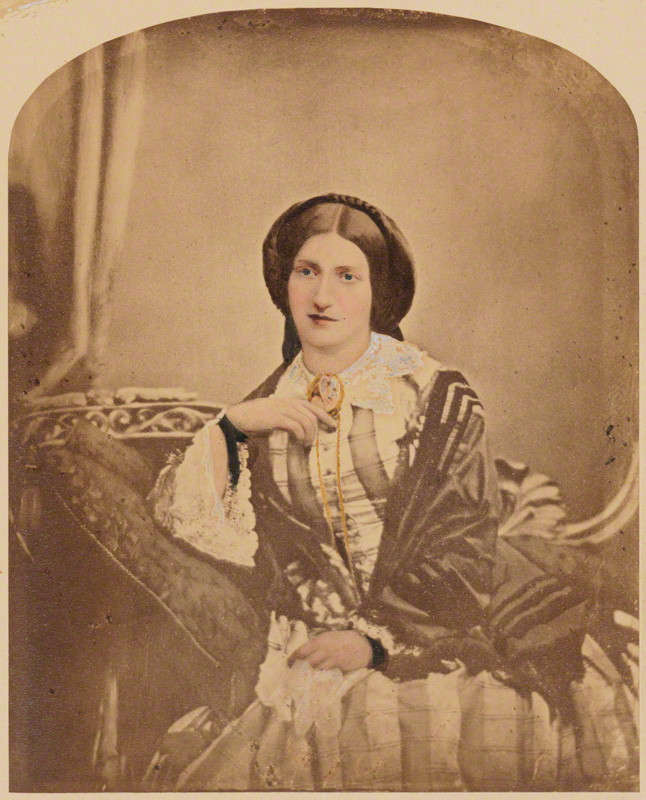
Welcome to this special bonus episode of The British Food History Podcast. I always make an extra episode for my monthly £3 subscribers. I wanted to make an episode where I talk with another food historian about a book. I asked Sam Bilton and she chose The Feasts of Autolycus: The Diary of a Greedy Woman by Elizabeth Robins Pennell (1899). An author I was not familiar with – and I really enjoyed reading the book and having this discussion.
We talk about Elizabeth Robins Pennell and how Sam discovered her, the expectations of women and greediness in the late Victorian period, food and morality, Camp coffee, stirring savouries, magnificent mushrooms, and kidneys – lots and lots of kidneys.
Subscribe to get access
Read more of this content when you subscribe today and unlock lots of premium content, including the secret podcast, bonus blog posts and recipes, my Easter eggs and a monthly newsletter. Please click here for more information.
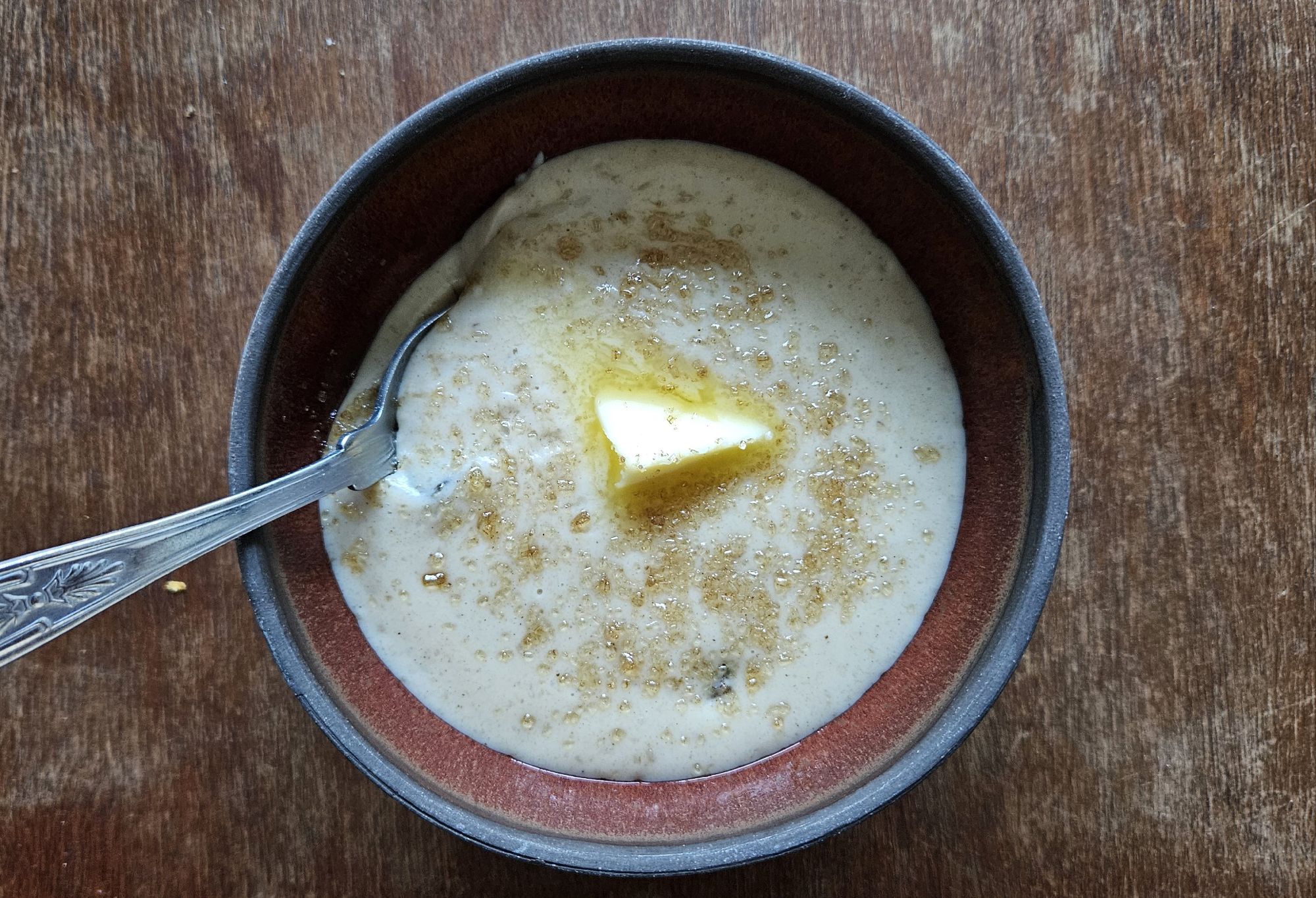
As I promised in the recent episode of The British Food History Podcast, Retro Foods with Briony May Williams, here is my post all about hasty pudding for my subscribers. There’s a recipe, plus – of course – some history. Enjoy!
The podcast is available to download on all apps, but you can stream here too.
Subscribe to get access
Read more of this content when you subscribe today and unlock lots of premium content, including bonus blog posts and recipes, my Easter eggs, newsletter and the secret podcast. Please click here for more information.
The tenth season of the podcast is being sponsored by Netherton Foundry, so please do check out their website[1] and support them if you can.
Stream the episode about Netherton Foundry here (or search for it on your favourite podcast app).
Kedgeree is a classic British breakfast dish that isn’t eaten so much these days. Perhaps it’s because it’s a bit much to tuck into first thing on a Thursday morning, though it does make a great lunch. Or maybe it’s the association with the officer class of the British Raj at a time when the romance of the British Empire is fizzling out. But whatever your feelings about that, there’s no denying that kedgeree is a classic piece of Anglo-Indian cookery. I call it Phase I Anglo-Indian cookery: ‘a result of the interface between Indian cooks and British wives of British officers and officials stationed in India’, as Alan Davidson put it.[2]
It’s a simple dish of mildly spiced rice, poached fish, onions and boiled eggs. The word is derived from the Tamil word khichri, a breakfast dish made from rice and mung beans (though other leguminous vegetables are also used). When the English arrived in India in the 17th century, they happily tucked into khichri, but as they became more established in the 18th century, the beans were swapped for protein-heavy fish.[3] Although I can’t confirm this, I think that the eggs were an addition made in Britain rather than India. Recipes are common in British cookery books of the 19th century, but there’s much variation, and a fixed, official recipe for kedgeree is impossible to find. Eliza Acton’s recipe is very much a leftovers dish, with any fish being used. Her only spice is cayenne pepper. Oddly, the eggs are beaten and fried with the rice.[4] In a 1950s edition of Beeton’s Book of Household Management, the eggs are boiled, and prawns are the fish of choice. The spices are paprika, black pepper and nutmeg. Weirdly, grated cheese is involved.[5]
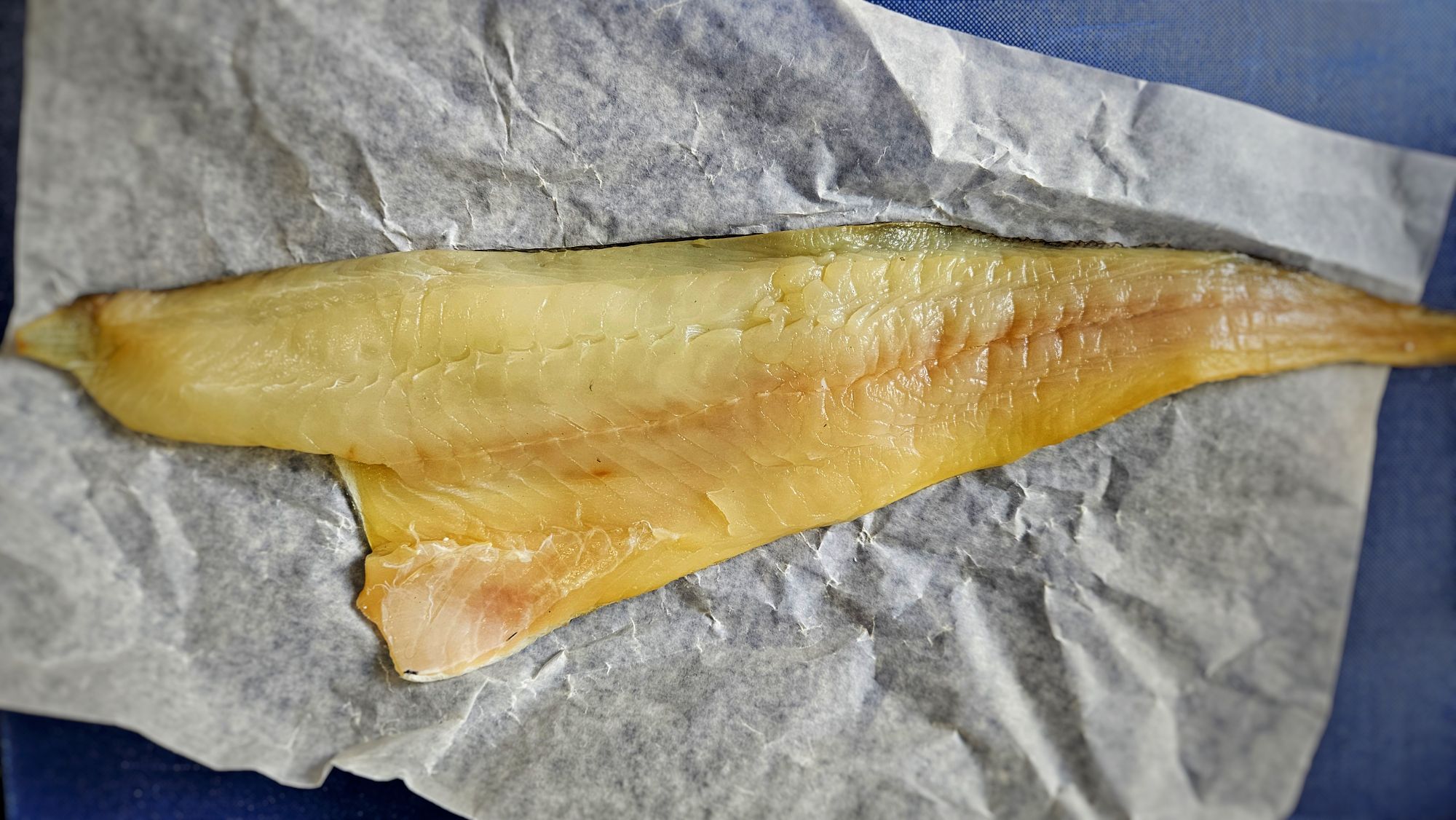
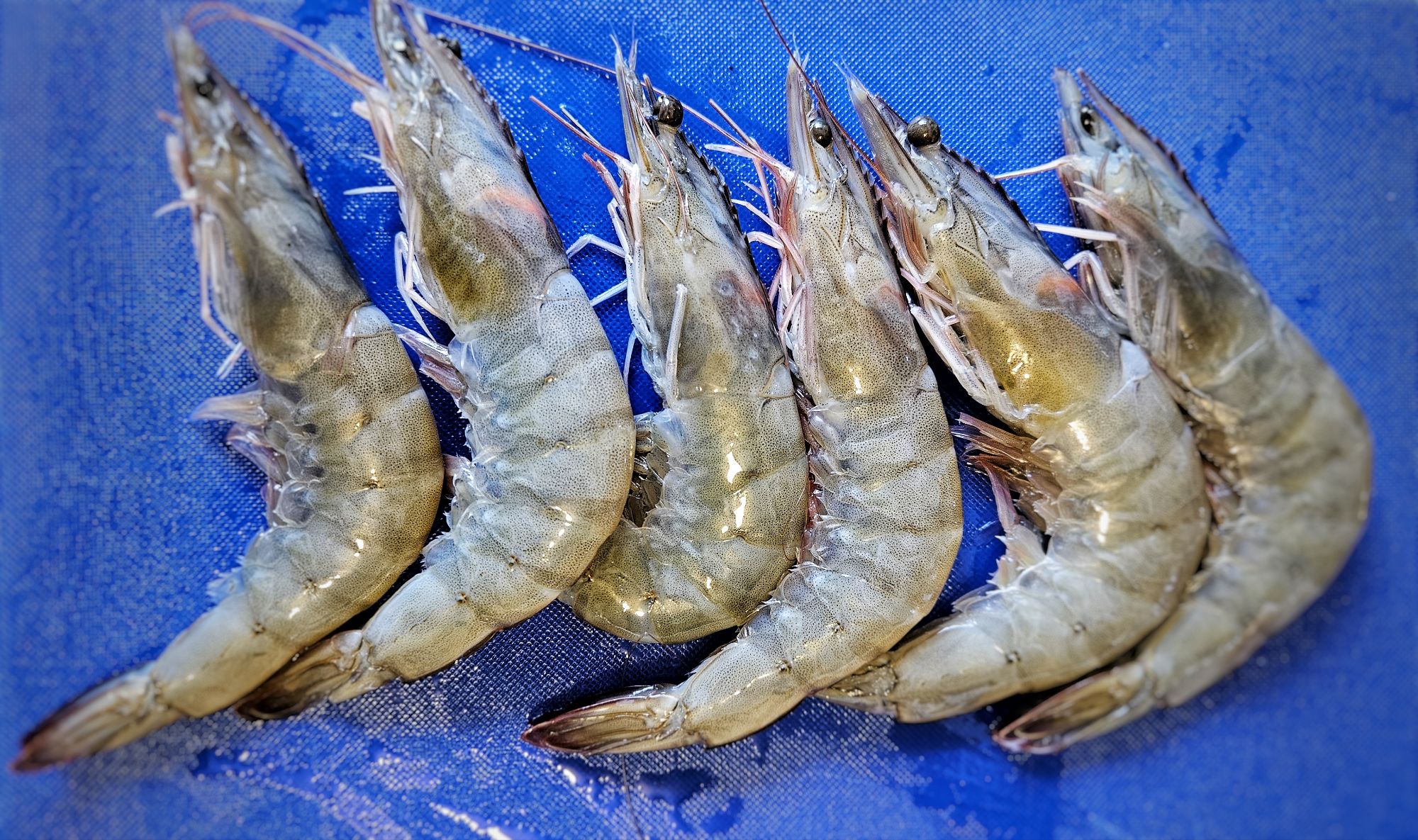
My fish of choice: naturally-smoked haddock and some nice, fat prawns
These days, the fish of choice is smoked haddock, but you can use any fish you like really. I like to add a few fat prawns whenever I’m feeling flush.
If you can, please support the podcast and blogs by becoming a £3 monthly subscriber, and unlock lots of premium content, including bonus blog posts and recipes, access to the Easter eggs, a monthly newsletter and the secret podcast, or treat me to a one-off virtual pint or coffee: click here.
Recipe
There are two ways you can make kedgeree: with freshly poached fish, as I describe below, or with leftover cooked fish, in which case, follow the method below, except for the stage where the fish gets poached in water and milk. Instead, use some fish or chicken stock instead of water and milk and follow the method as given, just letting the cooked fish warm through at the end of cooking.
I used my 10-inch Netherton Foundry Prospector Pan – the whole dish can be cooked in it, and when it is ready, it can go straight to the table to await your fellow diners.
My spices of choice are cumin seeds, garam masala and turmeric, but you can use whatever you like: curry powder works really well, as does a little smoked paprika or chilli powder. Some recipes use no spices at all, so if you are spice-averse, do not worry!
Serves 6 for breakfast, or 4 for a main meal
300 ml water
200 ml milk
2 bay leaves, crushed
One whole side of naturally-smoked haddock (around 250 g)
45 g butter
¾ tsp cumin seeds
1 medium onion or leek, sliced
3 cloves of garlic, finely chopped
¾ tsp salt
¾ tsp garam masala
½ tsp ground turmeric
Freshly ground black pepper
250 ml (200 g approximately) white basmati rice
1 handful of frozen peas (optional)
4 or 6 room-temperature medium eggs
4 or 6 whole prawns (optional)
2 tablespoons chopped parsley
1 lemon
In a saucepan heat the water and milk to scalding point with the bay leaves. Cut the haddock into two or three pieces so you can comfortably plop it into hot liquid. Allow the milk-water mix to come back up to a bare simmer, turn the heat off and leave the fish to poach for three or four minutes, until the flesh flakes easily. Remove from the liquid and set both the fish and the poaching liquid aside.
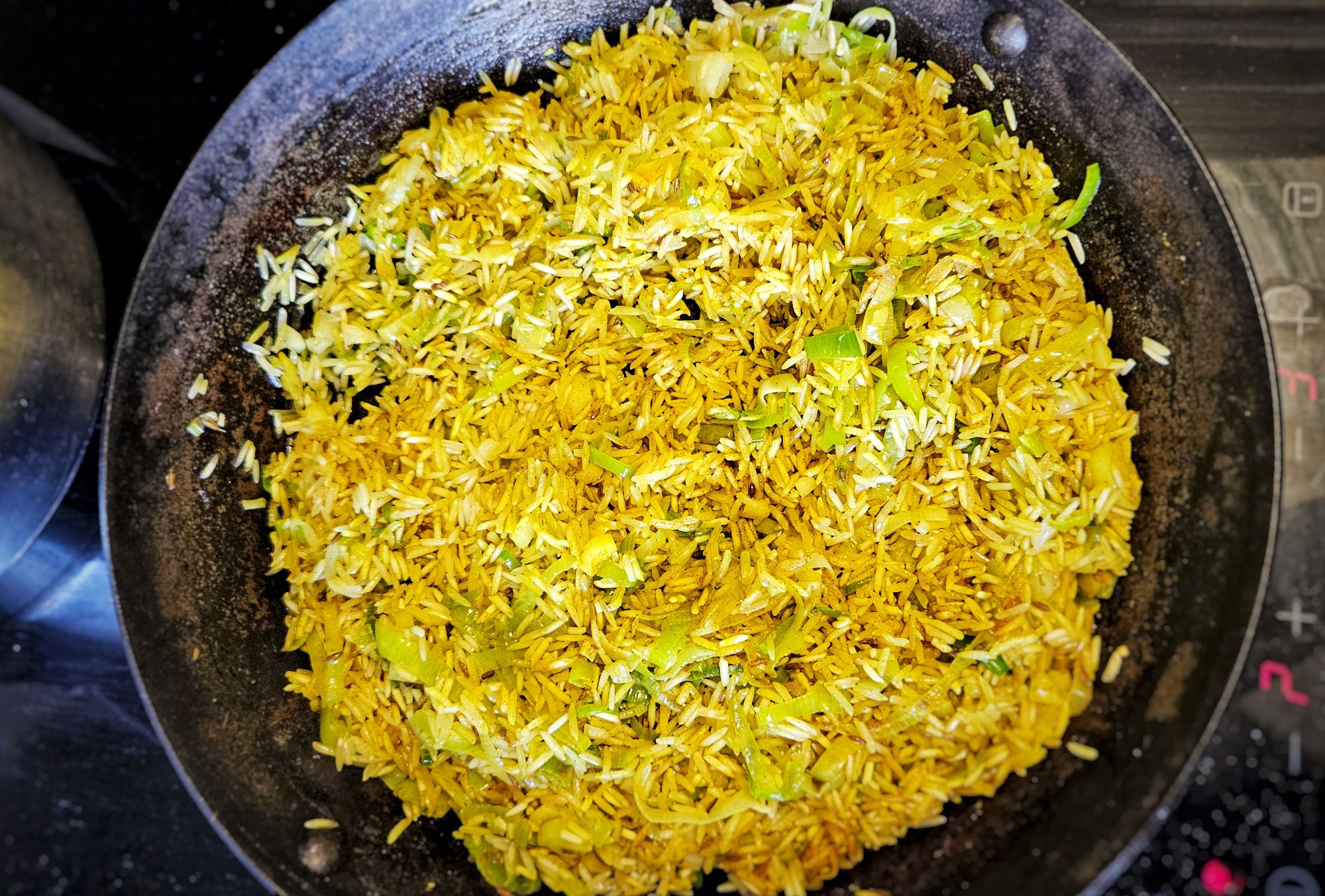
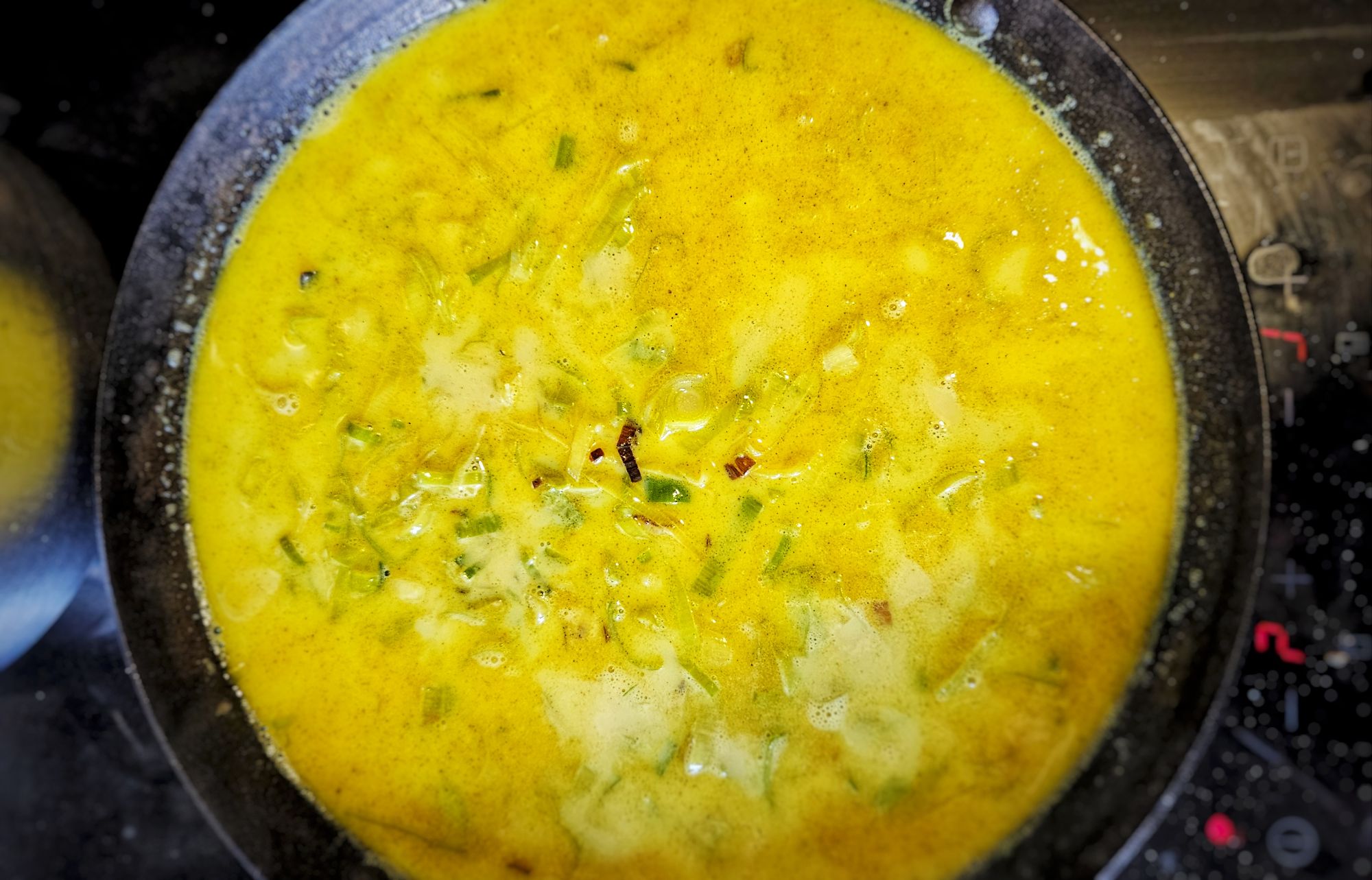
Place a sturdy-bottomed pan over medium heat – I used my 10-inch Prospector pan – and melt the butter. Once fizzling, add the cumin seeds and cook for a minute before tipping in the onion or leek, garlic and salt. Fry until soft, then add the garam masala and turmeric, plus a few turns of the peppermill. Fry for 30 seconds more, then stir in the rice and make sure each grain gets covered in the spices and oil.
Turn the heat down a little and pour the reserved poaching milk into the pan. Add the peas if using. Give everything a single stir to make sure nothing’s stuck and all the rice grains have separated. Do no more than one stir round, though – you’ll end up with claggy rice. Turn the heat down to a bare simmer, put on the lid and set a timer for 10 minutes.
Meanwhile, boil the eggs: get some water up to an excited simmer and gingerly sink in your eggs. Simmer for 6½ minutes, drain the water away, and refill the pan with cold water. Set aside.
When the 10 minutes are up, place the prawns on the rice and replace the lid. Now leave for two minutes. Turn the prawns, add the flaked fish, replace the lid and take off the heat. Leave everything to steam for two more minutes. As you wait, peel the eggs.
Take the pan to the table, remove the lid and fork through to mix, and serve with the boiled eggs, chopped parsley and the lemon cut into wedges.
[2] Davidson, A. (1999) The Oxford Companion to Food. Oxford University Press. Extending this idea, Phase II is when the people of the Indian subcontinent came to Britain and adapted their cuisines to British tastes.
[3] Burton, D. (1993) The Raj at the Table: A Culinary History of the British in India. Faber & Faber; Davidson (1999)
[4]Acton, E. (1845) Modern Cookery For Private Families. Quadrille.
[5] Beeton, I. and Ward & Lock (eds.) (1950) Mrs Beeton’s Household Management. Ward and Lock.
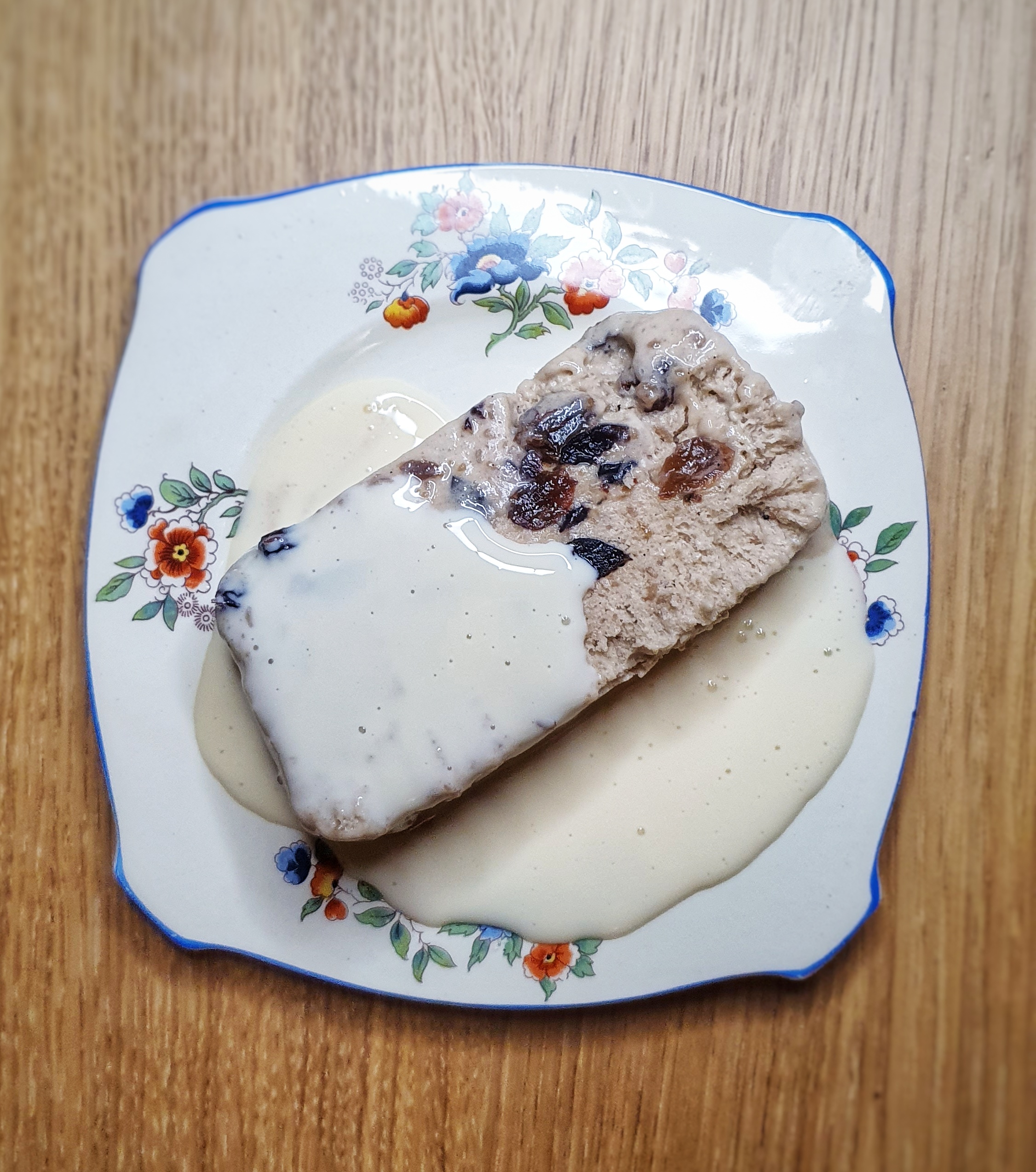
This delicious iced dessert, which was very popular in the 19th century at Christmastime, crops up in most cookery books of the time, and is described as ‘a quiet Victorian icon’ by Annie Gray in her excellent book At Christmas We Feast (2021).[1] It is associated with this time of year because of its main ingredient: puréed chestnuts, and it deserves a comeback.
Count Nesselrode (Creative Commons)
According to Eliza Acton, the pudding was invented by the famous Marie-Antoine Carême,[2] but it is not the case. In one of her best (and most obscure) books, Food with the Famous, Jane Grigson informs us that it was actually ‘invented by Monsieur Mony, chef for many years, to the Russian diplomat, Count Nesselrode, in Paris.’[3] Annie Gray took the research step further: the first printed recipe appears in Carême’s book L’Art de la Cuisine Française. In the original French version, he tells us he got the recipe from Mony, but in the English translation, he claims he – Carême – invented it.[4] Odd.
Listen to Annie discuss her book At Christmas We Feast with me in this past podcast episode.
Recipes do vary, though chestnuts are essential (unless you are Agnes Marshall, who asks – rather controversially – for almonds, in her Book of Ices[5]). Other ingredients include glacé and dried fruits, vanilla and maraschino liqueur – an essential. in my book, but some recipes suggest using brandy or rum as alternatives. There is a custard base, but the mixture is not churned like regular ice cream: this is a no-churn affair. It’s prevented from freezing to a solid block with the addition of airy whipped cream and Italian meringue.
If you like the blogs and podcast I produce, please consider treating me to a virtual coffee or pint, or even a £3 monthly subscription: follow this link for more information.
Recipe
There are several stages to making this pudding, and you need to start making it at least two days before you want to eat it. Don’t let the making of egg custard sauces and Italian meringues put you off. However, a good digital thermometer and electric beater are essential.
Serves 8
For the pudding:
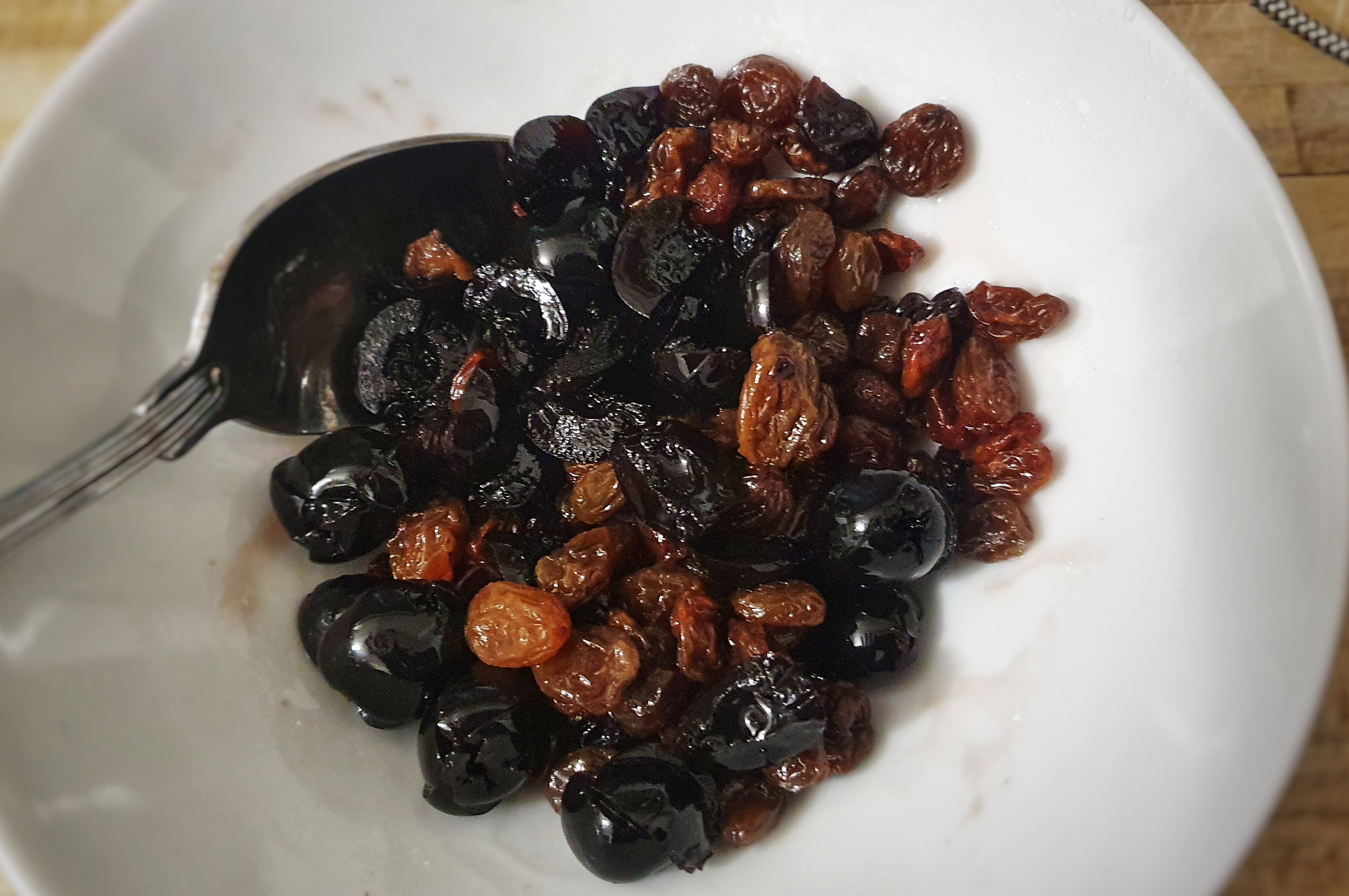
60 g chopped raisins or mixed fruit (currants, raisins and sultanas)[7]
60 g chopped candied peel or Maraschino cherries
80 ml maraschino
1 vanilla pod
300 ml single cream
3 egg yolks
160 g light brown sugar
160 g caster sugar
3 tbs/45 ml water
2 egg whites
300 ml whipping cream
440 g can or 2 x 200 g packets of unsweetened chestnut purée
To garnish: Maraschino cherries or candied chestnuts
For the custard sauce:
300 ml single cream or half-and-half whole milk and cream
50 g caster sugar
4 egg yolks
Around 25 ml maraschino (see recipe)
Soak the dried fruit and peel or cherries in maraschino overnight.
Next day, split the vanilla pod lengthways and scrape out the seeds and place both pod and seeds in a saucepan along with the single cream and heat to scalding point.
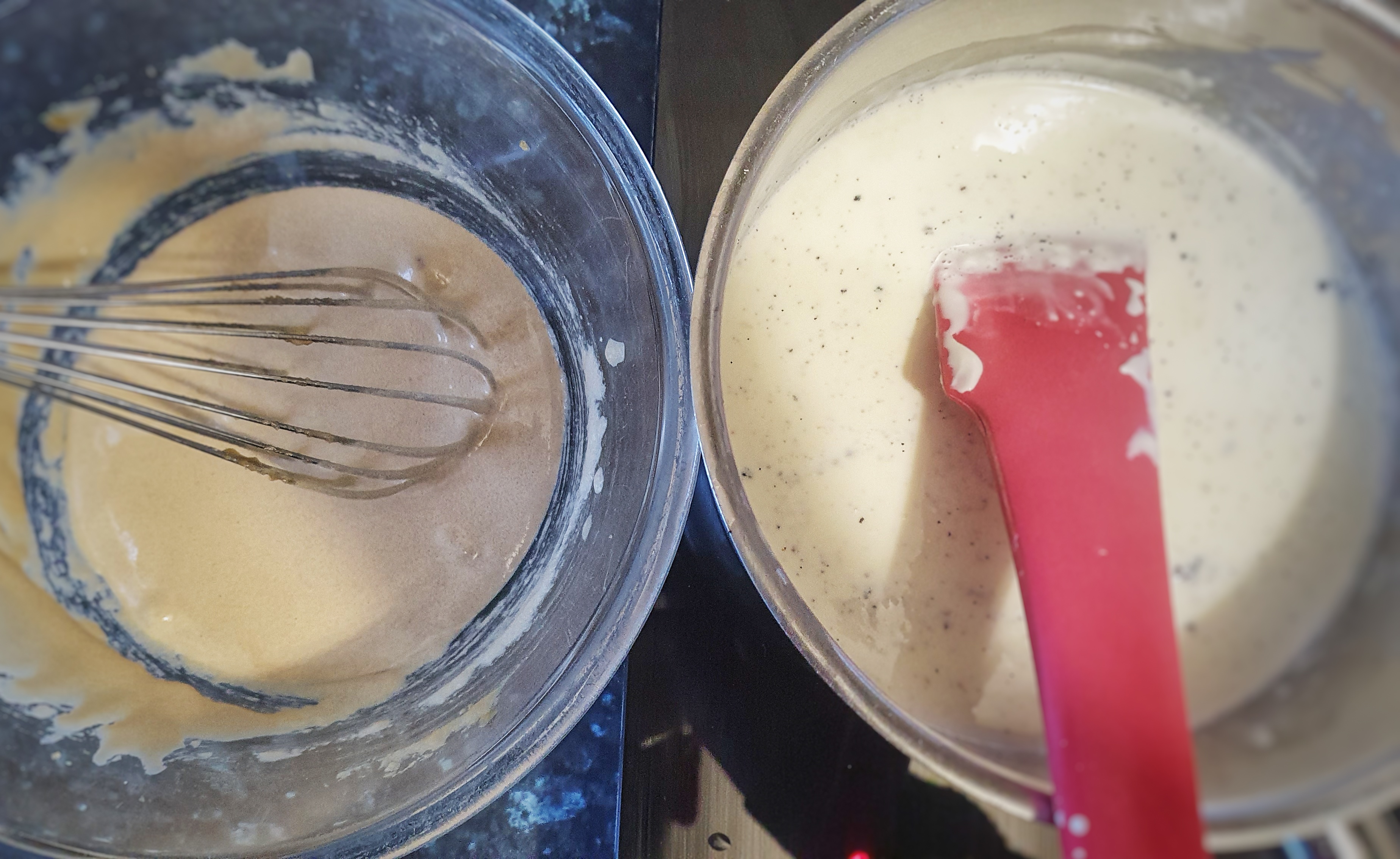
Meanwhile, put the egg yolks and light brown sugar in a mixing bowl, mix and then beat with a balloon whisk until it becomes a few shades paler. Pour in the hot cream by degrees, whisking all the time. Return the mixture to the pan and stir over a medium-low heat until it thickens – don’t let it boil, or you’ll get scrambled eggs – this should take about 5 minutes. If you want to use a thermometer to help you judge this, you are looking for a temperature of 80°C. Pass the mixture through a sieve into a tub, seal, cool and refrigerate until cold.
As it cools, make an Italian meringue: in a thick-bottomed saucepan, add the sugar and water. Place over a medium and stir until the sugar is dissolved, then bring it up to a boil. Insert your thermometer.
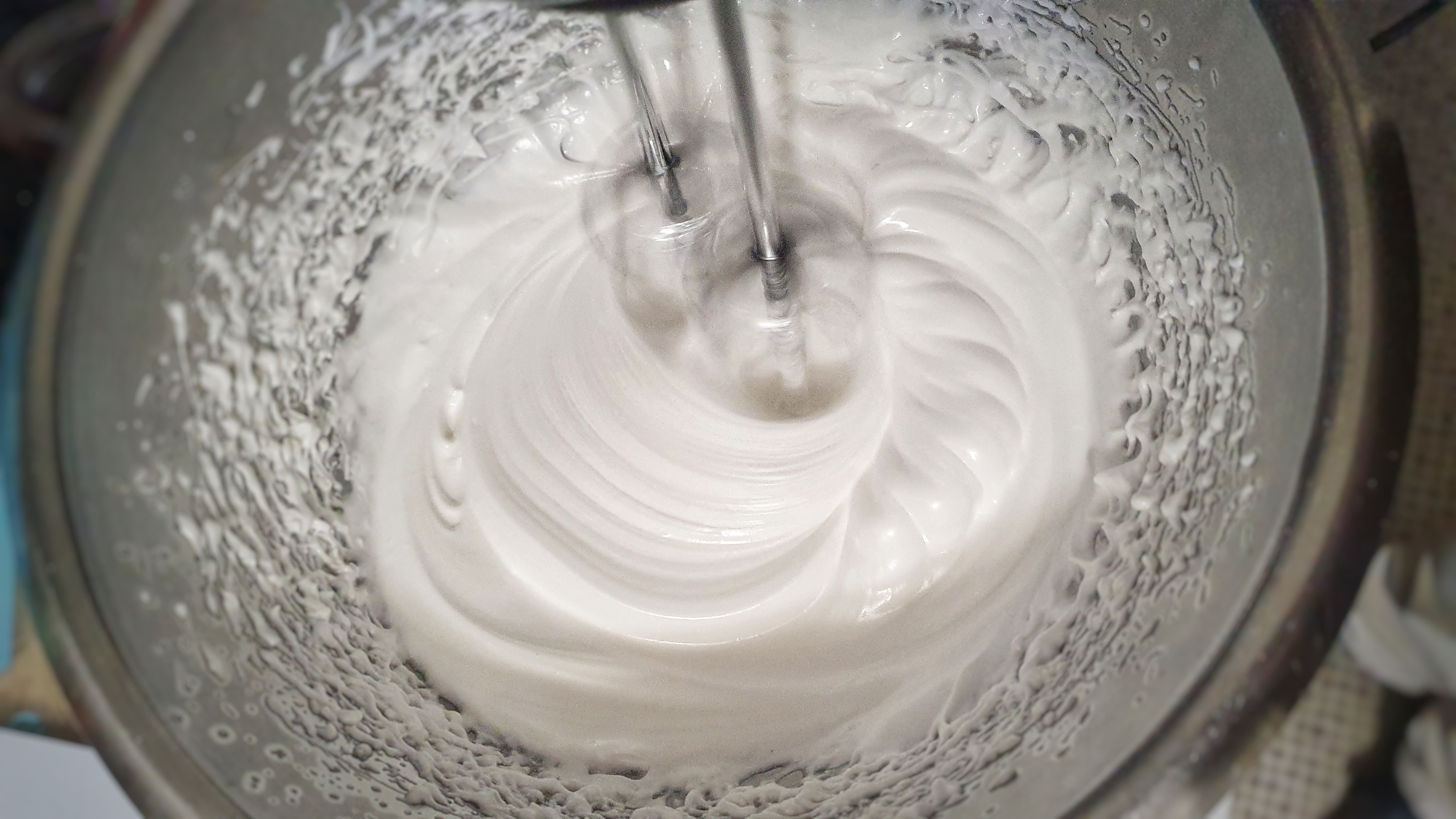
Meanwhile, put the whites in a bowl, ready to beat. When the temperature of the syrup hits 110-115°C, start beating the eggs to stiff peaks. When the syrup is 121°C, take the pan off the heat and trickle the syrup into the whites in a steady stream. Keep beating until almost cold – around 10 minutes – then cool completely. Whip the whipping cream until floppy.
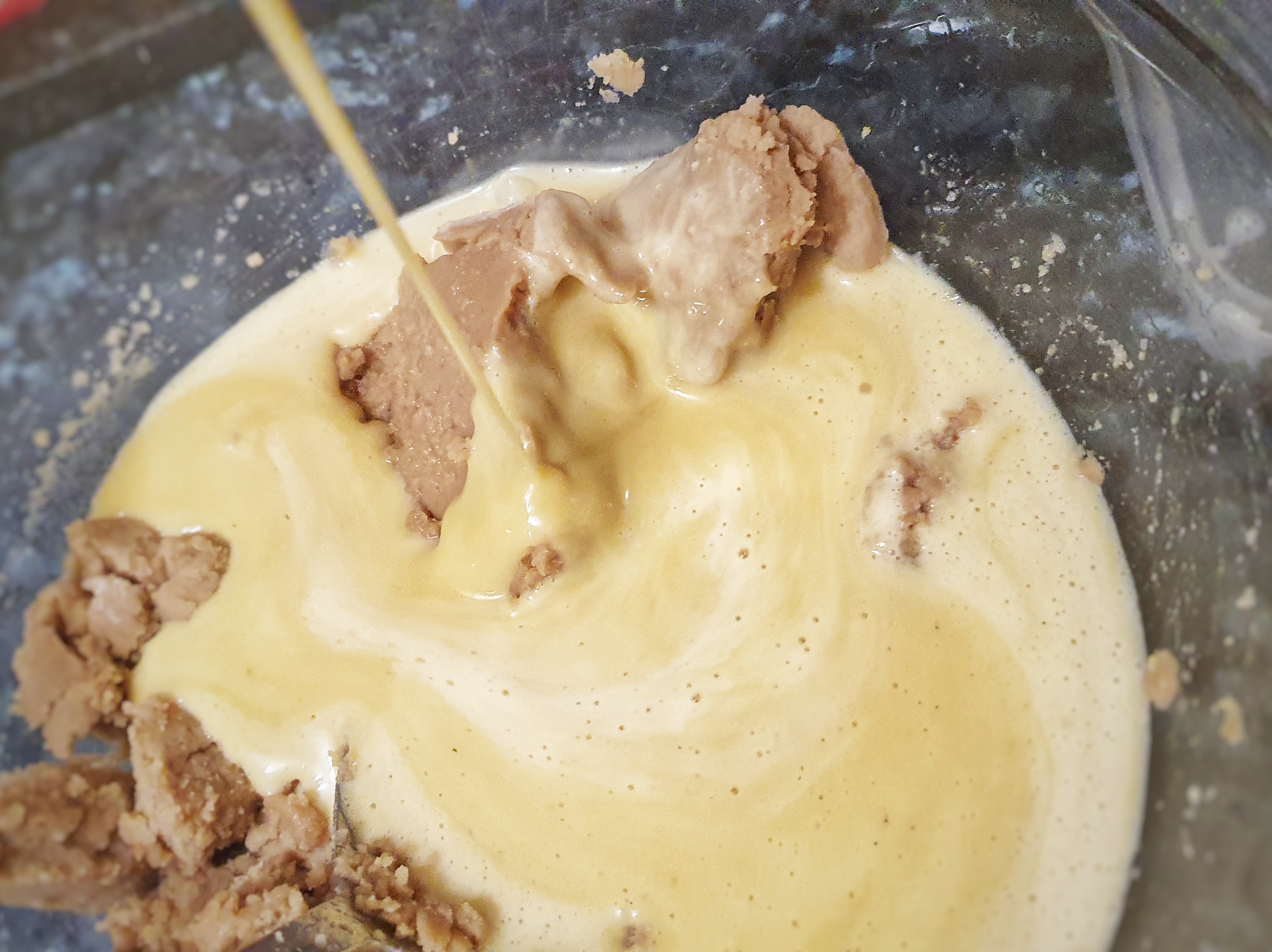
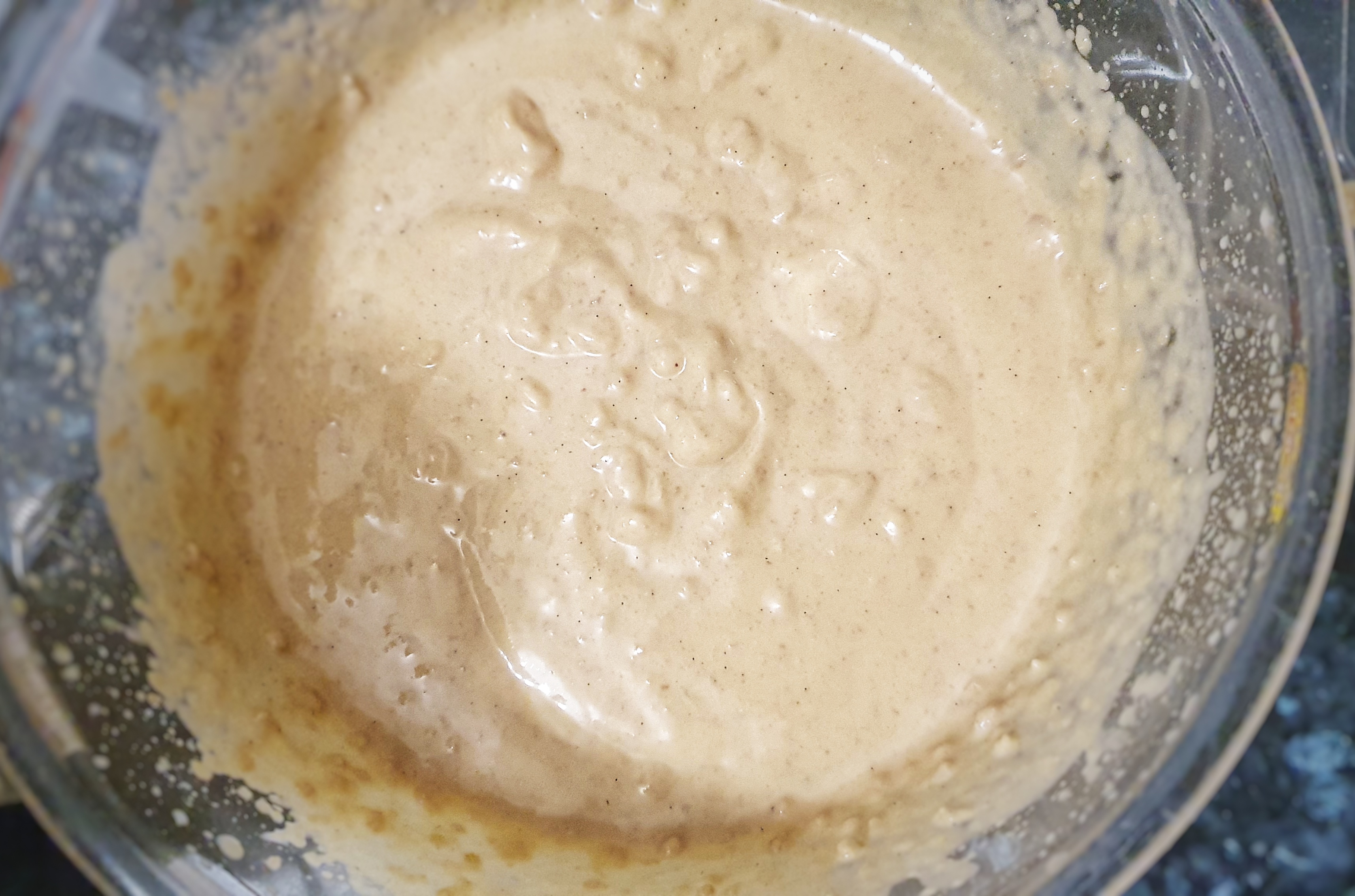
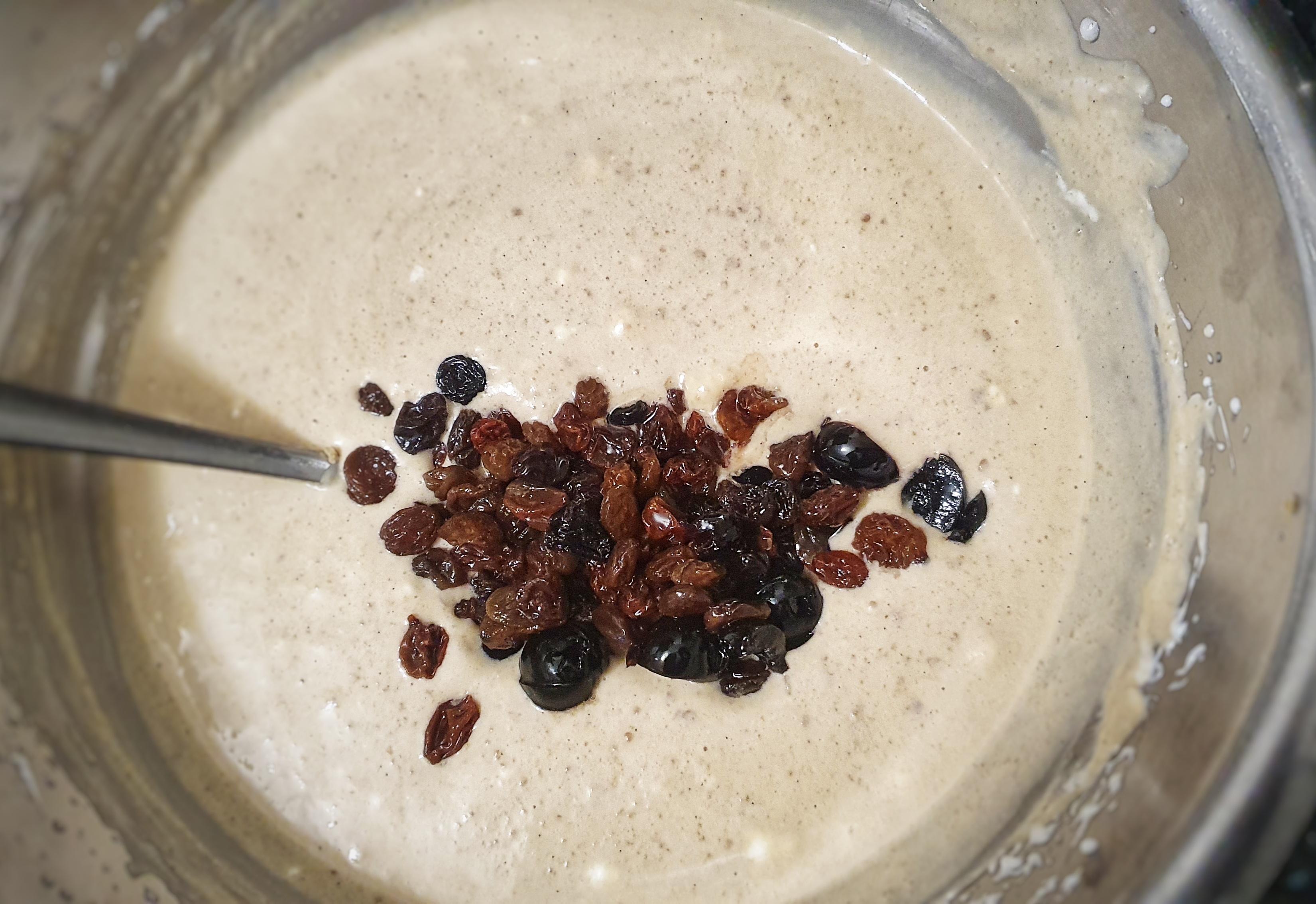
Now the Nesselrode pudding can be assembled. Mix the chestnut puree into the cold, rich custard; you may need to use your electric beater to make the mixture smooth. If you like, pass the mixture through a sieve. Using a metal spoon, fold in the cream, then the meringue. Take your time – you don’t want to lose all of the air you have introduced to the meringue and cream. Strain the fruits (keep the alcohol) and fold those into the mixture.
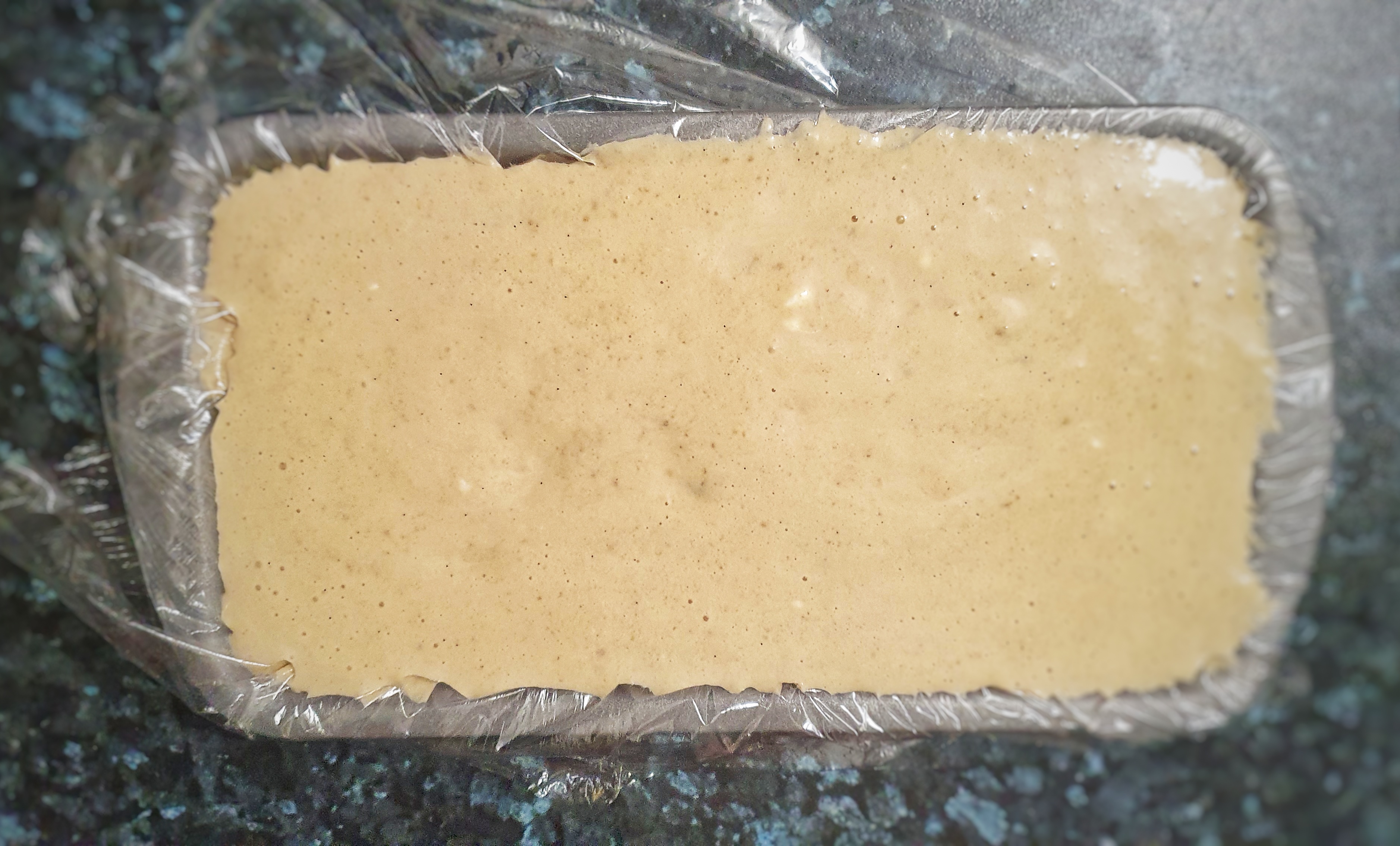
Select your mould – a generous 2 lb/900 g loaf tin is best, but you can use a pudding basin, or anything you like, as long as it has a volume of around 1.5-1.6 litres – and line it with cling film. Gingerly pour or ladle the mixture, cover with more cling film and freeze overnight.
Now make the custard sauce as you normally would – there’s a full method here – flavour with the strained alcohol. Taste it and add more booze if desired. When it tastes just right, add an extra half shot. Cool, cover and refrigerate.
To serve:
Remove the pudding from the freezer 30 to 40 minutes before you want to serve it. At the same time, place the custard sauce in the freezer so that it can get really cold.
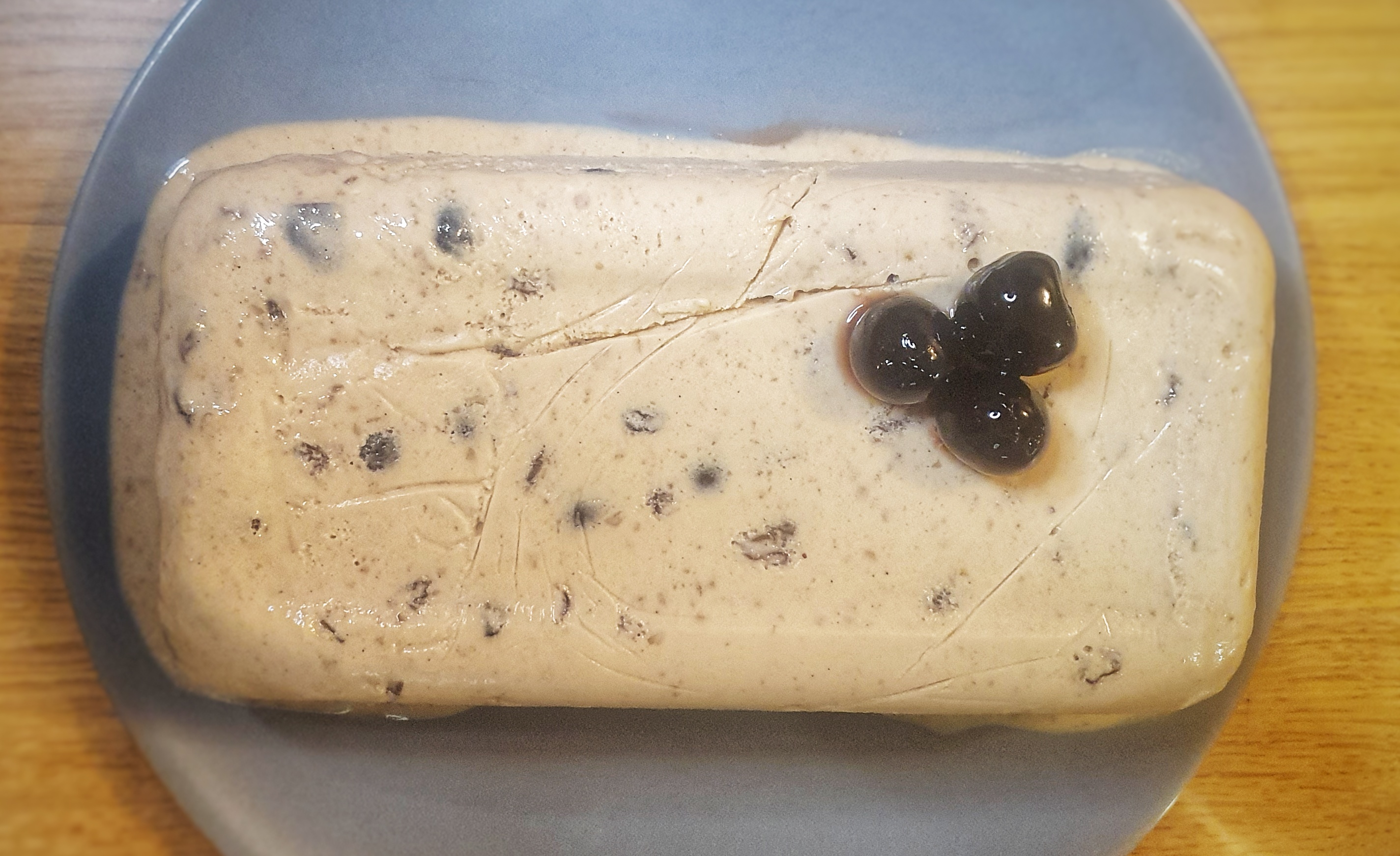
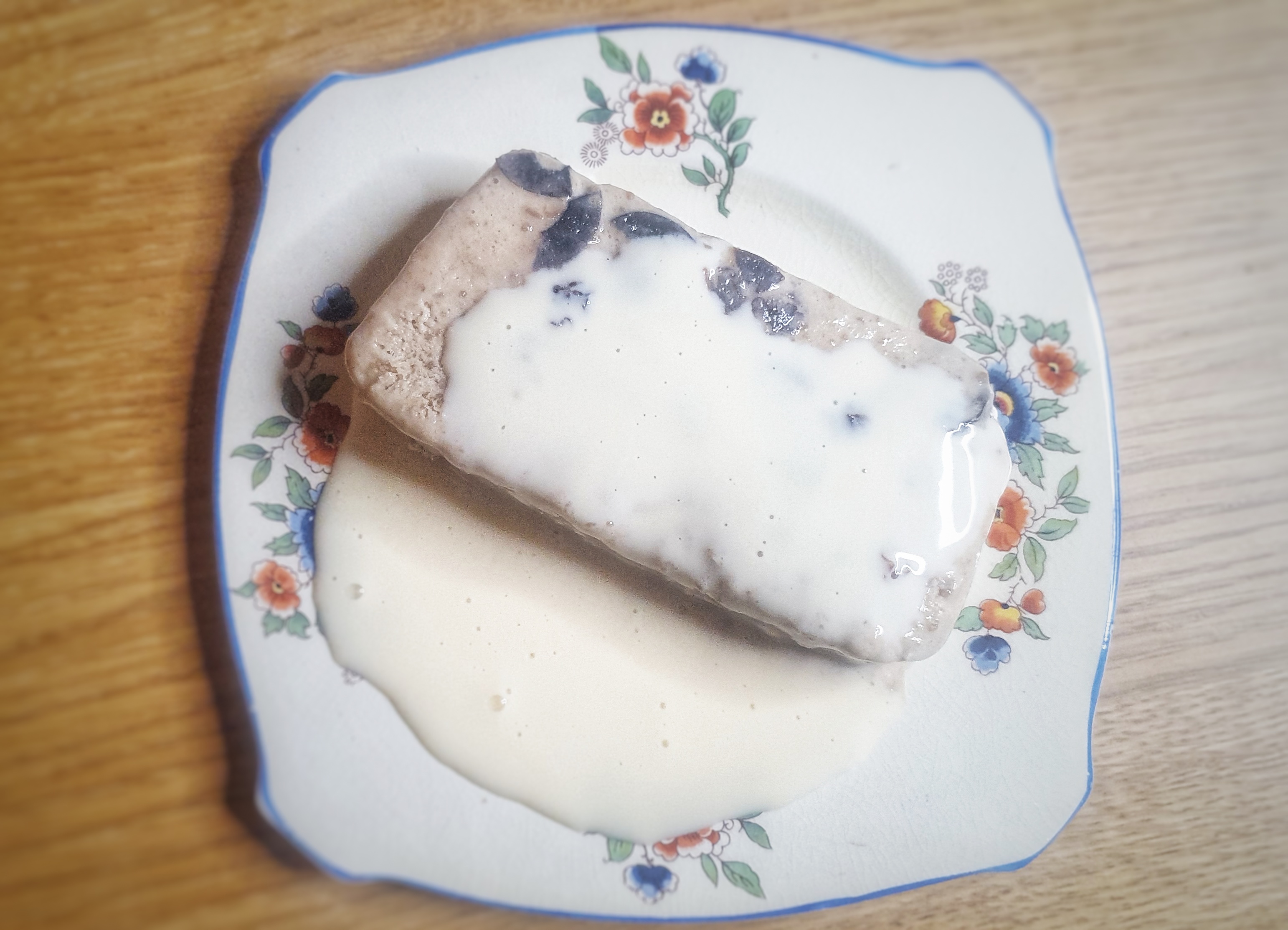
Turn out the pudding onto a serving plate, remove the cling film, clean up the edge with kitchen paper and garnish. If the pudding is a bit of a mess around the edge, pipe some whipped cream around it. Pour the ice-cold custard sauce into a jug and serve.
Note: to make nice, neat cuts, pour hot water into a tall mug or (heat-proof) glass and heat up a serrated knife; this heat and a gentle sawing motion should result in clean cuts.
Notes
[1] Gray, A. (2021) At Christmas We Feast: Festive Food Through the Ages. Profile.
[2] This earliest mention of the pudding in the many editions of Acton’s classic Modern Cookery was the 14th. Acton, E. (1854) Modern Cookery for Private Families. 14th ed. Lonman, Brown, Green, and Longhams.
[3] Grigson, J. (1979) Food with the Famous. Grub Street.
[7] When I made the pudding for the blog, I decided to forego chopping the fruit, wanting nice, big, plump fruits. A mistake: the large pieces sank – rats!
When we think of the food we eat, we think of it in terms of fuel – this is especially the case with starchy food, those made from flour because they are broken down into sugars and then converted slowly into energy in a form the body can use (unless we eat too much of it, then it is turned into fat). However, workers in factories around the world are very aware of the amount of energy trapped in flour: working with large amounts of it can be a dangerous business. Factory explosions have occurred causing damage, injury and death.
The aftermath of the Tradeston Flour Mill explosion, Glasgow 1872
The worst accident in the British Isles caused by flour happened on 9 July 1872 at the Tradeston Flour Mill in Glasgow, a century and a half ago. An explosion ripped through the mill seriously injuring 16 and killing 18, among them a mother of three with her three-month-old baby. What caused it? A report published in the journal Nature reported that the ‘origin [was] conclusively traced to the striking of fire by a pair of millstones caused by the stopping of the “feed” or supply of grain to them, and the consequent friction against each other, the result being the ignition of the mixture of air and fine flour dust surrounding the millstones.’[1] It might have been self-contained were it not for the cloud of flour, the explosion itself created. The mill was set up so that several mills were working together in a row, run by steam power, each explosion setting up another sending a cascade of flour bombs ripping through the building.[2] The most recent flour explosion in the UK occurred on 18 November 1981 in the Bird’s Custard factory in Banbury, Oxfordshire where a cloud of cornflour[3] exploded injuring nine.
Beware the explosive power of Bird’s Custard Powder
It has been theorised that it was a flour explosion that exacerbated the Great Fire of London in 1666 when an oven exploded next to several sacks of flour. The (alleged) bakery on Pudding Lane was owned by King Charles II’s own baker, Thomas Farriner. The blaze would continue for five days, destroying 13,500 houses and many important buildings including St Paul’s Cathedral. It killed just six people.
If you like the blogs and podcast I produce and would to start a £3 monthly subscription, or would like to treat me to virtual coffee or pint: follow this link for more information.Thank you.
[2] Dalgetty, L. (2022) ‘Remembering the Glasgow Flour Mill explosion that killed 18 people’, Glasgow Live, 10 July.
[3] Bird’s Custard isn’t thickened with egg, but with cornflour/starch and it is by far the main component, the others being colouring and a very fake vanilla flavouring. For more on custard click here.
Merry Christmas everyone! It’s time for my annual boozy Christmas drink, and this year’s is so good, you can even give it to the kids; if you take Mrs Beeton’s advice (I advise against it, but what do I know). It is called negus; the ingredients are simple, and you are almost guaranteed to have them this time of year: wine, sugar, citrus fruit, spices. Easy.
Its origin lies with the English officer class of the late 17th and early 18th centuries, who got into the very sensible habit of watering down their wine to avoid getting too drunk of an evening. They still wanted something to drink though. It is named after Colonel Francis Negus (1660-1732), ‘a well-connected gentleman’, who, aside from being a noted member of the officer class, was also an MP, and a talented horse rider and hunter, so-much-so he was given the position of Master of the Horse and Warden of Windsor Forest. Quite the chap it would seem. The earliest description known comes in the form of a handwritten note in a 1725 edition of Tacitus’s works. It said: ‘After a morning’s walk, half a pint of white wine, made and hot and sweetened a little, is recond very good. – Col. Negus, a gentn. of tast, advises it, I have heard say.’[3] Initially it was a heated mixture of white wine and water, sugar and then some citrus juice, sometimes lemons, or sweet or Seville oranges, and it hasn’t really changed that much.
Its low alcohol made it especially good for the infirm or chronically ill. One Dr William Buchan in his 1797 book, prescribes claret negus for those with ‘Slow or Nervous Fever’, what we would call depression today.[4] In the book Oxford Nightcaps (1827), the author tells us that a doctor friend of his, a certain Doctor Willich, thinks ‘Negus is one of the innocent and wholesome species of drink especially if Seville oranges be added’. He also recommends lemons, cinnamon, cloves and all-spice. And calves’ foot jelly, which was thought very nourishing to those who couldn’t digest anything too rich or challenging.
Mr Fezziwig’s Ball as depicted by John Leech
Into the mid-19th century, negus settled down as a drink to be enjoyed by everyone, the wine most often used now being port (a drink which had been made popular since the Napoleonic Wars). It is mentioned in Charles Dickens’s A Christmas Carol (1843). When the Ghost of Christmas Past takes Scrooge to show him the wonderful parties put on by his old boss, the kind and caring, Mr Fezziwig: ‘There were dances, and there were forfeits, and more dances, and there was cake, and there was negus, and there was a great piece of Cold Roast, and there was a great piece of Cold Boiled, and there were mince-pies, and plenty of beer.’[5] What a sight they would have been!
Isabella Beeton’s considered negus a children’s drink
So inoffensive was negus that it became a popular drink with kids, with Mrs Beeton informing us in 1861 that ‘[a]s this beverage is more usually drunk at children’s parties than at any other, the wine need not be very old or expensive for the purpose.’ Her proportions are 1 pint of port to every quart of water, plus a quarter of a pound of sugar, zest and juice of one lemon and some grated nutmeg. She adds: ‘Allow 1 pint of wine, with the ingredients in proportion, for a party of 9 or 10 children.’[6]
It’s essentially a weak version of my favourite hot-booze drink,smoking bishop, but child-friendly. Hm. I suppose it’s one way to get them to sleep on Christmas Eve night!
If you like the blogs and podcast I produce and would to start a £3 monthly subscription, or would like to treat me to virtual coffee or pint: follow this link for more information.Thank you.
The recipe
Use whatever wine you prefer and your favourite citrus fruit. I went with port and a clementine and added some nutmeg and cinnamon. I must say it was very drinkable.
I’ve metricated the volumes, but the rule of thumb here is 1 part wine to 2 parts water, and you can sweeten the mixture to your taste.
Makes 1.3 litres:
400 ml wine (port, claret or white wine)
Zest and juice of 1 citrus fruit (lemon, sweet orange, Seville orange, clementine, etc)
Spices: ¼ freshly grated nutmeg, a snapped cinnamon stick, a teaspoon of cracked allspice berries or bruised cloves; choose your favourites.
800 ml boiling water
100 to 120 g caster sugar.
Heat the wine slowly with the zest and juice of your chosen fruit, and the spices until scalding hot (but not boiling). Add the hot water, then add sugar to taste. Pass through a sieve into a punch bowl or jug. To serve, ladle into beakers or cups.
One final note before I go: in Jerry Thomas and Christian Shultz’s How to Mix Drinks (1862), there is a very interesting-sounding soda negus recipe. The wine is warmed up with sugar and spices, then left to cool, then soda is added before serving.[7] Worth a try I think!
Notes
[1] Purl was an ale that had been infused with wormwood. Sounds full-on. Potential future Christmas booze post.
[2] Anon. (1776) The Free-Mason’s Calendar: or, an Almanac for the Year of Christ 1776.
[3] Wondrich, D. (2021) The Oxford Companion to Spirits and Cocktails. Edited by D. Wondrich and N. Rothbaum. Oxford University Press.
[4] Buchan, W. (1797) Domestic Medicine, Or, A Treatise on the Prevention and Cure of Diseases, by Regimen and Simple Medicines. Edited by I. Cathrall. Richard Folwell.
[5] Dickens, C. (2010) A Christmas Carol and Other Christmas Writings. Penguin Classics.
[6] Beeton, I. (1861) The Book of Household Management. Lightning Source.
[7] Thomas, J. and Schultz, C. (1862) How to Mix Drinks, Or, The Bon-vivant’s Companion. Dick & Fitzgerald.
Hello everyone. Just a very quick post to let you know that I am giving a talk as part of the Museum of Royal Worcester’s Winter Online Talk series. The title of my talk is ‘Navigating Nineteenth-century English Meals – changing manners and fashions explored through Worcester porcelain’.
The talk is free and can be viewed online via Zoom. It’s on 15 November 2023 at 6pm (UK time). Click here to book your place.
It’s been really fun writing it and looking through the museum’s collection to find some interesting specimens to show and tell.
I do hope you can make it.
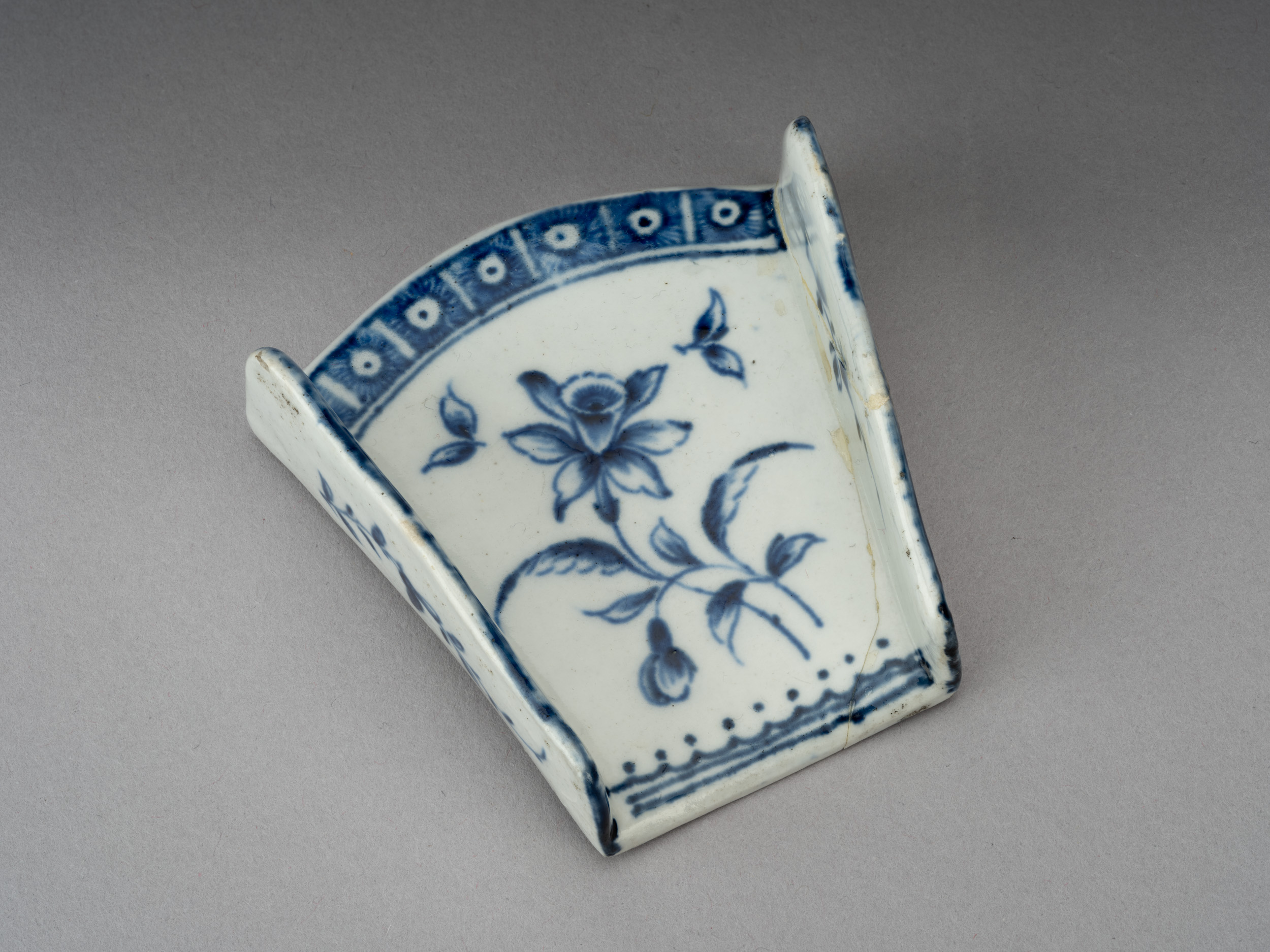
I’ll be talking about this item, amongst many others, but what is it? Find out on 15 November! (pic: Museum of Royal Worcester)
The good thing about being a lover of British puddings is that there is an almost infinite number to cook and try. All of the pudding recipes I have posted on the blog thus far have all been of the sweet variety, and they have all been fairly well known, but this year I am going to try and write some posts and recipes for savoury or obscure ones. First up is dock pudding which happens to tick both of those boxes. This pudding is one I have been meaning to cook for years, but I’ve only gotten around to it until now.
Dock pudding used to be very popular in Yorkshire, especially in the Calder Valley, West Yorkshire. The dock in question isn’t the common dock (the one you rub on nettle stings) but a particular species that goes under several names including bistort, passion dock and sweet dock, its Latin name is Polygonum bistorta.[1] It can be distinguished from the common dock by its yellowish spear-shaped leaves. The leaves are collected when young, alongside tender nettle tops, there is a recipe for it in Alexis Soyer’s classic 19th century work A Shilling Cookery For the People, where it is made with a mix of two-thirds passion dock, and one-third nettles.[2] These were supplemented or replaced with whatever greens were around: sorrel, raspberry leaves, chives, spinach, etc, the choice changing with the season. These are washed, sliced and cooked with onion or leek and oatmeal to make a very dark green porridge, which is fried in dollops in bacon fat, lard or beef dripping.[3] It has been likened to Welsh laverbread in colour and flavour, in that you will either love it or hate it.[4] It sometimes goes by the name herb pudding, which makes sense seeing as docks are only eaten in the springtime when they are tender. It is mixed with more oatmeal and water, tied in a cloth and boiled, cooled and fried in slices.
My patch of Passion dock
Technically, then, I could have used any green leaves, but I really wanted to make it with Passion dock; so called because it is found growing during Passion Week, the last week of Lent.[5] It was an extremely important food, the first fresh green vegetable after a winter of eating only pickled vegetables and salted meats. Many people were showing signs of scurvy by early spring, so few fresh vegetables were eaten. Dock is also said to be an excellent blood cleanser and good for the skin too, being a preventative of spots and pimples.[6]
Dock pudding was especially popular in the Victorian era, but was considered a famine food in the 20th century.[7] Very few people eat it now, but there is an outlier because the West Yorkshire town of Mytholmroyd has held the World Dock Pudding Championships every May since 1971.[8] I’m going to try my best to go next year.
If you like the blogs and podcast I produce and would to start a £3 monthly subscription, or would like to treat me to virtual coffee or pint: follow this link for more information.Thank you.
I found a patch of Passion dock growing in the Cheshire town of Lymm last year, but they were far too old and tough to pick, but I remembered this year. Oddly, I couldn’t find any nettles, but I did spot some sorrel and some wild garlic. I was in a bit of a rush, and didn’t have enough to make the very green sort of pudding, but I didn’t want to boil one (to save on fuel), so tried a common trick of cooking it in a saucepan, pouring and setting it in a tub so I could slice and fry it. This method is sometimes used for other savoury puddings such as black pudding or mealy pudding.
Makes 8 to 10 slices of pudding:
100 g trimmed, young leaves of any amount of the following: passion dock, nettles, spinach, sorrel or any other edible greens you like
1 leek or onion, sliced thinly
80 g oatmeal (not rolled oats)
1 tsp salt
Freshly ground black pepper
400 ml water
A smidge of flavourless oil such as sunflower or groundnut
8 rashers of streaky bacon
30 g lard or dripping, or 2 tbs of your favourite frying fat or oil
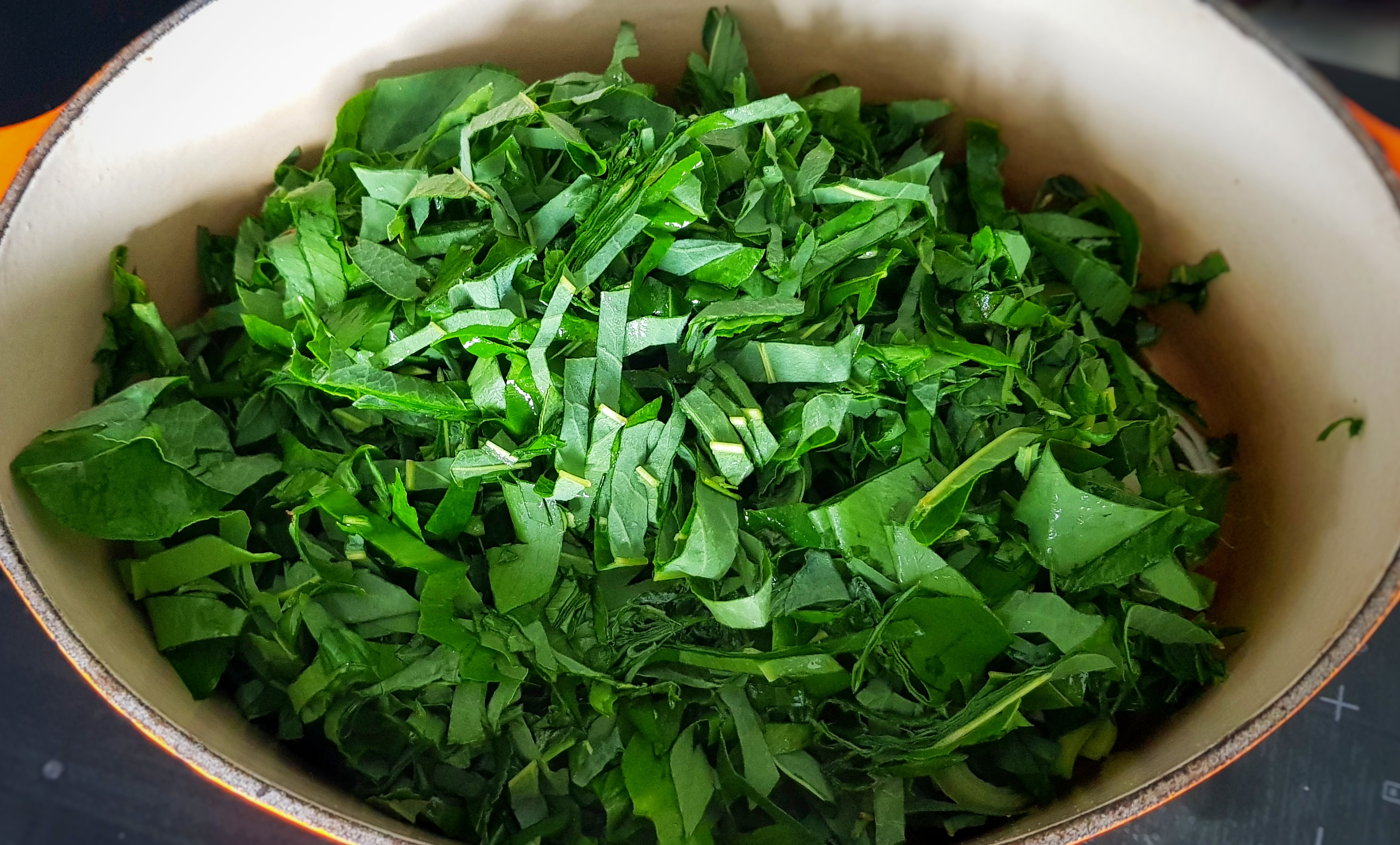
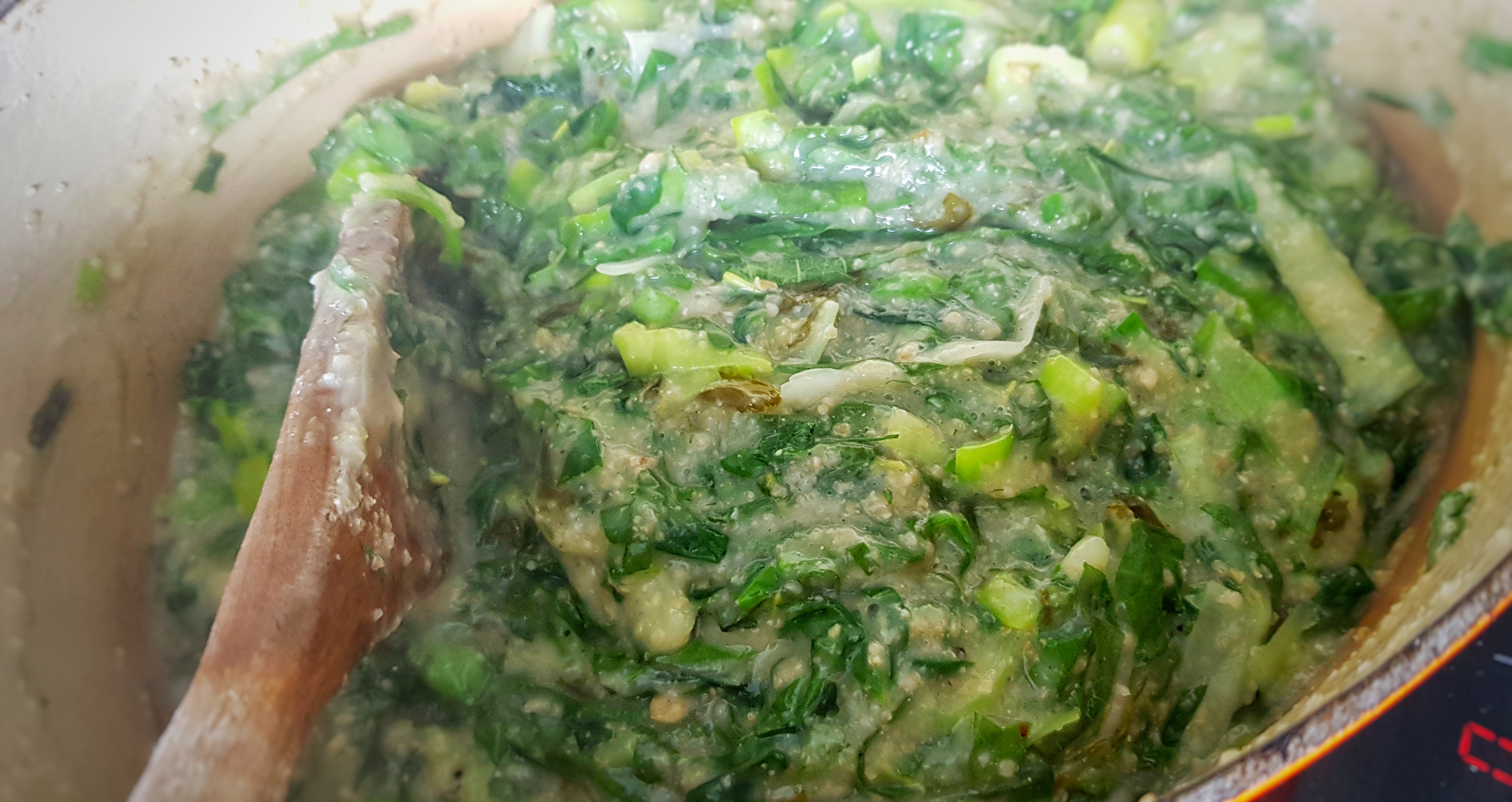
Your pudding needs to be cooked, cooled and set the day before you want to eat it (or several days before if you like). To do this, shred the leaves and add them to a pan with the leek or onion, oatmeal, salt, pepper and water. Bring to a simmer, stirring so that it doesn’t form lumps.
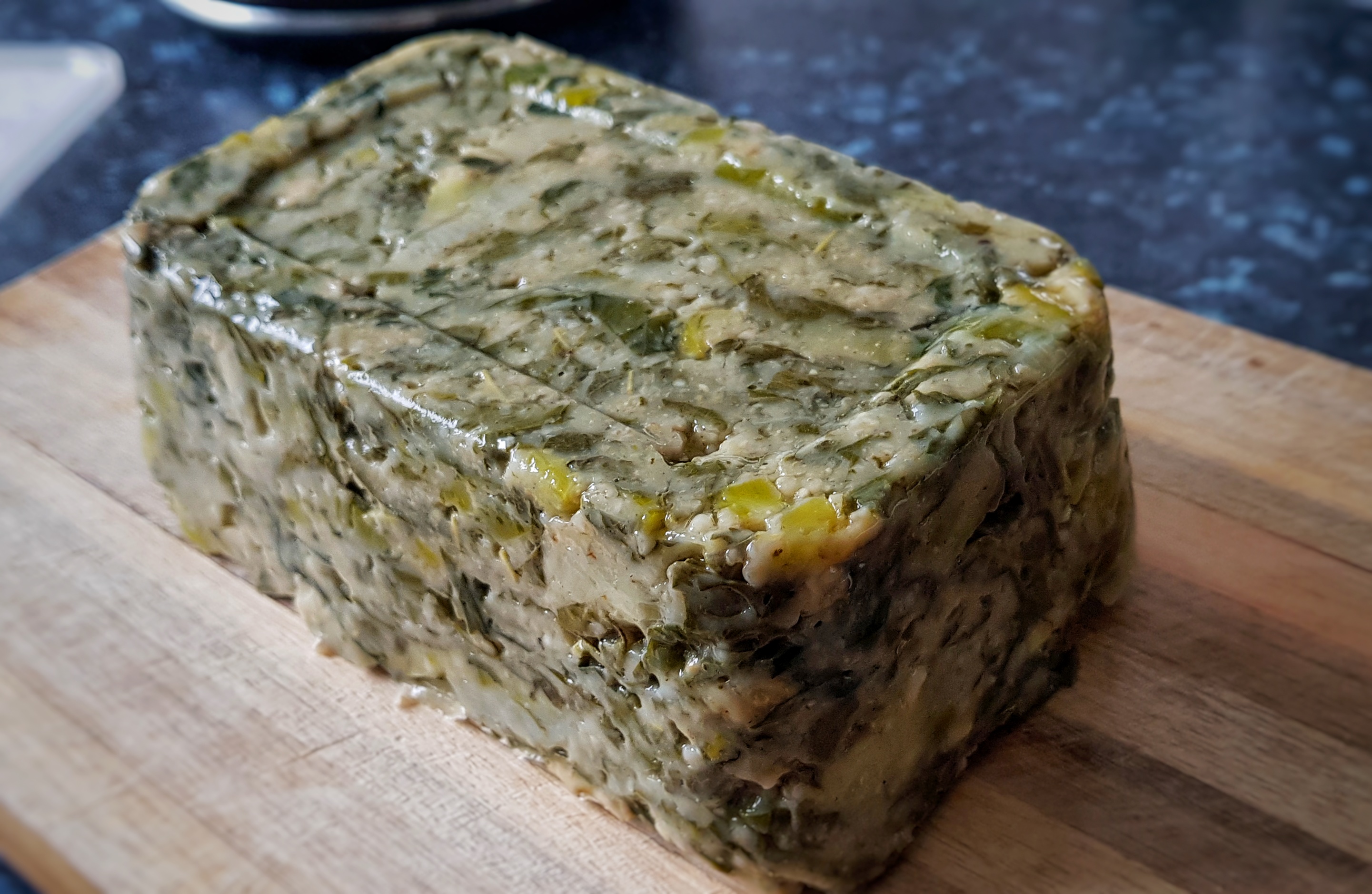
Cook for around 20 minutes and all of the vegetables are soft, then take off the heat. Now take a tub of around 1 litre capacity and brush with the oil. Pour the pudding into the tub, cover, cool and then refrigerate.
When you want to cook your pudding, first fry the bacon in your chosen frying fat or oil over a medium heat until very crisp. As they cook, prepare the pudding: turn out onto a board and cut even slices between 1 and 1.5 cm thick. It’s best to use a serrated knife for this task.
Remove the bacon rashers and keep warm as you fry the pudding slices: turn up the heat to medium-high and pop in the slices. It’s a bit like making bubble and squeak in that you need to wait and allow them to build up a good, crisp fried layer before you disturb them: a good 5 minutes. Turn over with a spatula and fry the other side for a further 4 or 5 minutes.
When ready, serve up with the bacon and whatever other breakfast things you like. I went with fried eggs.
Notes:
[1] Brears, P. (2014) Traditional Food in Yorkshire. Prospect Books.
[2] Soyer, A. A Shilling Cookery for the People: Embracing an Entirely New System of Plain Cookery and Domestic Economy. (Geo. Routledge & Co., 1855).
[3] Davidson, A. (1999) The Oxford Companion to Food. Oxford University Press.
[4] Mason, L. and Brown, C. (1999) The Taste of Britain. Devon: Harper Press.
[5] If you want to know more about the food of Passion Week, listen to this episode of the podcast:
The Corn Laws were in place between 1815 and 1842. During this time several petitions of repeal were made to Parliament; in all 1,414,303 signatures were presented within 467 petitions. There were, of course, signatures scribbled upon petitions against repeal of the Laws, but they were far fewer: just 145,855 signatures, a whole order of magnitude fewer!1 This goes to show just how powerful the country landowners were; no matter how bad things got, and no matter the number of signatures, Parliament would not budge. But there were folk chipping away at this issue, whether it be in the streets, in the townhouses, or in the corridors of power. Repeal would come, and there were several key players in the story, and in the second of my two posts on the Corn Laws, we shall meet them.
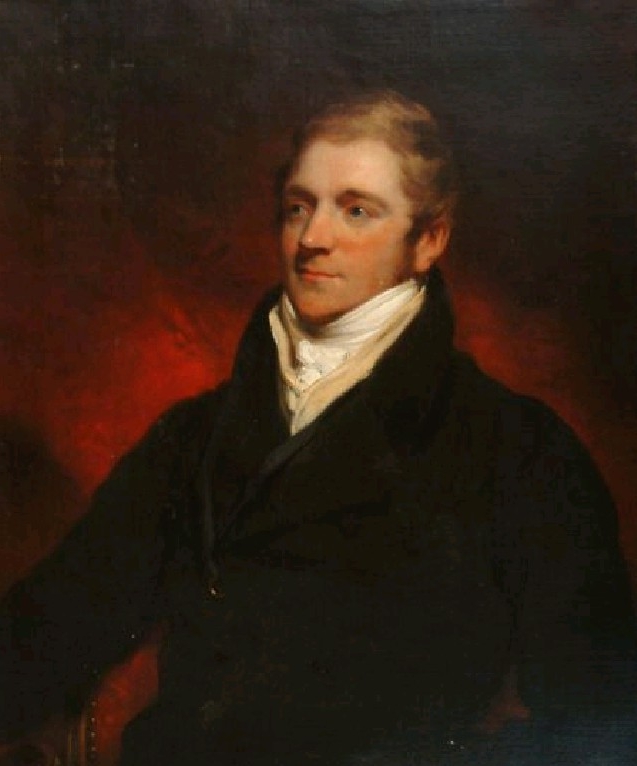
Thomas Tooke
Thomas Tooke (1774-1858)
An experienced merchant and economist, Thomas Tooke could see that the Corn Laws were having a deleterious upon the majority of the population. He argued that stopping the free grain in foreign grain was harmful to trade in broader terms, saying
There appears to be at the moment, a quantity of corn on one side of an impenetrable barrier, and a quantity of manufacturers on the other, which would naturally be interchanged, if it were not for the artificial hindrance occasioned by the present system.
The Laws were there to protect the landed gentry in the countryside at the expense of the income and quality of life of the working classes. It didn’t even help the farmers in the countryside because landowners charged them higher rents. As far as Tooke was concerned, making staple foodstuffs scarcer raised prices and adversely affected the working classes.2
Lord Liverpool, the Tory Prime Minister blocked his petition, but Tooke still presented his case to a House of Commons Select Committee in 1821. So impressive was his thinking and well laid-out his argument, he was made a Fellow of the Royal Society later in the same year. So, whilst his petition wasn’t debated, he still got to say his piece, which reinforced the idea to lower tariffs and emboldened those for whom repeal of the Corn Laws was the only fair and sensible option.2
Richard Cobden and John Bright
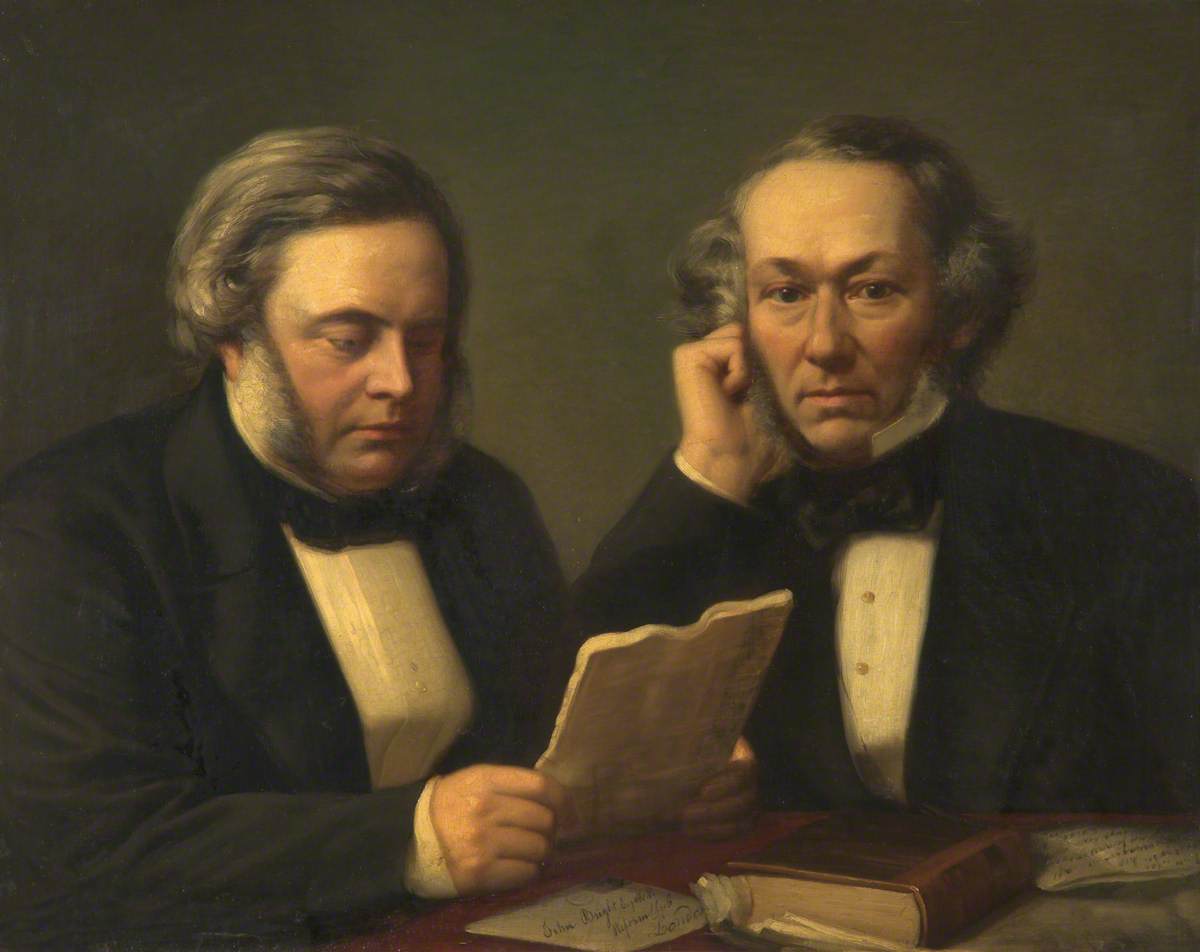
As soon as the idea of implementing the first Corn Law was debated in Parliament, anti-Corn Law groups sprang up all around the country, but they were not a united, cohesive front. This changed however with two industrialists Richard Cobden and John Bright, who together formed what would become known as the Manchester School. Tooke had taken the argument for repeal to the Commons, but Cobden and Bright would be so effective in communicating their argument that would both become MPs.
Richard Cobden owned a calico[*] printing mill and was the son of a poor farmer from Sussex, so could appreciate the harm the Corn Laws were inflicting on industry, and both the urban and rural workforce. He created the Manchester Anti-Corn League in 1839. His writing and speeches were based on the notions that free trade benefited the majority, and that manufacturing and trade should be allowed to continue with minimal interference from Parliament. In short, the Corn Laws ‘were both economically disastrous and morally wrong.’3
In 1941, he invited John Bright to join him and help him develop the political, economic and moral argument against the Corn Laws.4 John, also an industrialist, was Lancashire born and bred, a devout Quaker and a skilled orator, who managed to make protest and debate entertaining, ‘produc[ing] an entire theatre of opposition activity.’5
John Bright (1811-1889) & Richard Cobden (1804-1865)
They made quite the team: John was the man of the people, the salt of the earth, able to communicate their ideas to the common man In the North of England. The country had – and still has – a strong north-south divide, and Cobden’s southern accent made his speeches in Parliament more palatable, allowing him to give insight into the economics of the industrial north. Together they began to turn the tide of opinion both within and without the House of Commons.
If you like the blogs and podcast I produce, please consider treating me to a virtual coffee or pint, or even a £3 monthly subscription: follow this link for more information.
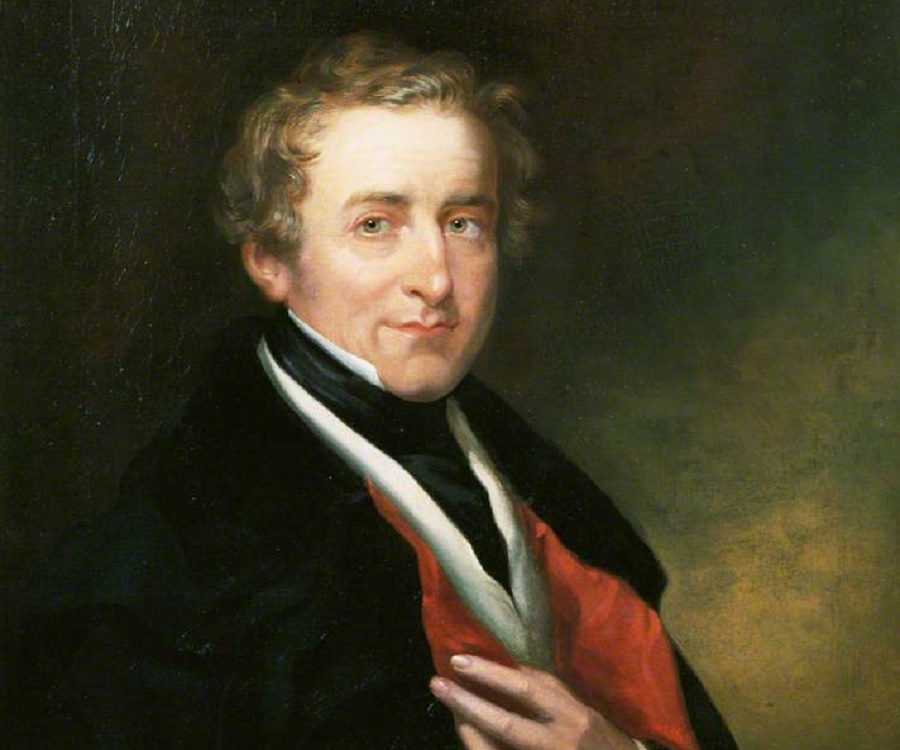
Robert Peel
Robert Peel (1778-1850)
Sir Robert Peel became Prime minister for the second time in 1841. He had won his position – partially – on his view that the Corn Laws should stay in place. However, Cobden and Bright’s arguments persuaded him to rethink his position. Peel could see that the Laws were only benefiting landowners and that the working classes – and some of the middle classes too – were beginning to starve. It was not sustainable, and revolution was on the cards: the early 1840s had seen a series of wet summers, lowering production and raising prices greatly. Then, the Irish Potato Famine hit Britain received much of its corn from Ireland, but with a dying population, the workforce didn’t exist that could farm the grain; add to that, a great number of Irish emigrating to Britain to escape the crisis only exacerbated the problem.6 Something had to be done: the Corn Laws had to be repealed. The opposition party, the Whigs – the more liberal party of the day – were generally up for repeal, but two-thirds of the Tory party were vehemently against it. Peel had tried to pass an act to real the Corn Laws twice already, but as the Potato Famine reached its peak in 1942, he attempted to pass it one more time. This was a rare case of a Prime Minister going against their party majority, and he knew it would be career suicide should the act get through, and it did, with a majority of 98.
Peel resigned shortly afterwards, and the legislation surrounding the Laws was dismantled over the space of three years, leaving behind a country where the working and lower-middle classes were empowered and very much pro-free trade.6 The Manchester School had achieved its goal. The School is considered by many to be the first political pressure group, and a most successful one at that.