Category Archives: Recipes

Fruit Curds Revisited

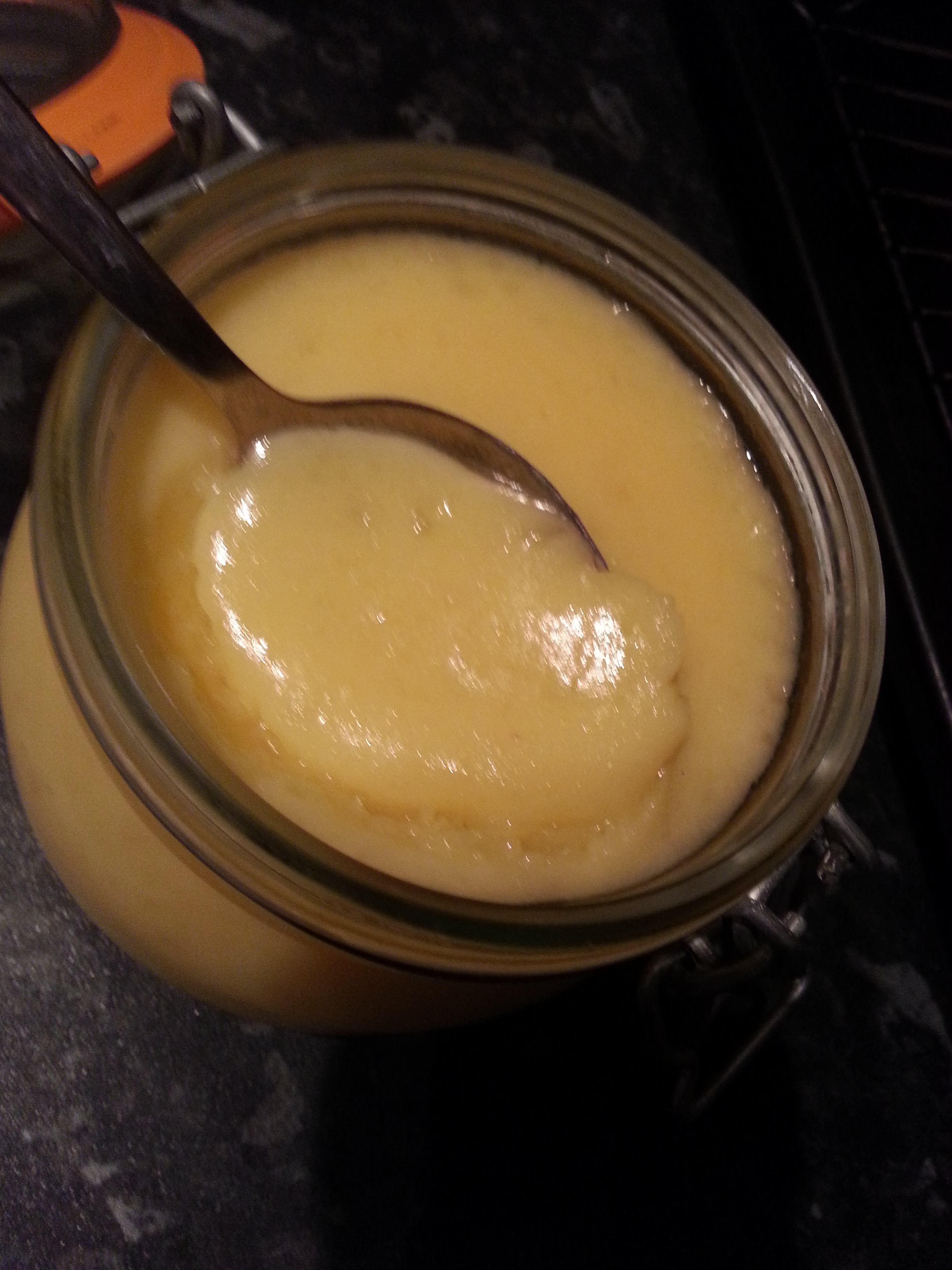
2013-12-02 22.14.04

By recent request, I have written another post on fruit curds. I have come up with several more recipes since I wrote the original post and they all originate from a common source; a single recipe that pops up in River Cottage Handbook No.2: Preserves by Pam ‘the Jam’ Corbin. This is a truly excellent book (as are all the RC Handbooks), that deserves a post of its own as part of my rather irregular Favourite Cookbooks series.

Anyway, this recipe is the best I’ve come across, it is for lemon and Bramley apple curd – and it is ripe for modification. Apple purée is used, giving a great texture, making a light nicely-set curd that needs less sugar than your typical lemon curd. Below is the original recipe that I have only very slightly tweaked, and then there is a few more: blood orange, spiced orange and pink grapefruit.

Lemon and Bramley Apple Curd

This recipe makes around 1200ml of curd.

2013-12-01 18.09.14

500g Bramley apple curd, peeled, cored and chopped

150ml water

Zest and juice of 2 lemons

125g butter, cubed

350-400g granulated sugar

5 medium eggs

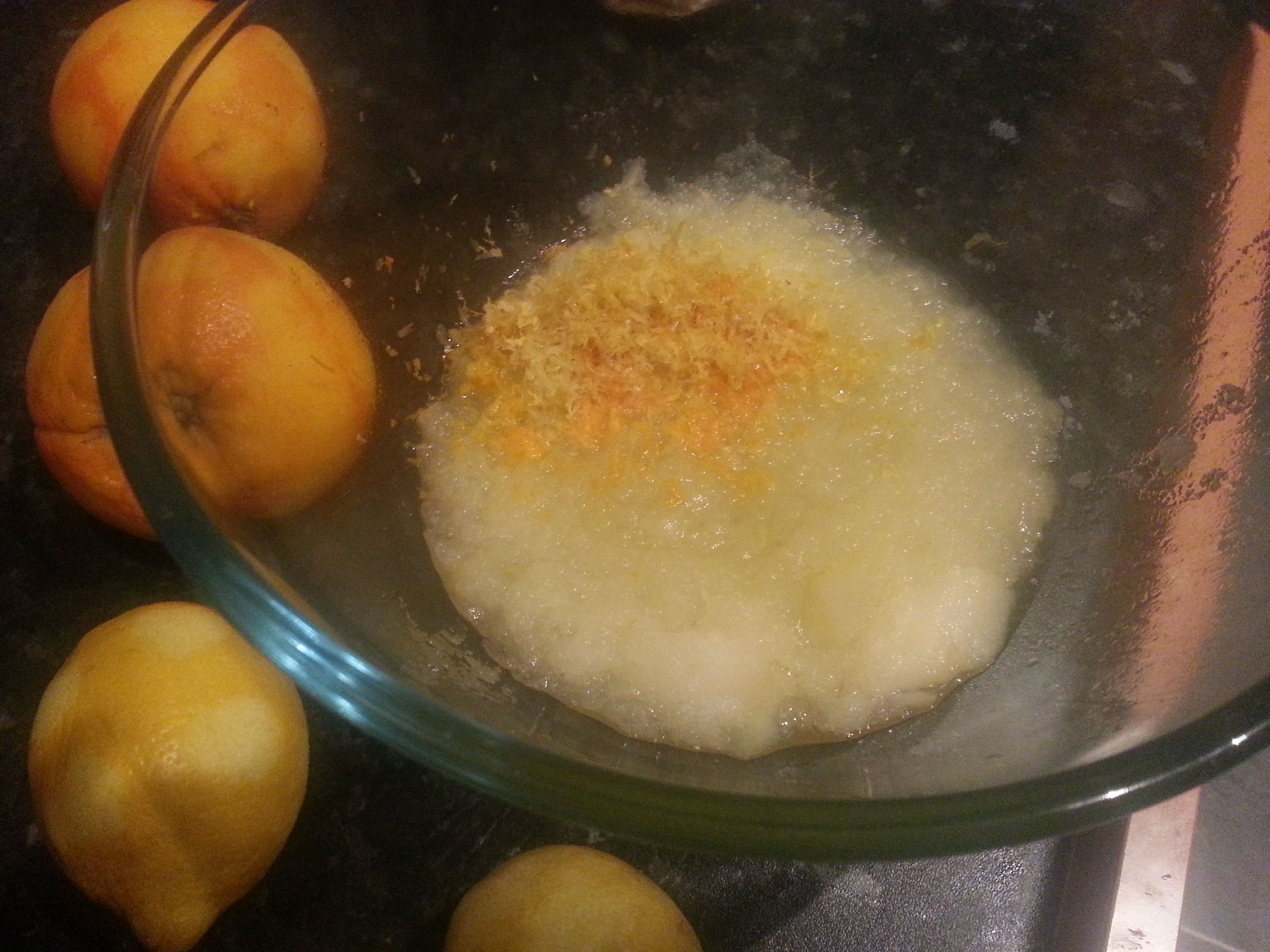
Put the apples and water in a small saucepan, cover and simmer until the apples break down into a purée. When cooked, put them into a large glass mixing bowl with all of the remaining ingredients except the eggs. Mix together – the heat of apples will dissolve the sugar and begin to melt the butter – and place the bowl atop a pan of briskly simmering water, making sure the water doesn’t touch the base of the bowl.

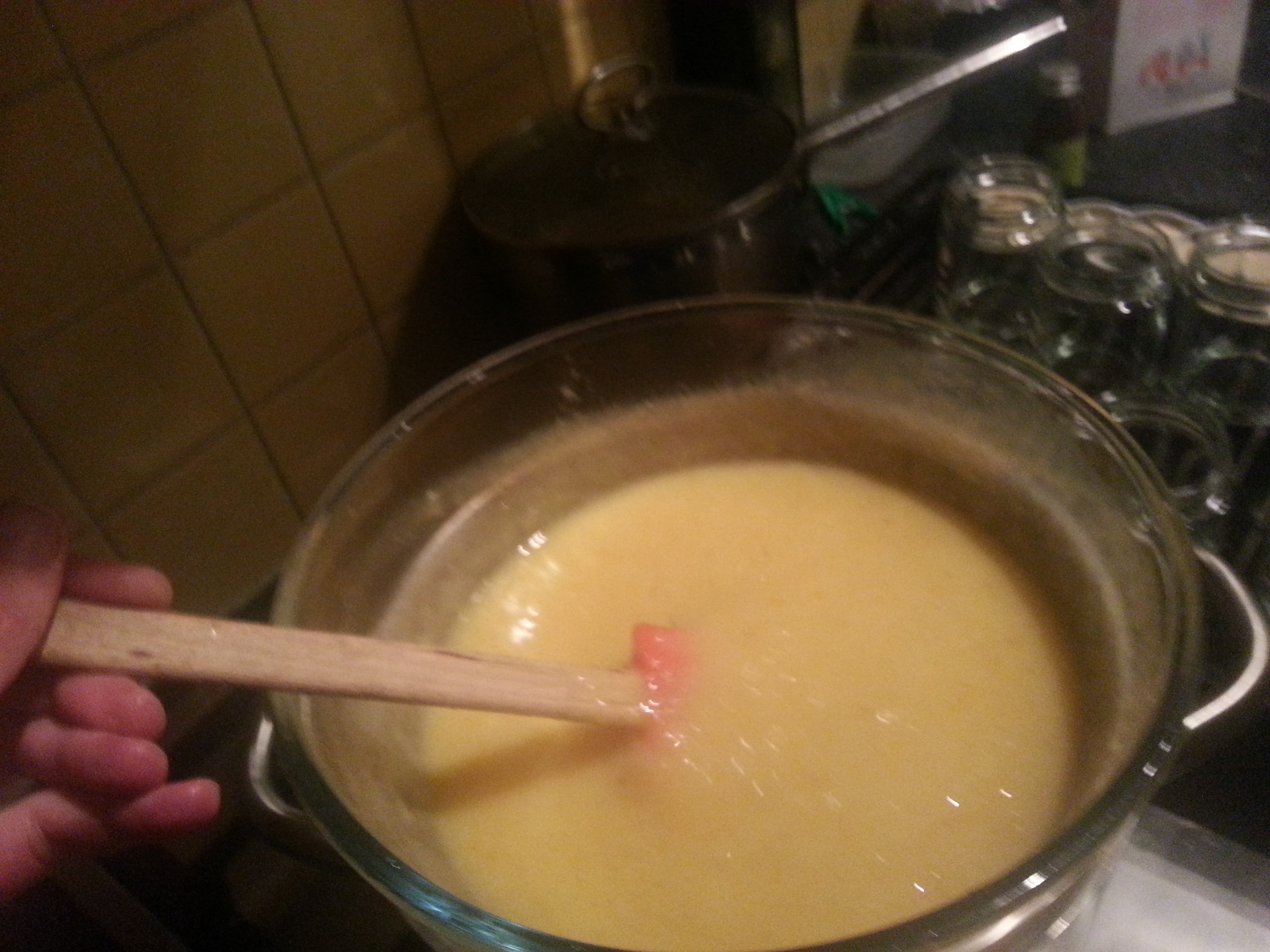
Whisk the eggs well and pass them through a sieve straight into the mixture, stirring them in well. Keep an eye on things and stir the curd frequently until it thickens; it doesn’t require constant stirring, but don’t be going off and dusting the sills. If you want to be scientific about it, eggs thicken at around 80⁰C, but temperatures of 75⁰C and above will thicken the curd sufficiently. Taste and add more sugar if liked – remembering that cold curd will taste much less sweet than hot curd.

2013-12-01 18.35.17

Pot in sterilised jars (25 minutes in a 125⁰C oven does the trick), cool and refrigerate. The curd will keep for 5 weeks.

Some variations

You can pretty much use any fruit juice you like, but you always need a little bit of lemon to add bite as well as to take advantage of its flavour enhancing properties.

Blood orange curd: as above but use the juice and zest of one lemon and two blood oranges.

Spiced orange curd: use the juice and zest of two lemons and two oranges, along with half a teaspoon of mixed spice. When the curd has thickened, add two teaspoons of orange flower water.

Pink grapefruit curd: use the juice and zest one lemon and two pink grapefruits.


If you like the blogs and podcast I produce, please consider treating me to a virtual coffee or pint, or even a £3 monthly subscription: follow this link for more information.


12 Comments

Filed under baking, cooking, food, Fruit, General, Recipes, Uncategorized

Forgotten Foods #4: Cock Beer

cockerel

Recently I have been thinking of re-igniting my interest in home-brewing. Previous attempts to make alcohol have never been successful. I have made white wine that tasted of rotten eggs, and made dandelion wine that, when bottled, exploded spectacularly in my lounge. Now I have a couple of books that spell out the process, and I am a little more confident that I can do it.

Naturally I have been hitting the old cookbooks for some historical inspiration and came across this recipe for cock-beer. In this recipe from 1780, you essentially make a giant cock tea-bag to impart its essence into your brewing beer:

Take 10 gallons ale, a large cock (the older the better). Slay, caw and gut him, and stamp him in a stone mortar. Add spice and put all in a canvas bag. Lower him into the ale while still working [i.e. fermenting]. Finish working and bottle.

That is actually a toned down receipt – many times live cockerels were used. Goodness knows how people didn’t die. Perhaps they did!

It doesn’t stop at cocks in beer, oh no, in Cornwall sheep’s blood – hot from the slaughter – was added to cider; and what did it taste like? According to Andrew Boorde, the 16th Century physician and traveller: “[it] is stark nought, looking whyte and thicke as pygges had wrastled in it.”

There were many tales of men’s heads being thrown into the hogshead along with the beer, and perhaps they weren’t just tales, because the cockerel wasn’t added to the beer for flavour (I suspect that the spices were added to mask the flavour of the bird). The idea is that the animal’s strength, courage and vigour would be imparted into the brew. So these beers were in fact more remedies than proper drinks.

King William III

William III: Cock Beer Lover

That said, two brave brewers called Chris Thomas and Adam Cusick, brewed a batch from this very recipe, obviously with a certain amount of interpretation. They did welch a little bit by using a cooked chicken. However a delicious ale was produced that was mellow and ‘shared distinct similarities with a strong Belgian ale’. Apparently, William III’s drink of choice was cock beer, and it has been noted several times through the centuries for its superior quality.

My gut feeling is that is must be foul (no pun intended), yet it gets all this praise. Well, when I become a seasoned brewer of beer, I might just give it a go.

One last thing: tantalisingly, it has been suggested that the word cocktail (a work whose origin is famously unknown) comes from cock-ale. O how I wish it was true.


If you like the blogs and podcast I produce, please consider treating me to a virtual coffee or pint, or even a £3 monthly subscription: follow this link for more information.


6 Comments

Filed under Brewing, Britain, food, General, history, Meat, Recipes

Dulse

brown_william_marshall-the_dulse_gatherers~300~10437_20110602_316_22

The Dulse Gatherers by William Marshall Brown, 1863-1936

Nobody really eats dulse, or any other seaweed for that matter, in England these days, though they used to. It is a pity because I do like the stuff. It is eaten in Ireland and parts of Scotland still; I ask friends to bring back a bag of it whenever they cross the seas. I recently received a bag from my friend Hugh.

Dulse had been eaten for over one thousand years in North-Western Europe, the ancient Celtic Warriors of old ate dulse as they were marching, and during the seventeenth century British sailors ate it to prevent scurvy (although it was originally used as an alternative to chewing tobacco). Even today, its healthful properties are noted; my friend Evelyn from Ballymena, Northern Island tells me:

When I was pregnant, the midwife thought I was very healthy as my blood pressure and iron levels were so good. Iron goes up to 17 mg/dl max but I was the first person she’d seen that had 15 – apparently quite unheard of for a lady, especially a pregnant lady! We put it down to the dulse (nothing else remotely healthy going on at that time in my diet), and she’s been recommending it to everyone.

Its popularity in Ireland as well as Scotland led to dulse being popular in the USA too when they emigrated over the Pond, although none of my American friends seem to have heard of it.

The dulse industry has obviously died a bit of a death in England, and the rest of the UK and Ireland, compared to days of yore. Charles Dickens, writing in 1858, reminisces about childhood holidays in Aberdeen where there were often over a dozen ‘dulse-wives’ selling dulse:

[O]f all the figures on the Castlegate, none where more picturesque than the dulse-wives. They sat in a row on little wooden stools, with their wicker creels placed before them on the granite paving stones. Dressed in clean white mutches, or caps, with silk-hankerchiefs spread over their breasts, and blue stuff wrappers and petticoats, the ruddy and sonsie dulse-women looked the types of health and strength… Many a time, where my whole weekly income was a halfpenny, a Friday’s bawbee, I have expended it on dulse, in preference to apples, pears, blackberries, cranberries, strawberries, wild peas and sugar-sticks.

He recalls a conversation:

A young one would say: “Come to me, bonnie laddie, and I’ll gie ye mair for yer bawbee than any o’ them.”

An old one would say: “Come to me, bonnie laddie, and I’ll tell what like yer wife will be.”

“Yer dinner ken yerself.”

“Hoot aye – I ken brawly: she’ll hae a head and feet, an mou’, and eyen, and may be a nose, and will be as auld as me, if she lives as lang.”

“Aye: but ye gie me very little dulse for my bawbee.”

“Aye,” replies the honest woman, adding another handful, “but sic a wife is weel worth mair siller.”

The dulse-wives exploded into laughter, when the woman suggested some one like herself, as the ideal wife which youth is doomed always to pursue and never to attain.

Oh! those dulse-wives.

My friend Evelyn reminisces:

It comes with shells and little crustaceans on it; my friend Maisie used to spend hours ‘cleaning’ dulse & would then give me nice little bags with no icky bits on them. Strangely it doesn’t seem to fall under any health and safety rules. Old men that live by the sea just grab a load and dry it on the rocks in the sun.

You can also buy it dried and flaked in sealed bags looking  like reddish tea leaves. Even better, of course, you can forage for it. I must say seaside foraging forms a hole in my knowledge. I should try and remedy that.

Cooking with Dulse

Dulse can be eaten as is, or used in salad and sandwiches. I personally think it is best eaten cooked so I’ve included a couple of simple recipes for you.

Mashed Potato with Dulse

This is a great recipe and much healthier than regular mash because it uses olive oil as opposed to butter. It’s vegan and gluten free too, so you shouldn’t get any complaints from anyone!

It could not be easier, really. First, scrub and then boil some potatoes in their skins without adding any salt. Remove the skins and mash them. Next, finely shred the dulse and fry it in olive oil – you’ll need about 15 grams of dulse for every kilogram of potatoes used. Of course, if you are using the flakes, you can sprinkle them straight into the hot oil. This takes just a few seconds. Add the oil and dulse to the spuds and mix, mashing in some extra olive oil if need be. Season.

Serve with lamb, beef, chicken or fish


 If you like the blogs and podcast I produce, please consider treating me to a virtual coffee or pint, or even a £3 monthly subscription: follow this link for more information.


Lamb & Dulse Broth with Dulse Shards

2013-09-16 19.15.26

I came up with this soup when I found some frozen lamb stock secreted at the back of a freezer-drawer recently. It draws on that classic combination of lamb and seaweed. This recipe requires the rock-dried dulse to make the sweet-tasting shards, but any dulse can be used for the soup itself.

Ingredients

1 tbs butter or olive oil

1 carrot, diced

1 stick celery, diced

a sprig of thyme

a sprig of rosemary

a bay leaf

60g red lentils

2 or 3 tbs dried, chopped dulse

1 litre well-flavoured lamb stock

salt & pepper

For the dulse shards:

‘leaves’ of dried dulse

sunflower, groundnut or rapeseed oil for frying

Melt the butter or oil in a saucepan, add the carrot, celery and herbs. Fry gently for 10 or 15 minutes until the vegetables are soft and translucent. Add the lentils and fry for another two minutes before adding the dulse and lamb stock. Bring to a simmer and cook for around 20-25 minutes until the lentils have cooked and broken up, thickening the broth. Season.

Meanwhile, prepare the dulse shards. Heat up some oil in a frying pan and when hot, throw just one or two dulse pieces into the oil. The dulse will immediately sizzle, crisp and change colour as if by magic. After just a few seconds, remove and drain on kitchen paper. Fry all your dulse pieces in this way, and break them up into shards and place them gently on top of your finished soup.

14 Comments

Filed under Britain, cooking, food, foraging, General, history, Ireland, Recipes, Soups, Vegetables

To Make Vegetable Stock

As promised in my last post a good recipe for a basic vegetable stock which is definitely robust enough to be swapped for chicken or fish stock in any recipe.

It is hard to be exact when making stock because it depends upon the vegetables you like, the vegetables you have and what the stock is to be used for. It’s also worth mentioning that if you don’t have tomatoes, for example, don’t worry, just include something else to make up for it.

The basics are fundamental. You need at least three of the following: onion, leek, carrot, celery and garlic and then everything else is a bonus. I would say you should use at least 3 more vegetables.

The good thing about a vegetable stock is that because it is only simmered for 20 minutes you can get away with cabbage, cauliflower, broccoli, or any other brassicas before they go all farty. Asparagus trimmings, sweetcorn, pea pods, and anything else you can think of all count. Keep your trimmings in a freezer bag until they are required.

The same goes for herbs: freeze parsley stalks and anything else that is looking a bit sad sat in the bottom of the fridge. Avoid mint as it tends to overpower vegetable stocks.

The spices I like to use are peppercorns, cloves and then either some fennel seeds or some allspice berries, but it’s up to you really; cumin or cardamom, nutmeg or mace, chillies or lemon peel have all worked successfully in the past.

Remember: the whole point of making your own stock is that you don’t get the same thing every time. I have never included a vegetable that hasn’t worked, even ones you won’t suspect like beetroots, cucumbers, lettuces and courgettes.

For more general information on stocks click here.

This recipe makes around 1 ¾ litres of stock.

2013-09-01 11.56.01

Ingredients

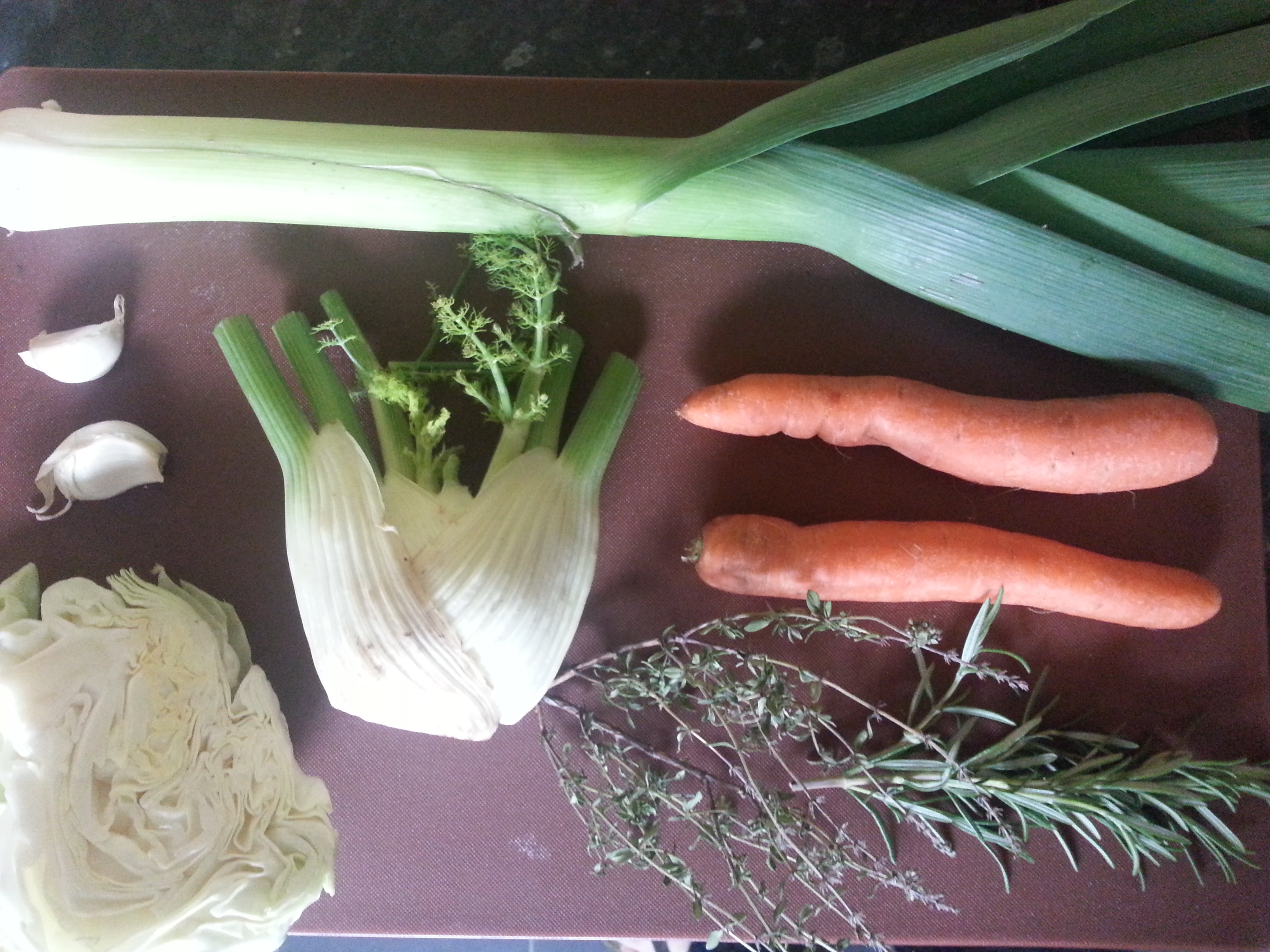
At least 3 of the following: 1 large onion, 1 carrot, 2 cloves of garlic, 2 sticks celery (with leaves), 1 leek (include the green top)

75g brassica – e.g. cabbage, broccoli, turnip &c

2 tomatoes

½ fennel bulb

Any other vegetable trimmings (if using all trimmings, go for at least 300g in weight)

30g butter or 2 tbs olive oil

2 bay leaves

6-10 parsley stalks

4 springs of thyme

1 sprig rosemary

6 peppercorns

6 allspice berries or a teaspoon of fennel seeds

3 cloves

around 2 litres of water

Begin by preparing your mirepoix; a mirepoix is just vegetables chopped very small so that the maximum amount of flavour can be extracted in the minimum amount of time. I go for the easy option and use a food processor.

2013-09-01 12.08.58

Heat the butter or oil in a pan and fry the vegetables for around 10 minutes so that they soften but don’t colour.

Tip the vegetables into a large saucepan or stockpot along with your herbs and spices. Cover them with cold water and slowly bring to a bare simmer. Try and make sure the stock doesn’t boil. Simmer the stock on the smallest hob on the lowest possible heat so that it merrily ticks away for around 20 minutes.

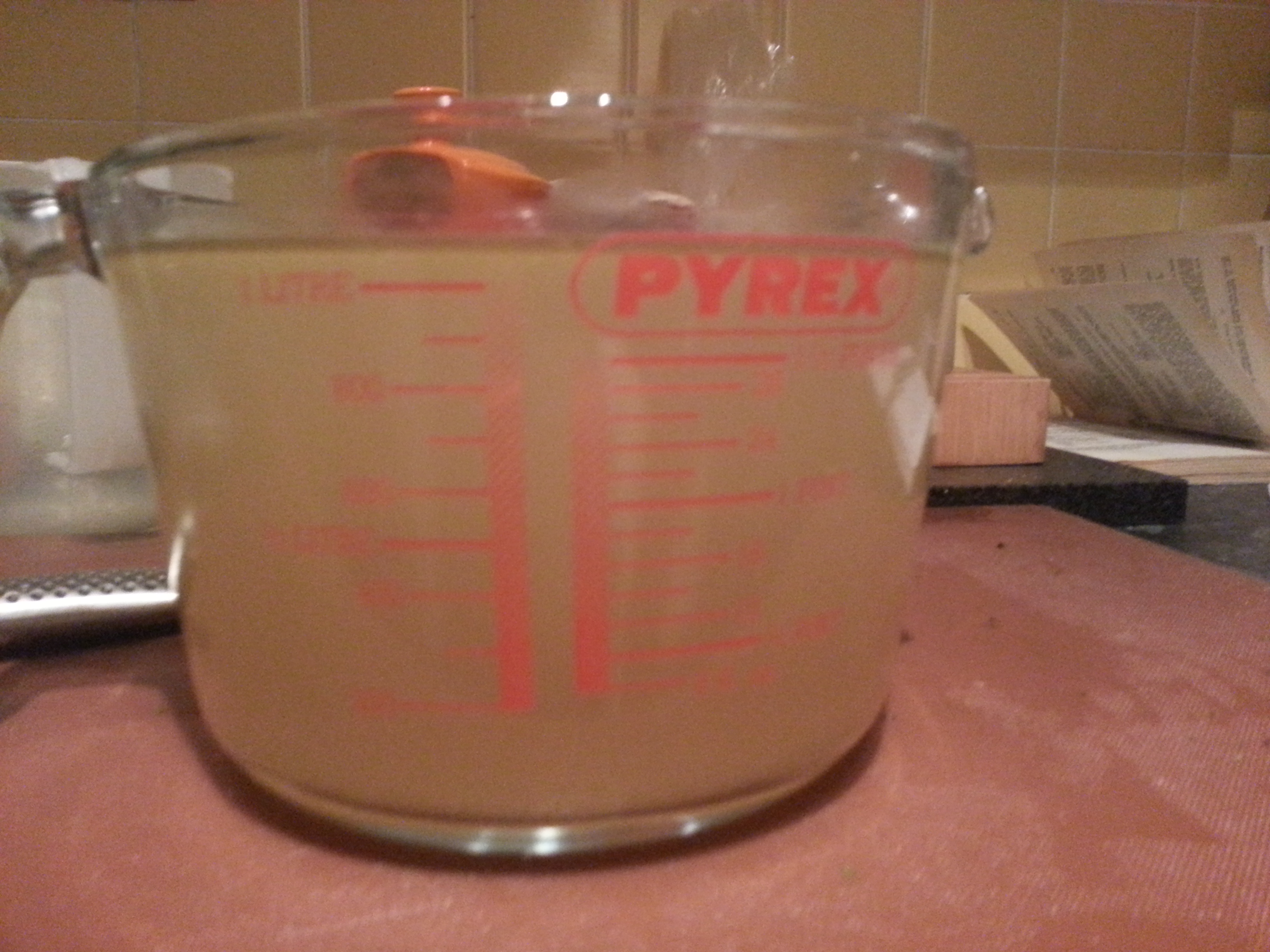
Let the stock cool slightly before straining it off. Avoid seasoning it with salt – wait until you’ve made the dish you are to use the stock for.

Your vegetable stock is now ready to use.

2013-09-01 20.06.34

If you want, you can reduce it, but you must be careful not to boil it hard as the subtle flavours will evaporate and the stock will look and taste like overcooked sprouts. The best way reduce it is to pour the stock into a wide pan and let it simmer and reduce gently.


If you like the blogs and podcast I produce, please consider treating me to a virtual coffee or pint, or even a £3 monthly subscription: follow this link for more information.


1 Comment

Filed under cooking, food, Recipes, Vegetables

Stock-making, a quick guide

Stock is the body and soul of soups – Lindsay Bareham

I have been making my own stocks for years now and it is part of my regular kitchen routine. I sequester bones, meat offcuts, fish heads and trimmings, vegetable peelings and herb stalks in bags in the bottom of my freezer so that I can combine them appropriately whenever I need to. It’s a thrifty way of living; often making a large batch of stock costs only the price of the fuel that cooked it.

For those that do not cook much at home, stock-making is sometimes regarded as some kind of alchemy, yet this is a misconception, and indeed there are many very complicated stock recipes, but the home cook (I include myself here) need not bother with these. The chances are you have made stock several times and have thrown it down the sink without a second thought, because in its most basic form, the water you cook your vegetables in is a good, light vegetable stock.

From a history point of view, one cannot pin-point when stocks were first made, and one cannot unravel the origins of stock from soup. Take this example from Good Things in England by Florence White:

[The soup] is nothing more than the water in which young cabbage has been boiled…It is extremely good and delicate and tastes very much like chicken broth. It is not merely an economy but a luxury; one of the best of health and beauty drinks.

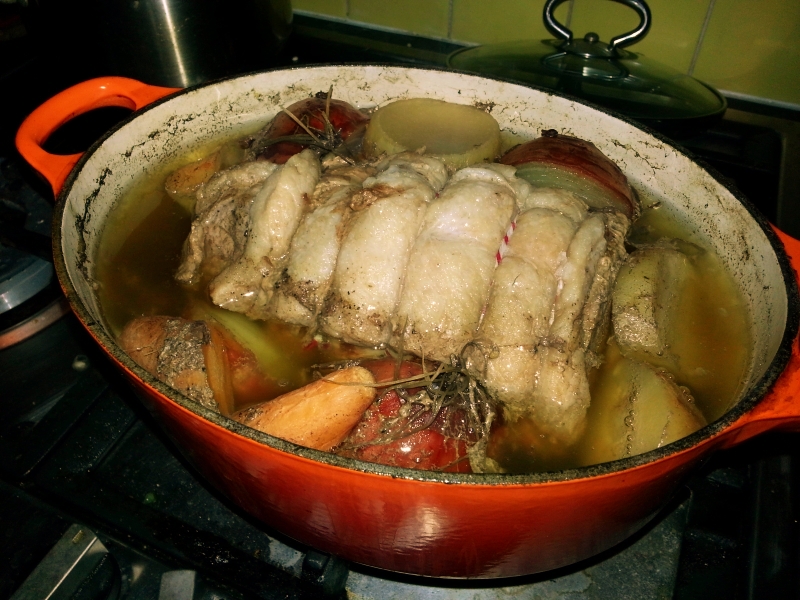
Wise and thrifty cooks throughout the millennia used the water that their tough meat joints were simmered in or their fish poached in and used them as the base of another dish. One of my favourite dishes is poached silverside of beef which consists of beef, herbs, a couple of veg and water. The resulting broth makes beautifully-tasting soup.

2013-05-02 20.47.25

Poached Silverside of Beef

Seeing as we are trying to be thrifty folk, I thought I would give you a quick guide to stock-making. As I have mentioned, it will save you money, and – like when you make your own bread – you will see how sublime it can taste. Every stock you make will taste a little different each time and it can be tailored to suit its use, e.g. add a few fennel seeds to a stock for a fish soup. Best of all, your soups and stews won’t taste of stock cubes. There is nothing wrong with having a stash of them in your food cupboard, I would do too, but with my very frustrating onion and tomato intolerances, I usually have to do my own. The point is, that when you use bought stock cubes, every soup and stew ends up tasting the same.

If you like the blogs and podcast I produce, please consider treating me to a virtual coffee or pint, or even a £3 monthly subscription: follow this link for more information.


What makes up a stock?

This is the beauty of stock-making; there are no hard-and-fast rules with respect to ingredients.

All good stocks should contain some flavoursome vegetables and aromatic herbs and spices, often called a bouquet garni, as well as the main ingredient: this might be meat and bones, fish, or, more vegetables. The stock might be seasoned or enriched with salt, wine, soy sauce, Worcester sauce, tomato puree, mushroom ketchup or any number of other things, though it is usually best to do this once the soup or stew that the stock is being used for has been made.

Stock vegetables

2013-09-01 11.56.01

The vegetables used in your stock are often key to the quality as they add a lot of depth. The three basic vegetables used for most stocks are carrots, celery and onion, though I personally add garlic and leek to this ‘trinity’ (a trinity in five parts?). My general rule of thumb is to try and include at least three of the five. Anything else is a bonus, really. Fennel is a good addition, if used sparingly, as are tomatoes, mushroom peelings, pea pods. Lentils, parsnips and potatoes add an earthiness, but should be avoided if you don’t like your stock cloudy. Brassicas such as cabbage, cauliflower, of sprouts should be used very sparingly, especially in meat or poultry stocks that have a lengthy cooking time, they are great in vegetables stocks though. Vegetables need to be roughly chopped in long-cooked meat stocks, and chopped small (a mirepoix as it is called in the trade) in quick-cook vegetable and fish stocks. A food processor makes an easy job of it.

2013-09-01 12.08.58

Herbs, spices and other aromatics

Like the vegetables, the herbs and spices you add will depend upon what you have and they are essential. Must-haves herbs include bay leaves, parsley stalks, thyme and rosemary. Other herbs are great if you can get hold of them. Dill stalks in a fish stock are delicious as is a tiny mint sprig in a summertime lamb stock. I keep and freeze all my herb stalks to use later in stocks – there’s no need to throw them away. Must-have spices include black peppercorns, cloves and allspice berries.

The thinly-pared rinds of citrus fruits are also used quite a lot: a strip of orange peel transforms a game stock and lemon rind really lifts chicken, vegetable and fish stocks.

These herbs and spices are often tied up into a faggot or bouquet garni, though I never bother to tie mine up for stock, though I do for stews and soups where careful and efficient removal is required.

Poultry, meat and game

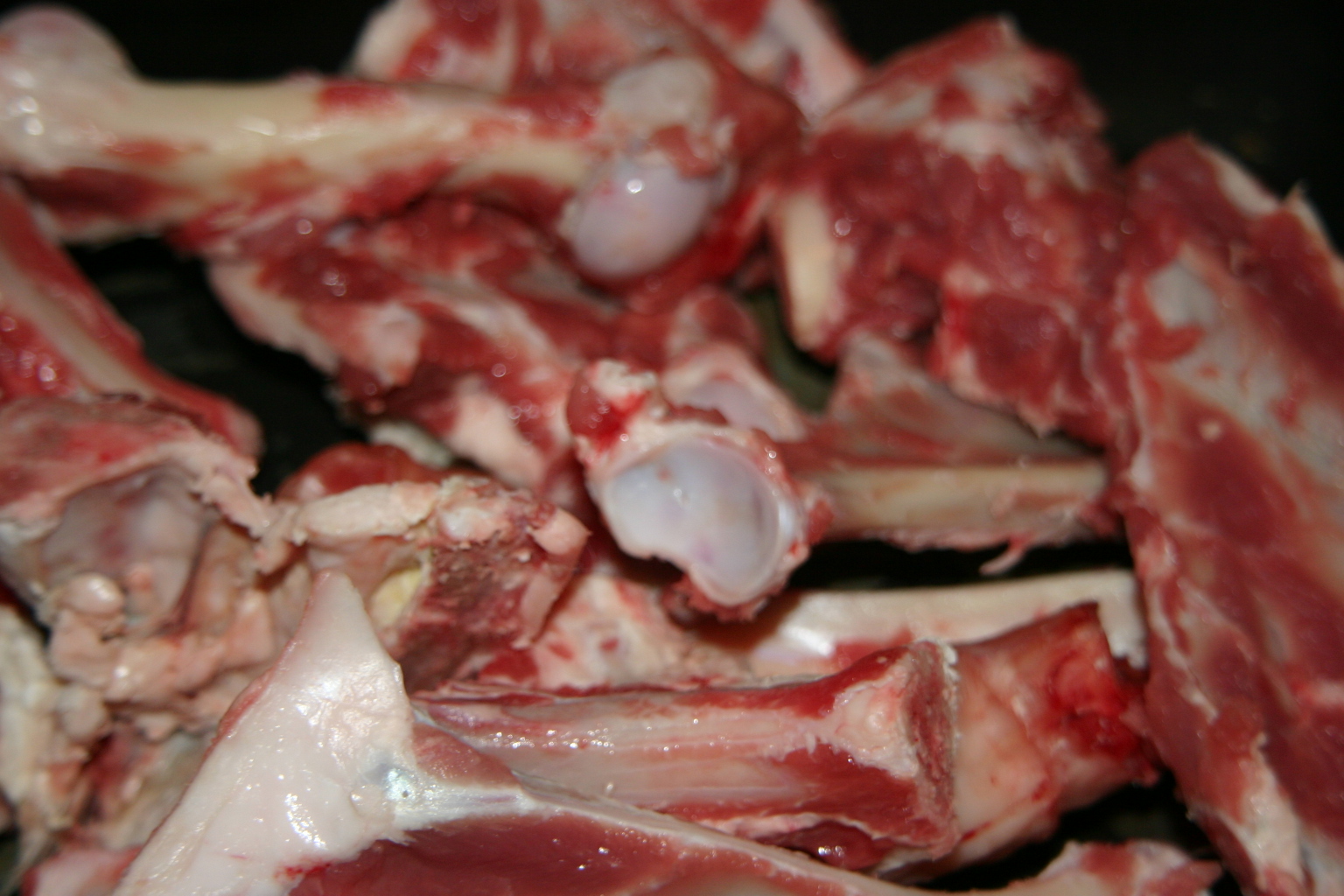
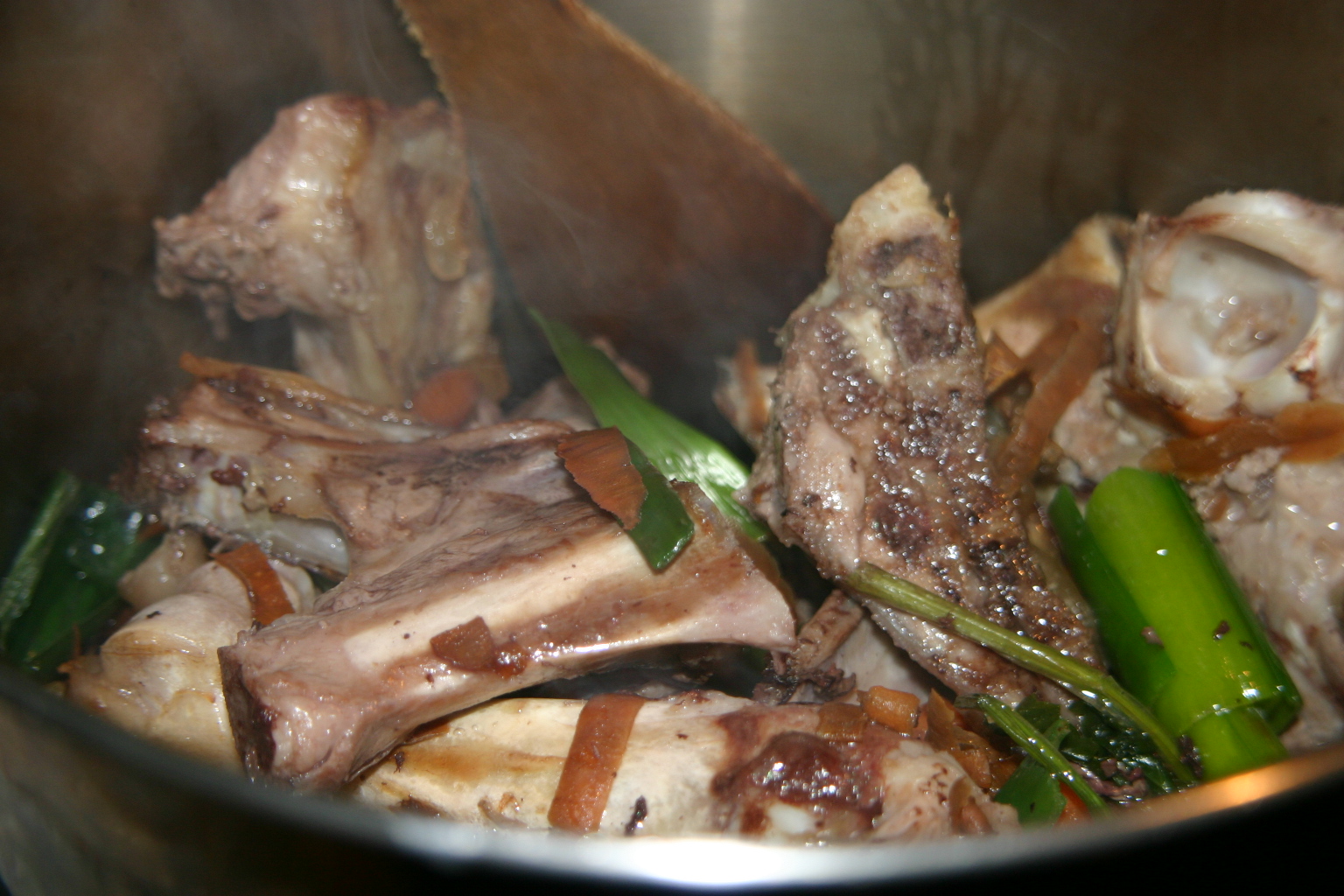
Use whatever you have – raw meat and bones, or bones from a roast. A little goes a long way: I have made game stock using a single woodcock carcass that still tasted great. It is best to avoid bones that have already been stewed as most of the flavour will already have leached out, but do add any left-over pan juices, jelly or gravy. Raw meat or bones will benefit greatly from a quick roasting in a hot oven for 20 minutes or so.

2013-01-11 17.40.58

The important thing here is to treat your stock meat properly – if you boil the stock hard, the tasty amino acids and textural gelatine will not go into your stock, but will either form a nasty grey scum or will be trapped within the meat. Low simmers and long cooking times are essential.

2013-01-11 18.12.08

It is best to avoid kidneys and livers in stocks, as their flavour is far too strong, but hearts, tongues and heads all make good additions.

Fish

Fish stocks, in contrast to meat stocks, can be made in minutes. Use bones and trimmings in your stock, but avoid oily fish such as mackerel and sardines. Mussel, clam, cockle or oyster liquor would be delicious, if you ever have any.

Clarifying Stock

You might want to clarify your stock after straining it. This is straight-forward enough to do and there are several methods. The quick method is to whisk a mixture of egg whites and broken egg shells into the hot stock. The eggs grab hold of and magically mop-up the cloudy substances. The slow – and best – method is to freeze the stock, tie it in muslin and let the melting stock drip through. This method makes beautifully clear stocks.

There are a few tricks to avoid cloudiness in the first place: Don’t use starchy vegetables like potatoes, lentils and parsnips and avoid peppercorns. The best way is it leave the stock be; prodding, poking and rearranging items is the surest way to cloud it.

2013-03-21 20.18.50
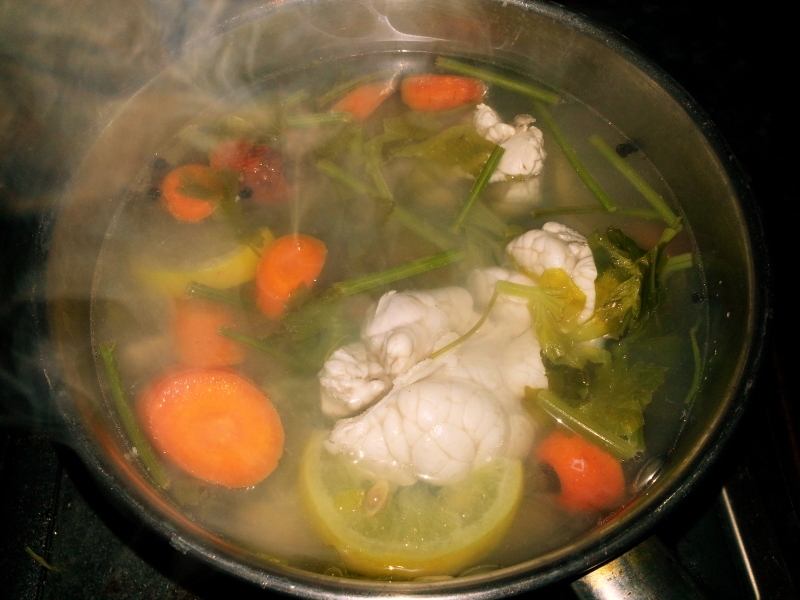
Poaching sweetbreads in a light vegetable stock called a court-bouillon

Some stock-making rules:

  1. Start with cold water and bring to a simmer slowly. This is the most important rule of all. As the water gradually heats, the flavours leach out and don’t boil away and connective tissues break down to release their gelatine. The stock should never get hotter than a bare simmer; you want the odd gurgle, nothing more
  2. Remove the scum before you add the herbs and spices. If you don’t the scum gets all caught up in it, making a nasty grey mess. Skim the scum, then add the aromatics.
  3. Remove the layer of fat. Nobody wants greasy soup. The best way to do this is to let it cool and then scrape the fat layer away. If time is an issue, lay paper napkins on the stock’s surface.
  4. The amount of water you use depends on your pot. Don’t follow the recipe when it comes to adding water. Arrange the ingredients in your pan with few gaps and add enough water to just cover.
  5. Break the bones and cut up the meat. This increases the surface area and therefore increases the flavour of your stock.
  6. When storing stock, cool it quickly and keep in the fridge up to 2 or 3 days. Any longer than that, freeze it.
  7. Reducing stocks enhance the flavours and mean you can store more in the freezer. You must strain the stock and skim it of fat before reducing it. Meat stocks you can boil it quite heard, but vegetable and fish stocks need to be treated a little more gently.

Stock recipes

Every post I write a post with a stock recipe or information about stock I tag it appropriately. Click here to see the posts.

I will post a good vegetable stock recipe in the next day or so, as it is the most useful of all the stocks and I already have posted a duck stock recipe.

The best advice is really to use stock recipes as a guide only, use what you have to hand. Keep your vegetable and meat trimmings in a bag in your freezer and you’ll find that you’ll quickly fill them.

9 Comments

Filed under cooking, food, General, Meat, Recipes, Soups, Uncategorized, Vegetables

Chicken-of-the-Woods

I have written a few posts on foraging and natural history in Britain, here’s a little post about a lovely edible mushroom:

As I was walking in Lyme Park at the weekend I kept an eye out for edible goodies. Lyme Park is great for oyster mushrooms because of the large number of beech trees in the forests there. However, I did not expect to find a splendid chicken-of-the woods growing on a dead tree trunk just off the path to the children’s play area! Goodness knows how many had walked past it unaware of the delicious treat..

2013-08-05 19.16.57-1

Although I am by no means an expert, I recognised it straight away – a large bracket fungus with multiple brackets with a beautiful and almost garish orange and sulphur-yellow coloration. In fact, another name for it is the sulphur polypore (the polypore part is because it doesn’t have gills on its underside like a typical fungus, but many tiny pores). There really is nothing else like it, so you can be pretty certain of what it is.

However, before I go on: always confirm you have correctly identified the fungus and check more than one field guide. The two I use are the River Cottage Handbook No.1: Mushrooms, for quick reference and the Collins Fungi Guide for more detailed descriptions. If you are not 100% sure of what you are picking, don’t pick it!

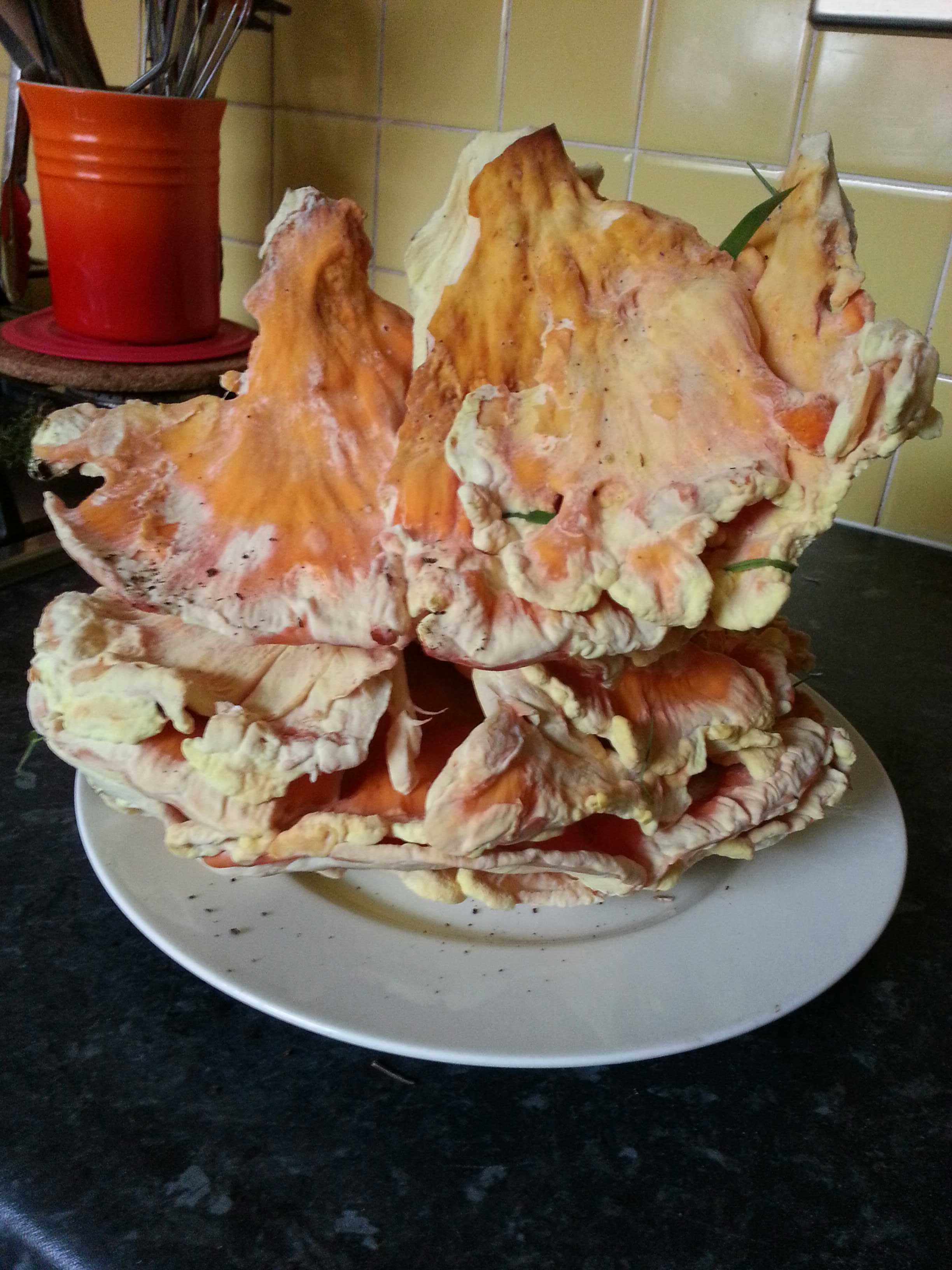
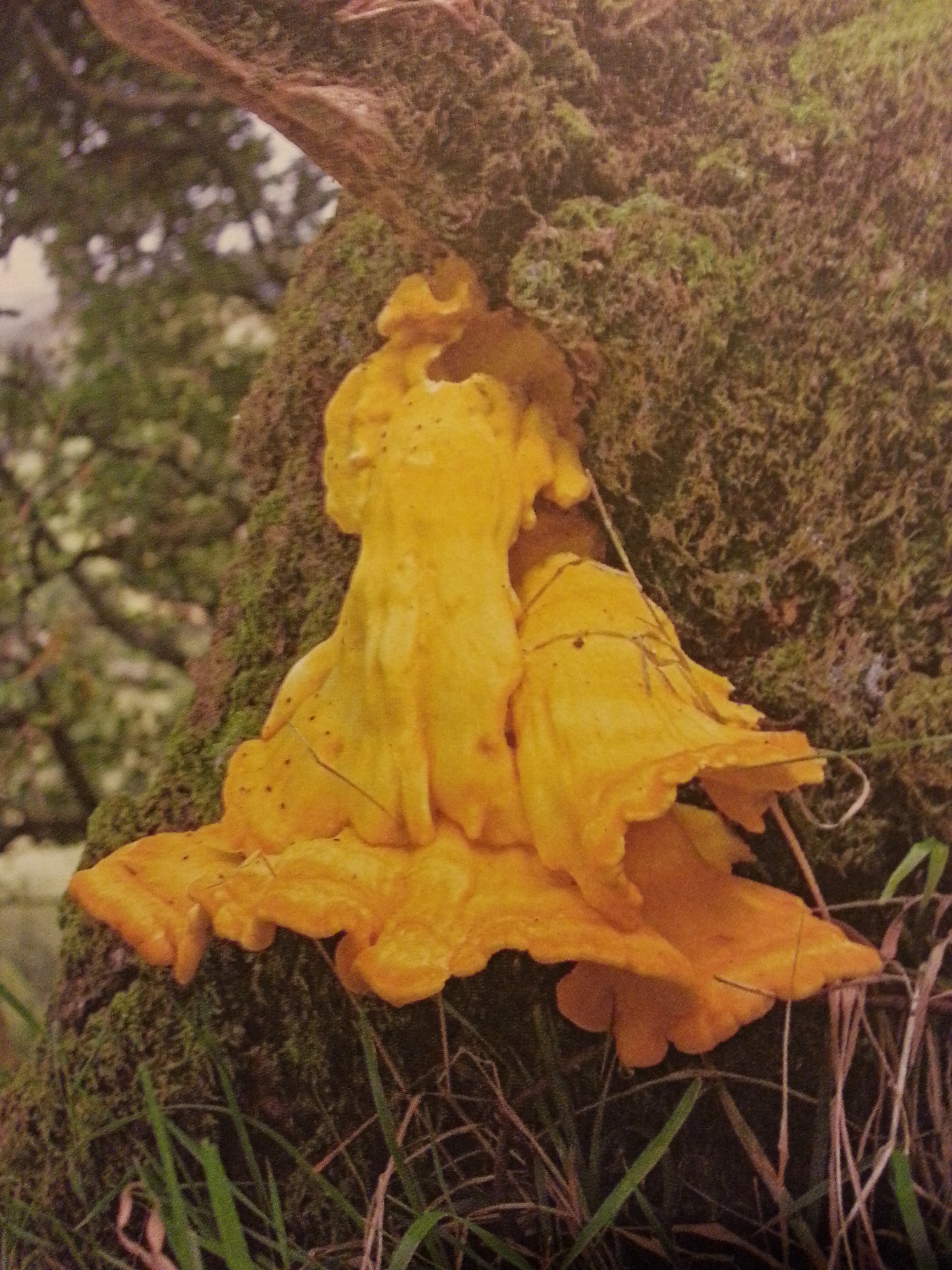
As with all fungi there is a certain amount of variation – there can be many brackets or a few, they can be a range of widths from a few inches to a couple of feet, the brackets can be neat and flat, or can look as though they’ve poured out and frozen, like orange lava, in a Dali-esque manner. The one I found had grown around blades of grass, trapping them like flies on amber. I didn’t take it all because I thought I’d see if the intact part would grow back – if I’m lucky I might be able to collect a regular ‘crop’ over the next few months!

Unfortunately, I didn’t take a photo in situ because my phone has run out of batteries, but here’s a few pictures I have found in books and on the ‘net that shows off this variation:

2013-08-08 21.47.13
chicken wood tall
chicken woods flat
chicken woods tall

From (in order) John Wright, First Nature, Cornell University, Malcolm Storey

Chicken-of-the-woods, or to give its scientific name Laetiporus sulphurous, is only found on trees, and the trees can be living or dead. It is usually found in the Summer and Autumn, and occasionally in Winter if it is a mild one. It grows most commonly upon oak and also yew, cedar, cherry wood, sweet chestnut, and willow. It is worth pointing out that all Laetiporus species are edible except if found growing on poisonous trees such as yew and cedar.

Whilst on the subject of edibility, I should also mention that Laetiporus sulphurous is only edible when cooked.


If you like the blogs and podcast I produce, please consider treating me to a virtual coffee or pint, or even a £3 monthly subscription: follow this link for more information.


Cooking with Chicken-of-the-Woods

This fungus is called chicken-of-the-woods because it’s firm flesh is pale and fibrous but tender, like chicken breast. For that reason it makes an excellent meat substitute for vegetarians. What a coincidence it is that I have a friend visiting me who is vegetarian; we could put the chickeniness to the test.

I did hope it was good because the chicken-of-the-woods I found was pretty big, weighing in at 2 kilograms and bigger than my head! It therefore would keep me and my visiting friend Stuart in meals for most of the week.

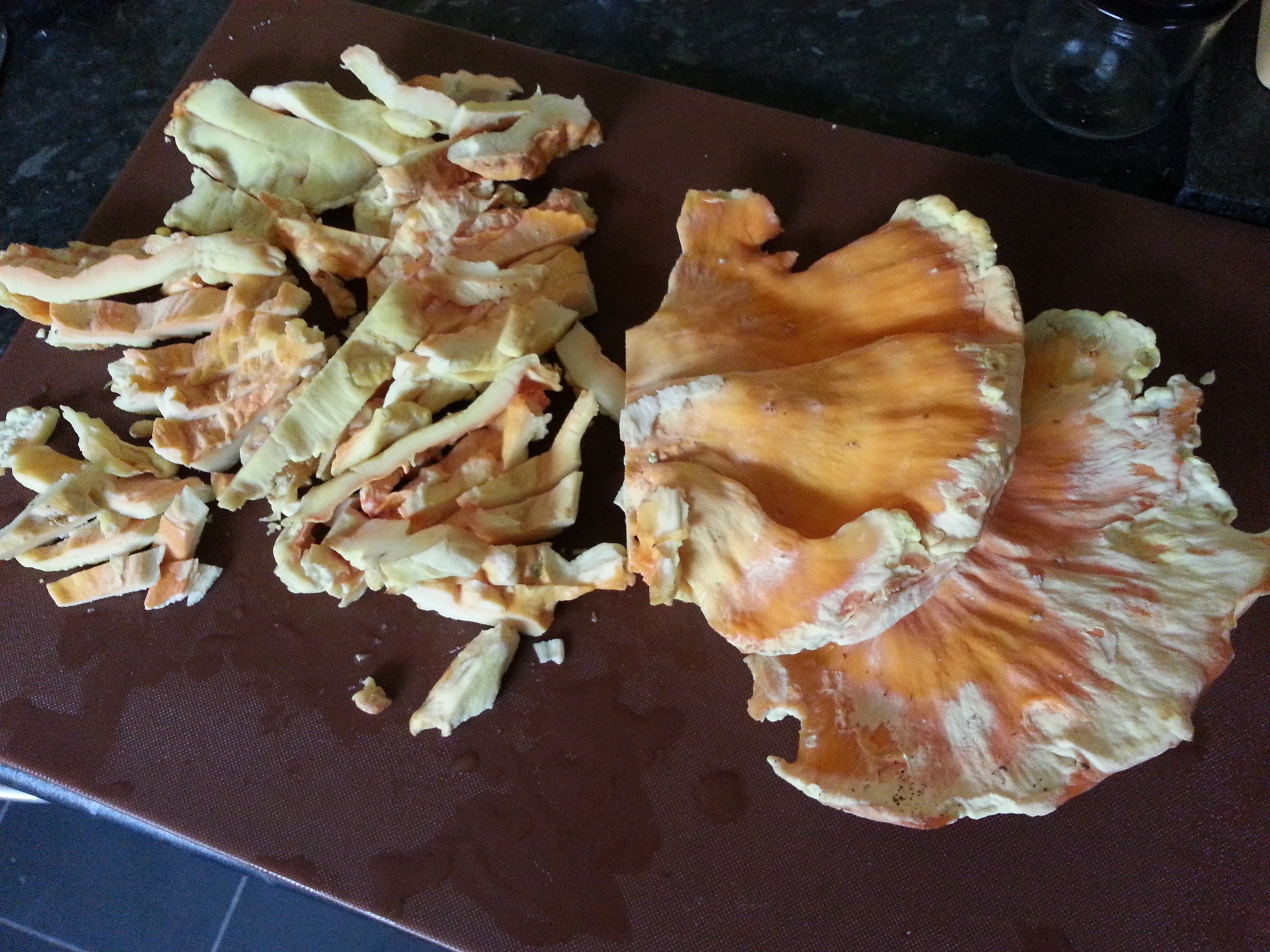
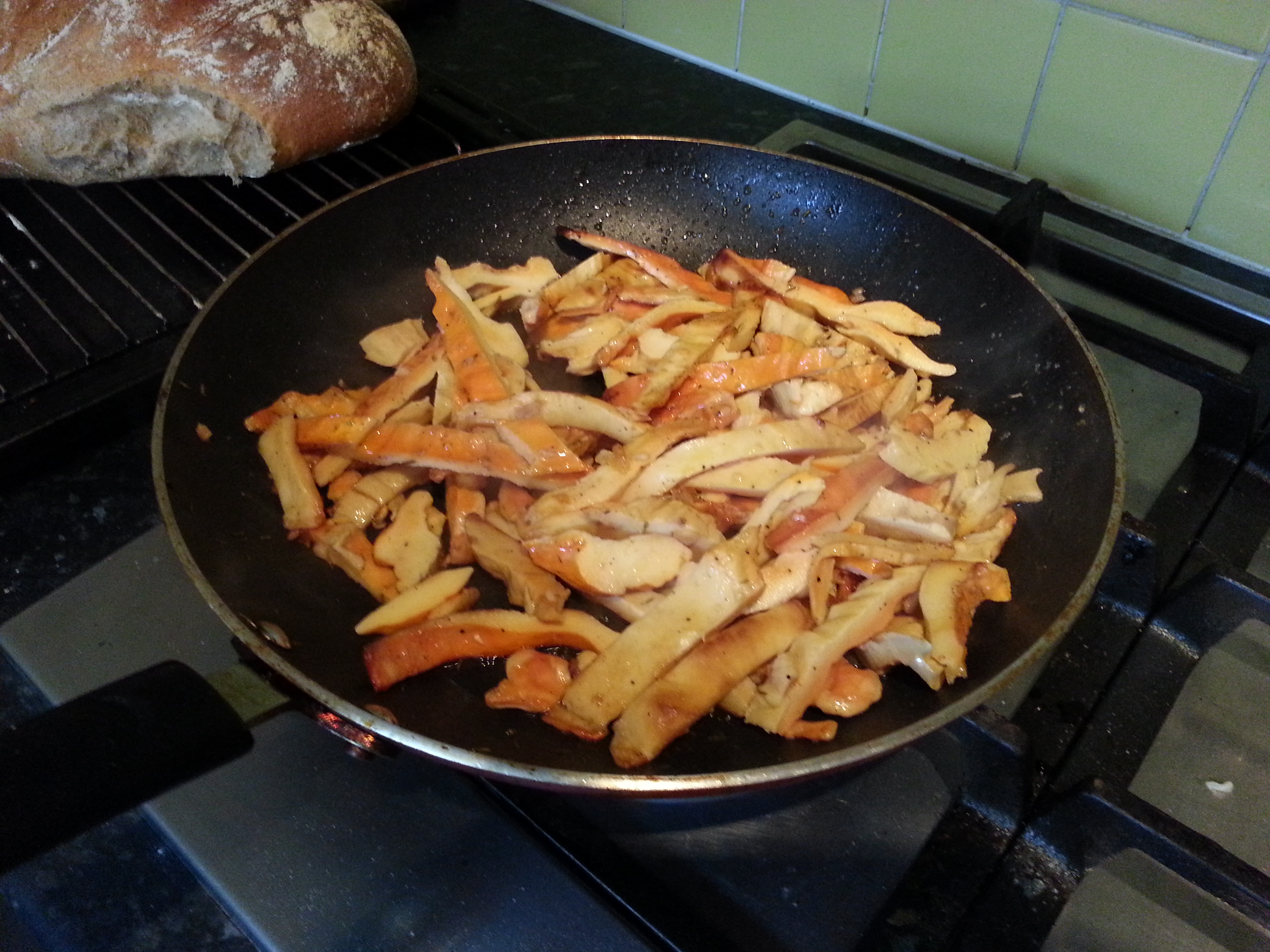
Preparing it is simple. Separate the brackets from each other and trim away and tough woody bits then rinse it under the tap briefly to get rid of any soil and creepy-crawlies, then slice it reasonably thinly. Then it is just a question of integrating it into a recipe. As you slice, you’ll notice that the flesh is rather dry, so when frying it you should add a little water so that it can absorb it and become more typically mushroomy in texture.

2013-08-05 19.26.52


Its firm flesh is tender and yielding and definitely has a truffle aroma and flavour when cooked – there’s a lot of umami going on in that mushroom! It’s definitely the tastiest wild mushroom I have found thus far. We couldn’t understand why it hasn’t been cultivated as food because it was so substantial and satisfying, and better than any TVP, Quorn or other mock meats. Maybe I’ve found a gap in the market…

Here’s what I made with it:

One third was turned in simple mushrooms on toast  – a recipe can be found for that here – the only changes I made was to add a little water after a few minutes’ sautéing, and to omit the cream/milk. Whenever you try a mushroom the first time, this is the thing to cook for it shows it off in all its glory! It fed 4.

2013-08-05 20.07.07

The second third was used in a stir fry with the typical stir-fry veg, soy, (vegetarian) oyster sauce and, again, some water. This really showed off its meaty qualities. Excellent. This fed 2.

2013-08-06 20.04.18

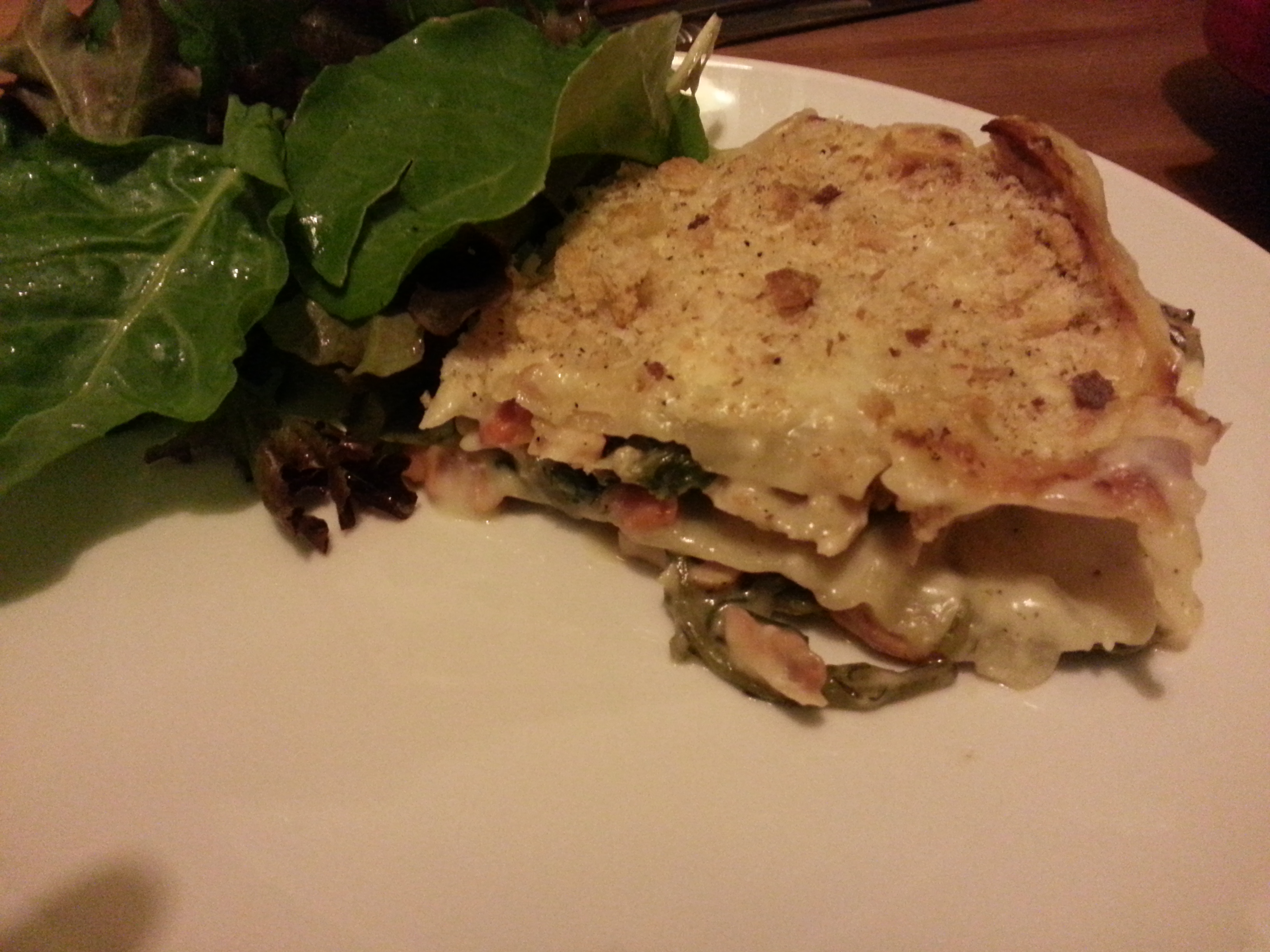
The last third was a spinach and chicken-of-the-woods lasagne. I made a simple béchamel sauce flavoured with Lancashire cheese, black pepper and nutmeg, then sautéed the mushrooms in olive oil, added some water and steamed the spinach on top of the mushrooms. Everything was layered up in the usual way, finished with some Parmesan and breadcrumbs and baked. This fed 4….

2013-08-08 20.59.11

Now it is all used up, and we didn’t even get bored of it. I do hope another grows back on that tree trunk…

10 Comments

Filed under Britain, cooking, food, foraging, natural history, nature, Recipes, Uncategorized, Vegetables

Asparagus

asparagus plate

A botanical plate showing the life cycle of the asparagus plant

Asparagus season in the UK very short, going from only May until June. Of course, these days we are no longer a slave to the seasons and can have fresh asparagus that has been grown in Peru or Kenya whenever we like. I love the stuff, but I do feel that our food loses some if its magic when seasons no longer matter. It is for this reason I only buy British asparagus.

Asparagus has been eaten in Ancient Egypt, Greece and Rome and has been loved in France for many centuries, and it is the carefully cultivated and selected French type of asparagus that made its way to Britain in the seventeenth century, a time of great ‘vegetable improvement’, and it is still grown here today. This does not mean that prior to this date we did not eat it or try to cultivate it.

The etymology of asparagus is interesting – many people think that it was called sparrow grass, but the upper class thought it a vulgar term and subtly changed its name to asparagus to make it sound more posh. This is not quite true: it actually began life as asparagus coming from Mediæval Latin, then it was shortened to sparage in Late Old English and then further modified to asperages in Middle English. It was anglicised to sperach or sperage in the 16th century, but strangely it was officially spelled as asparagus to be in line with Latin. The word asparagus became associated with “stiffness and pedantry”, and the “folk-etymologi[s]ed” sparrow grass arose in reaction to these Latin throwbacks. All this information came from the wonderful Online Etymological Dictionary. I love the Old English word – eorðnafela – sounds like some kind of elf queen from a Tolkien book.

There are three main types of asparagus which all come from the same plant: there are the common all-green tender spears that have very good flavour, and then there is white asparagus, made by ‘forcing’ the spears to grow in the absence of light by earthing up around and over tips. These are not typically grown in Britain, though you do spot them from time to time, though they have usually come from Holland or Belgium, where white asparagus is popular. Lastly, there is lavender-tipped asparagus which is simply white asparagus that has been allowed the see the sun again and just colour slightly. White and lavender-tipped are much more fibrous than the green but have a much more delicate flavour.

Asparagus is also infamous for a certain side-effect after it has been eaten and digested: the distinctive smell it leaves in our urine, which is liked by some, but hated by others:

[Asparagus] cause a filthy and disagreeable smell in the urine, as everybody knows.

Louis Lemery, Treatise of All Sorts of Food, 1702

all night long after a dinner at which I had partaken of [asparagus], they played (lyrical and coarse in their jesting as the fairies in Shakespeare’s Dream) at transforming my chamber pot into a vase of aromatic perfume.

Marcel Proust, In Search of Lost Times, 1913

[Proust always overdid things – have you ever read his description of madeleines?]

The chemical in question is called asparagusic acid, though not everyone has the ability to produce it (though most do) and not everyone has the ability to smell it (though most can).

Proust

Big ponce: Proust


If you like the blogs and podcast I produce, please consider treating me to a virtual coffee or pint, or even a £3 monthly subscription: follow this link for more information.


Preparing Asparagus.

It is very straight-forward to prepare asparagus. You first need to remove the woody part at the base of the stem. You can do this with a knife, but this involves guess-work, so it is easier to break the spears one at a time because they have a natural snap point where the woodiness lessens. You can trim the ends of course if you want to be fancy. If you have very thin young spears, you may not have to snap them at all. Along the stem of the plant there are strange little leaves that lie flat against the stem; you can remove these if you like, but I tend not to unless the spears are particularly thick.

Asparagus and Eggs

Asparagus needs little cooking: just a few minutes steaming is required. Traditionally it is cooked in a tall asparagus pan so that the spears can be boiled upright. Here’s how I like to cook mine – it shows off the flavour of asparagus cooked simply.

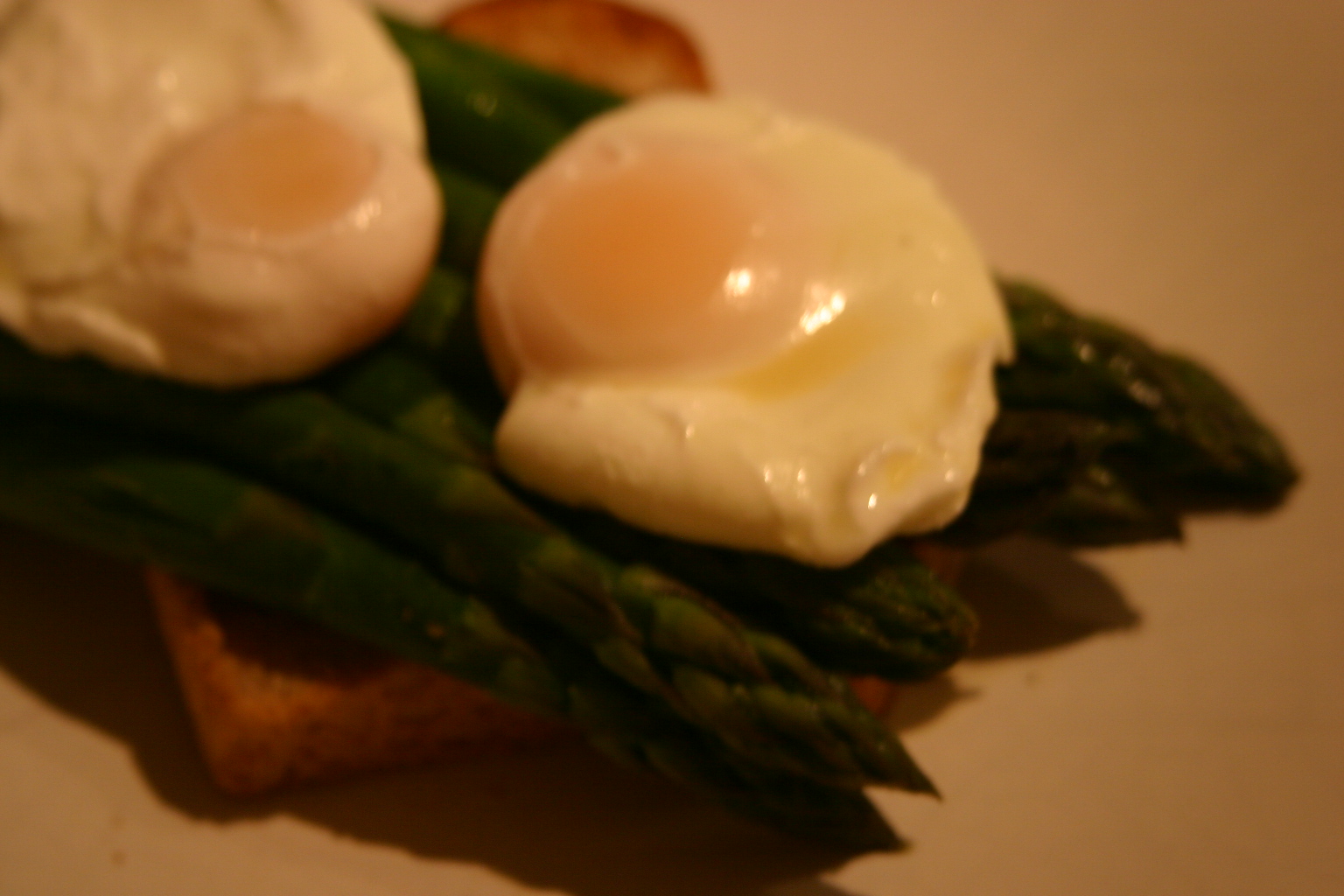
Prepare your spears and place them in a pan in just a few tablespoons of water and a knob of butter. Cover so that the asparagus part-boils and part-steams. Check if they are cooked by probing the thickest part of a spear – it should be nice and tender. Asparagus spears of a middling thickness will take no longer than four minutes, and will most likely be done in three. Once cooked, season with salt (if needed) and black pepper.

Serve on toast with some of the asparagus-flavoured butter and poached eggs.

8 Comments

Filed under Britain, cooking, food, General, history, Recipes, Uncategorized

Have a Heart?

I am aiming to write at least one recipe on every cut of meat, cheap or expensive, regular or odd (see here for the main post). At Levenshulme Market a few months ago, I came across a calf’s heart at the dairy farm Wintertarn’s stall, so I bought it and stole it away in my freezer until I found a recipe I wanted to try.

Heart crops up in many recipes such as pork faggots or haggis, but these days is rarely eaten as a cut of meat in its own right. In the war-time home stuffed pig’s or lamb’s hearts were pretty popular because offal cuts were not rationed. This naturally has damaged the reputation of the heart as something that is good eating. Prior to the 20th century, heart was a very popular cut of meat, even with the middle and upper classes. I like this recipe that appears in Elizabeth Raffald’s book The Experienced English Housekeeper (1769) ‘To make a Mock Hare of a Beast’s Heart’:

Wash a large beast’s heart clean and cut off the deaf ears [see below], and stuff it with forcemeat…Lay a caul of veal…over the top to keep in the stuffing. Roast it either in a cradle spit or hanging one, it will take an hour and a half before a good fire; baste it with red wine. When roasted take the wine out of the dripping pan and skim off the fat and add a glass more of wine. When it is hot put in some lumps of redcurrant jelly and pour it in the dish. Serve it up and send in redcurrant jelly cut in slices on a saucer.

elizabeth raffald

Elizabeth Raffald

I think this sounds like a delicious recipe to try, and perhaps I will when I come across a large beast’s heart in the butcher’s shop window. However, it might be a little bit of a challenge for someone not used to eating such things. Instead, I give a recipe for a delicious and simple marinated calf’s heart, as a good introduction to the texture of heart which is not as tough as old boots as you may first expect, but firm and has the familiar taste of meat.  However, before you cook a heart, you need to know how to get it ready.

Preparing Heart

FxCam_1358467420942

The hearts of small animals such as ducks and chickens can simply have any large blood vessels removed and you are done.

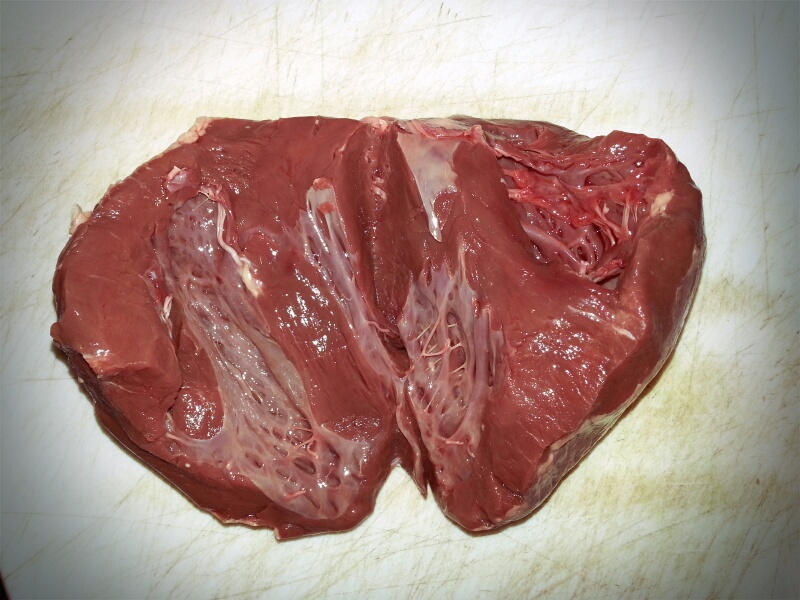
Preparing a larger heart such as calf, ox, lamb or pig might appear to be a little daunting at first, but it is really quite simple. First of all the large blood vessels as well as the two large flaps that used to be known as ‘deaf ears’ are trimmed away from the top of the heart as well as any obviously sinewy parts. This should leave the heart looking neat with two cavities within. If you want, trim away the fat, but if it is to be roasted, the fat provides a natural basting. In fact, there is so little fat within the heart itself that often it needs to be larded with strips of fatty bacon. Large ox hearts are often quartered and frozen away to be used over several meals.

Pop the heart in some salted water until you are going to cook it.

Grilled & Marinated Calf’s Heart

This recipe is a modern one and it comes from the Nose-to-Tail chef Fergus Henderson. It is very simple and very healthy – pieces of calf’s heart that have been marinated in Balsamic vinegar, quickly griddled then served up with a nice salad.

For four

Ingredients

1 calf’s heart

around 6 tbs Balsamic vinegar

salt

pepper

1 tbs chopped fresh thyme

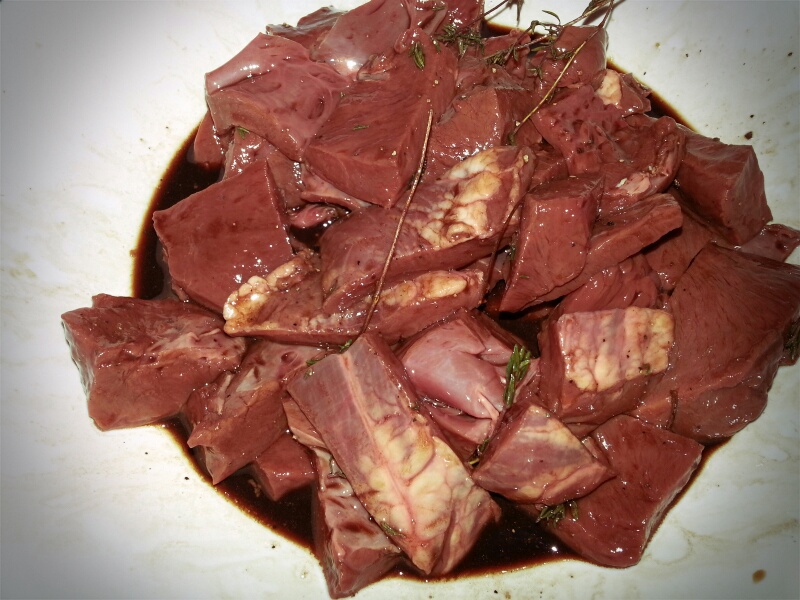
First of all prepare the heart: trim it as explained above and remove any thicker pieces of fat. In this case, the heart is cooked quickly, so it doesn’t require the fatty basting. Cut it open and lay it out flat and cut into 2 or 3 centimetre (1 inch) squares.

FxCam_1358467450898

You need each piece of meat to be about half a centimetre (¼ of an inch) thick, so some very thick parts, such as the ventricles, will need to be sliced horizontally. Tumble the pieces of heart into a bowl along with the vinegar, salt, pepper and thyme, making sure everything gets coated well. Cover and marinate for 24 hours.

FxCam_1358468271386

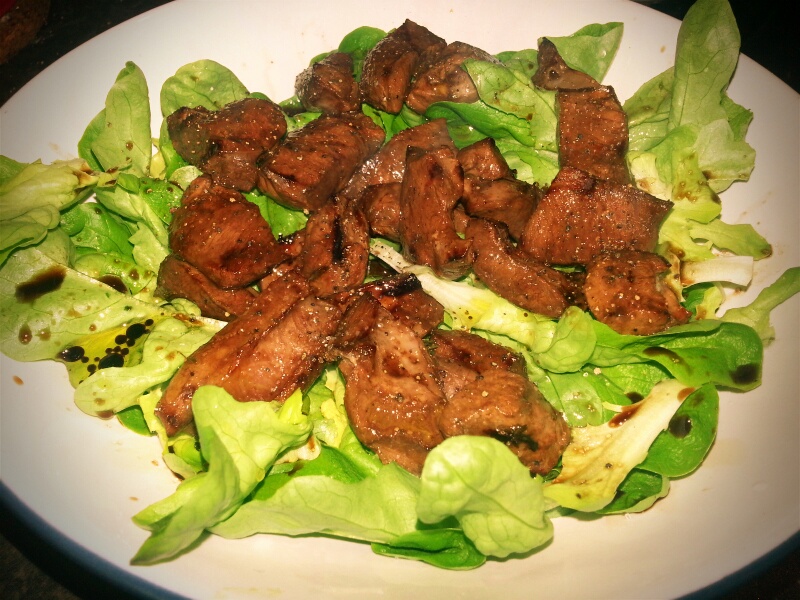
To cook the meat, you need a red-hot griddle – either on a barbeque or over a hob – that has been lightly greased with some rapeseed oil. Place pieces of heart on the griddle and turn after 2 or 3 minutes and cook the same time on the other side.

Serve straight-away with ‘a spirited salad of your choice’, says Mr Henderson, ‘e.g. waterctress, shallot and bean, or raw leek.’

FxCam_1358535726575

If you like the blogs and podcast I produce, please consider treating me to a virtual coffee or pint, or even a £3 monthly subscription: follow this link for more information.


4 Comments

Filed under Britain, cooking, food, General, history, Meat, Recipes, Uncategorized

Sweetbreads

Sweetbreads with bacon and garden peas

One of my irregular offal-themed posts (see main post Tail to Nose Eating):

For those that are not aware, sweetbreads are a type of offal and come from the thymus, situated at the base of the throat, of either calves or lambs. For this reason they are often called throat sweetbreads. The thymus produces T cells which help us to attack any pesky germs that try and make us ill. The pancreas is commonly sold as heart or stomach sweetbreads, there are other rarely used sweetbreads too such as tongue and cheek sweetbreads. Most people think that sweetbreads are the testicles of calves and lambs; in fact, very rarely are testicles sold under the name of sweetbreads, they are more commonly sold as fries or stones.

Don’t be put off by the thought of eating a gland – they taste light, with a suspicion of iodine and do not have a strong offal flavour. If you are new to offal, or fear it a little, sweetbreads are a good place to start I reckon. But why are they called sweetbreads? Well, they are sweet because they taste richer and sweeter compared to typical meat, and they are bread because the old English word for flesh is bræd.

Sweetbreads were once very, very popular, but have now died a comparative death. Though, like many of the old forgotten cuts of meat, there is a slight resurgence, but nowhere near the dizzy heights of the 18th and 19th centuries. Almost every meat dish seems to have been decked out with breaded sweetbread garnishes. In those days; they were cheap and they were plentiful and they were delicious. Sweetbreads are not the easiest of cuts to get hold of these days, with most of them being snapped up by restaurants, and the few that get to your butcher are snaffled very quickly by those in the know. This, in some ways, in a good thing – they become, not a mere garnish, but the star of the show, something to be savoured. In Jane Grigson’s book Good Things, they have a whole chapter to themselves!

Sweetbreads are best served simply: grilled or fried alongside some dry-cured streaky bacon. Sweetbreads love bacon. They also love black pudding and sweet vegetables such as beans and peas.

I got lambs’ sweetbreads from my butcher WH Frost in Chorlton. For some bonkers reason we can’t sell British calves’ sweetbreads in this country, but we can sell those that have come from mainland Europe.

20201204_133419-01.jpeg
Lambs’ sweetbreads in their raw state

Preparation of sweetbreads

Whether you get calves’ or lambs’ sweetbreads they first need to be soaked in salted water for a few hours. This gets rid of any impurities. If you can, change the water a couple of times, but it is no big deal if you do not.

Next, the sweetbreads are poached. This can be in simple salted water, but more normal is a light stock such as chicken or vegetable or in a court bouillon of herbs and vegetables.

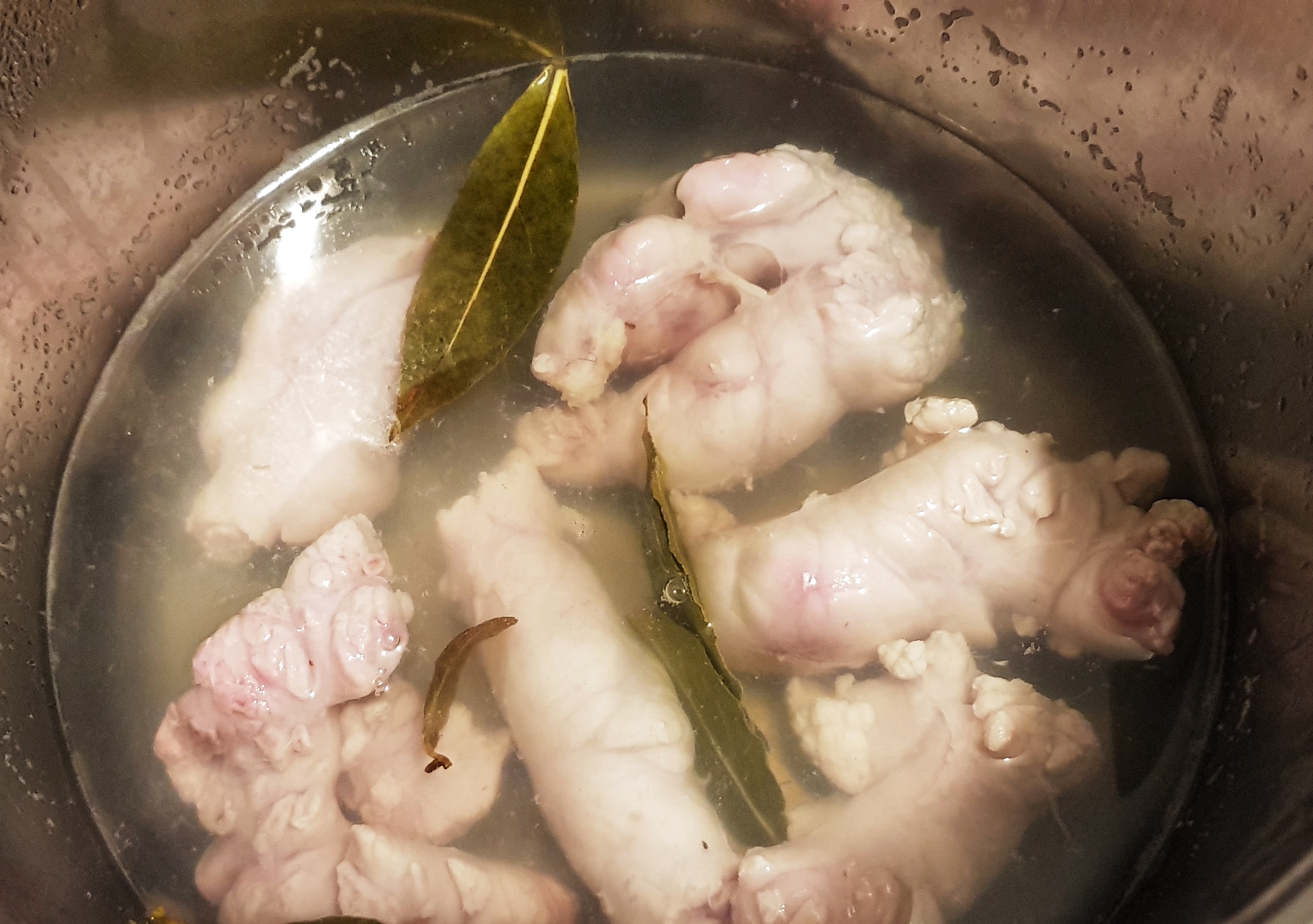
Simply pop your sweetbreads into the water or stock, bring to the boil and simmer gently for five minutes. Remove, drain and cool before removing any gristly bits. The tricky part is doing this whilst keeping them whole.

Sweetbreads gently poaching in a simple court bouillon

If you like the blogs and podcast I produce, please consider treating me to a virtual coffee or pint, or even a £3 monthly subscription: follow this link for more information.


Fried Sweetbreads with Peas and Broad Beans

This recipe is great if you’ve never cooked with sweetbreads before – they are sliced up, so if they do fall apart when preparing them, it doesn’t matter. This recipe is also a very quick dinner – taking only 10 minutes or so to cook. I don’t think it needs to be served with anything, except perhaps a slice of wholemeal bread and butter. By the way, there is nothing wrong with using frozen peas and beans here. This recipe is adapted from The River Cottage Meat Book by Hugh Fearnley-Whittingstall and it serves four people.
Ingredients

around 150g (6 oz) garden peas, fresh or frozen

around 150g (6 oz) broad beans, fresh or frozen

3 tbs olive oil

100g (4 oz) dry-cured smoked streaky bacon, cubed

500g (1 lb) prepared lamb’s or calf’s sweetbreads, sliced

plain flour seasoned extremely well-seasoned with salt, pepper and a little Cayenne pepper

1 garlic clove, very finely chopped

salt and pepper

Plunge the beans and peas into boiling water for one minute, then drain and tip into cold water. Heat the oil in a frying pan and fry the bacon begins to crisp.
Meanwhile, toss the sweetbreads in the seasoned flour and tip them into the pan along with the bacon. A minute later, add the garlic and fry everything a nice golden brown. Tip away any excess oil and stir in the beans and peas. Cook for another minute, season with salt and pepper and serve piping hot.
21 Comments

Filed under Britain, cooking, food, General, Meat, Recipes, Uncategorized

Pompion (Pumpkin) Bread

I was recently bequeathed a lovely home-grown organic pumpkin from my good friends Simon and Rachel Wallace – they are slowly but surely building up a small-holding on a farm in the Derbyshire country. They are living the dream, and I am more than a little jealous. Anyway, I wanted to do the lovely pumpkin justice and make some nice meals. I remembered a recipe for pumpkin bread that appears in English Bread and Yeast Cookery by Elizabeth David. She takes it straight from the original manuscript, an 18th century periodical called The Family Magazine. Back then pumpkins were more commonly called pompions, and it is more like some advice rather than a recipe:

Slice a pompion, and boil it in fair water, till the water grows clammy, or somewhat thick; then strain it through a fine cloth, or sieve, and with this make your Bread, well kneading the dough; and it will not only increase the quantity of it, but make it keep moist and sweet a month longer than Bread made with fair water only.

The Family Magazine, 1741

It funny that the British have always had a thing for bread that stays ‘fresh’ for as long as possible; the French, for example, expect the opposite and buy there’s once or twice daily . It goes back to the days when the old brick bread ovens were lit but once a week so the bread – and other goodies – had to last. This love for bread with a long shelf-life is also often blamed for our love of the moist mass-produced packaged breads that go mouldy before they go stale, but I digress.


If you like the blogs and podcast I produce, please consider treating me to a virtual coffee or pint, or even a £3 monthly subscription: follow this link for more information.


I thought I would give this pompion bread a go, but I felt that boiling the poor thing to death was a bit wasteful, and I wanted the bread to have some pumpkin flavour so I roasted it, mashed it up and added it to a basic bread dough along with a little sugar and some mixed spice. It turned out to be delicious so I thought I’d give you the recipe to try. I don’t think it resembles the original recipe, but it certainly inspired me to make it. By the way, it doesn’t stay fresh for a month, but it is very much moist and edible five days later. It goes great with soup and stews or with jam or just butter spread on it.

This recipe makes 2 good-sized loaves.

What you need:

600g piece of pumpkin or other squash, deseeded weight

500g (1 lb 2 oz) strong white flour

50g (2 oz) fine oatmeal

1 ½ tsp mixed spice

25g (1 oz) fresh yeast, or 1 tsp dried instant yeast

2 tsp salt

50g (2 oz) sugar

25g (1 oz) softened butter or olive oil

225g (8 oz) warm water

olive oil

extra flour

extra oatmeal


What you do:

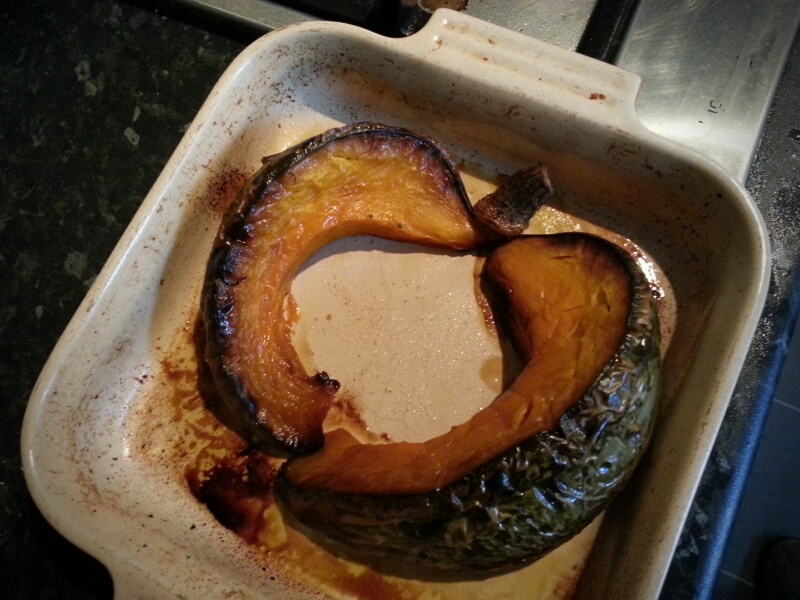
Begin by roasting the pumpkin in a little olive oil until soft – around 30 minutes at 180⁰C (350⁰F). When cooked, remove from the oven, cool, remove skin and mash to a pulp.

FxCam_1360684693650

Mix the flour, oatmeal, mixed spice and sugar in a bowl, then crumble the fresh yeast on one side of the bowl, and spoon the salt one the opposite side. Make a well in the centre and pour in the water along with the olive oil. Notice that I have given the weights of liquids here – I’ve taken to doing this with all my baking recently; you can be much more accurate that way. (For most water-based liquids one millilitre weighs one gram. You can thank Elizabeth David for that one.) Lastly, add the cool pumpkin.

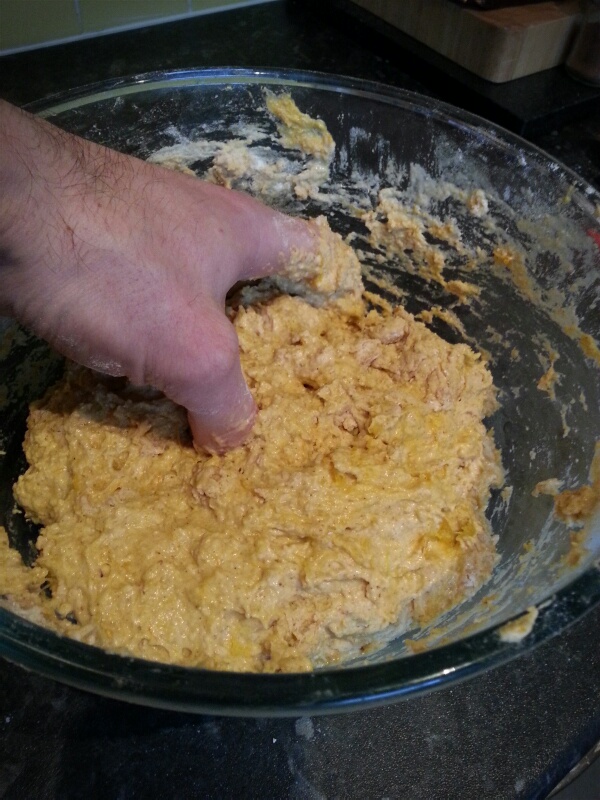
Using you hand, mix everything to a sticky dough – it will be very sticky but don’t worry.

FxCam_1360685406730

Rub a teaspoon or two of olive oil on your work surface and turn out your dough onto it; the oil makes it easier to knead without it all becoming a hideous sticky mess. Keep kneading and adding more oil if need be. If all this seems like too much effort and mess, use the dough hook on a food mixer instead.

When the dough is smooth, do a final kneading on a little flour, then pop into a clean bowl that has been lightly coated with oil to prevent sticking. Cover with Clingfilm (other plastic wraps are available) and allow to ferment away until it has at least doubled in size.

Knock back the dough and shape into two loaves – you can do round cobs on a greased baking sheet or in greased tins, whichever you prefer. i used two cake tins so that my cobs would keep some shape.

FxCam_1360697841988

Cover and allow to prove. Make appropriate cuts and dustings of flour or oatmeal. When doubled in size put into a cold oven. Set the temperature to 220⁰C (425⁰F) and leave for 15 minutes. Turn the heat down to 180⁰C (350⁰F) and bake for a further 15 minutes. Allow to cool on a rack completely before breaking into it.

FxCam_1360707421659

6 Comments

Filed under baking, bread, Britain, cooking, Eighteenth Century, food, history, Recipes, Vegetables