
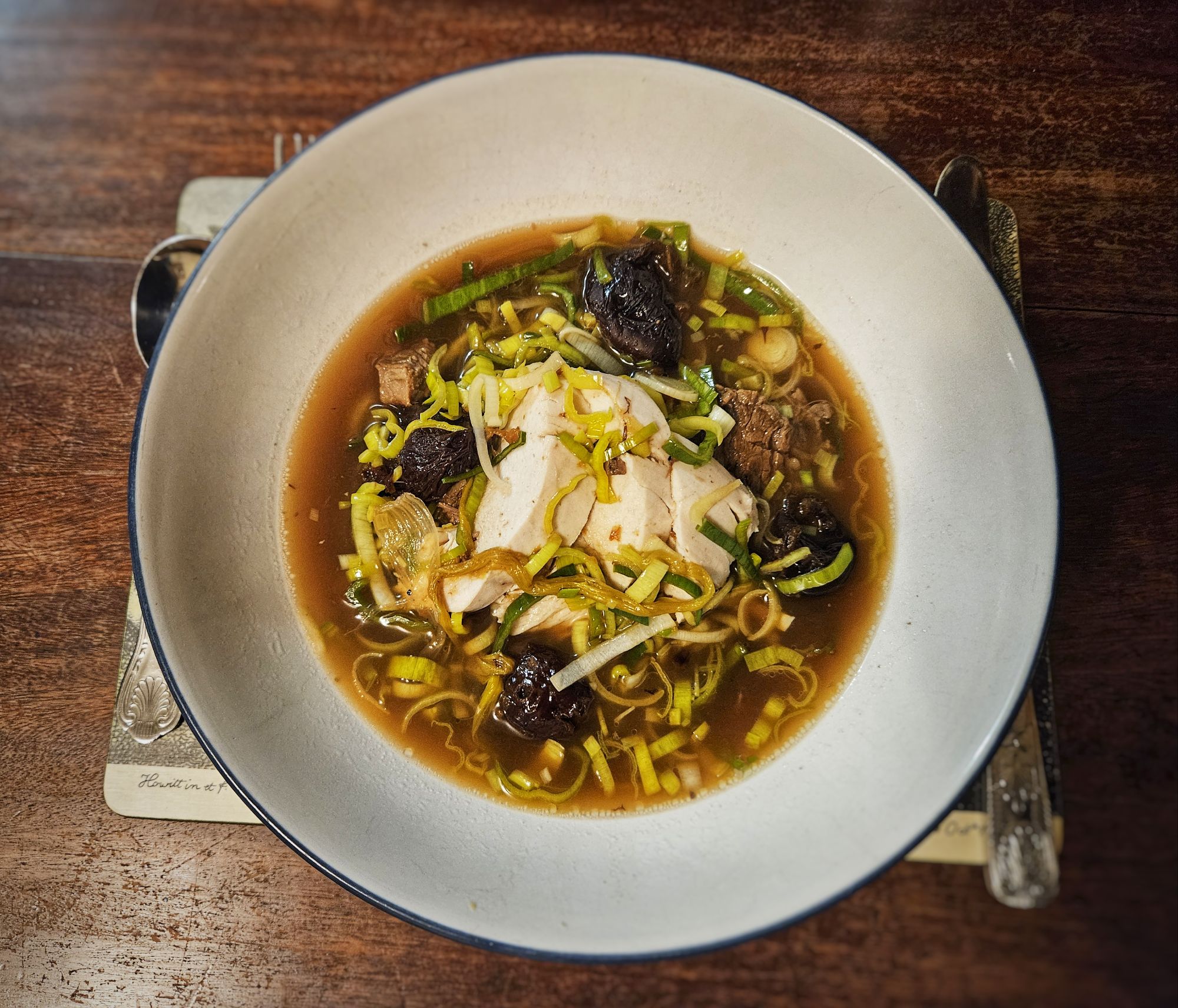
Conjure up an image of a bowl of cock-a-leekie soup; what pops into your mind? Are you thinking of an umami-rich broth of chicken, leek and beef, enriched with unctuous prunes, or a watery can of Baxter’s with soggy leeks and a suggestion of chicken? If I were asked this as a child, it would be the latter, but today I am glad to say that it is the former!
Cock-a-leekie is one of the best of the world’s chicken soups. Actually, it might be the best – made properly. It’s a cornerstone not only of Scottish cuisine but also of the rest of Britain; recipes for cockie-leekie crop up in both English and Welsh cookery books. The traditional recipe used a cockerel or boiling fowl; a tough bird with lots of flavour, lots of leeks and usually some beef or beef stock. Today, I use a well-flavoured oven-ready free-range chicken.
Recipes vary to some degree, but many include prunes – I think they are essential, not just for their sweetness but also the viscosity they give to the broth itself. Meg Dods used shin of beef and uses lots of trimmed leeks: ‘The soup must be very thick of leeks…boiled down into the soup till it becomes a green lubricous compound.’ She considered the practice of adding prunes an ‘obsolete’ one.[1] In The Scot’s Kitchen (1968), F. Marian McNeill uses beef or veal stock in place of meat. Regarding prunes, she approves: ‘I am all for the addition of prunes, to be served one in each plate.’[2]
In England, things go a little awry. For example, in Alexis Soyer’s A Shilling Cookery for the People (1855), there is a recipe for ‘New Cock-a-Leekie’. What makes it ‘New’? Well, it contains no chicken. The reason given in the book, written in the style of two friends corresponding with each other, was that ‘I found I had all that was required, barring the bird’. It ‘deceived not only my husband, but my friend from the other side of the Tweed.’[3] The cock-a-leekie that appears in the 1883 edition of Cassell’s dictionary of cookery is very delicate: chicken and leeks poached in white (veal) stock with rice,[4] which seems more like invalid food rather than a hearty meal.
On the subject of this wonderful soup, Dorothy Hartley wrote that the Scots have kept this fine old soup unchanged through the centuries. (I don’t like to think what would happen to any foreigner who tried to tamper with Cockaleekie.)’[5] She had obviously never read Soyer or Cassell!
I have adapted my recipe from Jane Grigson’s English Food (1993). I have cooked it many times, both at home and professionally. It is very simple but requires good quality ingredients (including plenty of prunes). There are disagreements regarding how one should serve cock-a-leekie. Again, I go with Jane’s advice:
The correct way of serving cockie-leekie is to put a slice of beef, a bit of chicken, some prunes, leeks and soup into each bowl.[6]
If you can, support the podcast and blogs by becoming a £3 monthly subscriber, and unlock lots of premium content, including bonus blog posts and recipes, access to the easter eggs and the secret podcast, or treat me to a one-off virtual pint or coffee: click here.
Recipe
This recipe makes a huge amount of soup. Any leftover soup is even more delicious heated up the next day or the day after that, and it freezes very well.
The amount of salt added may appear startling, but remember that we are adding plain water, not stock, so it really does need it. Trust me.
Served with a couple of slices of well-buttered wholemeal bread, this is a complete meal.
Ingredients
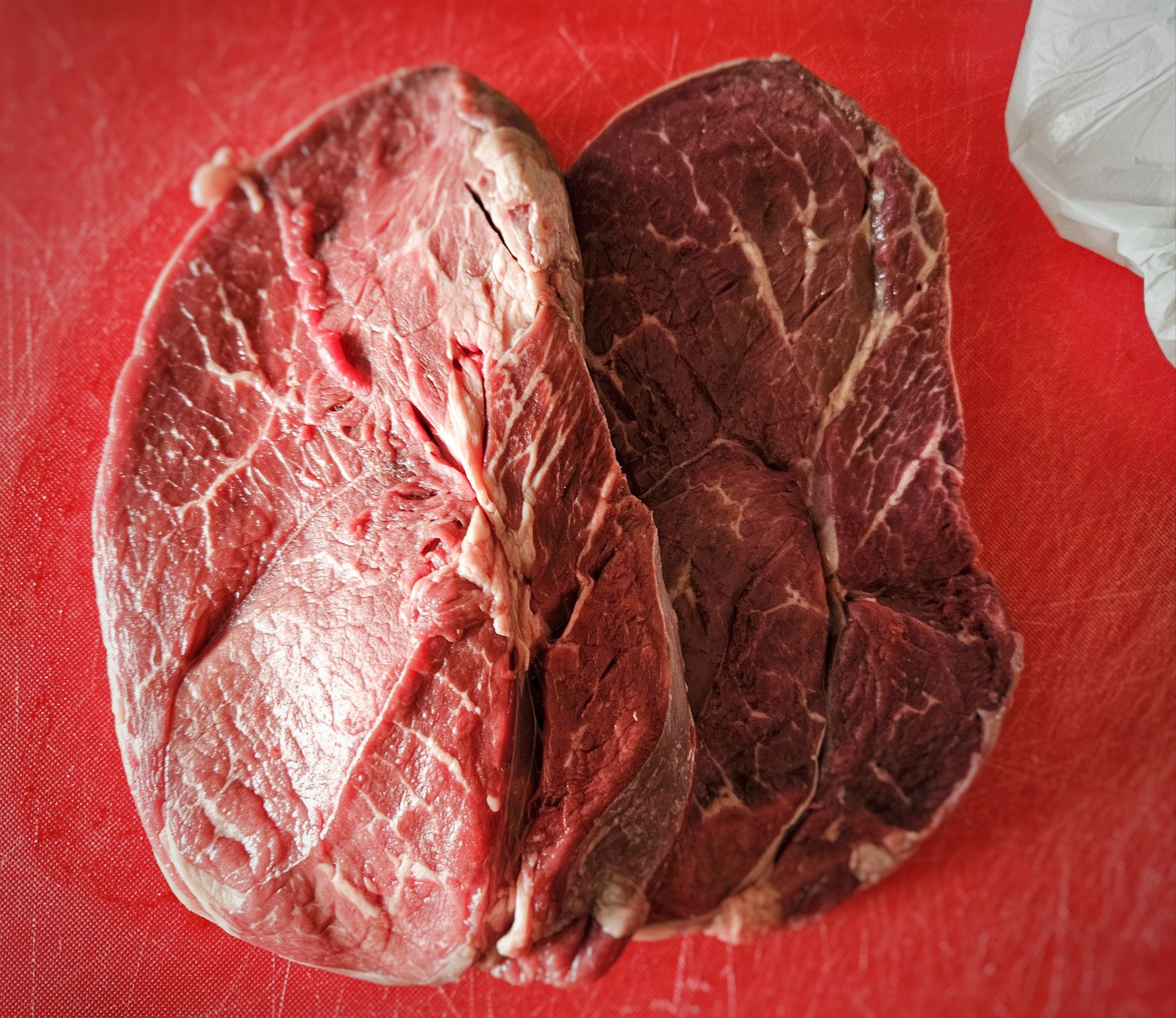
1 kg braising steak
3 litres water
4 tsp salt
1 medium-sized chicken
6 good-sized leeks, trimmed
500 g stoned prunes
Freshly ground black pepper
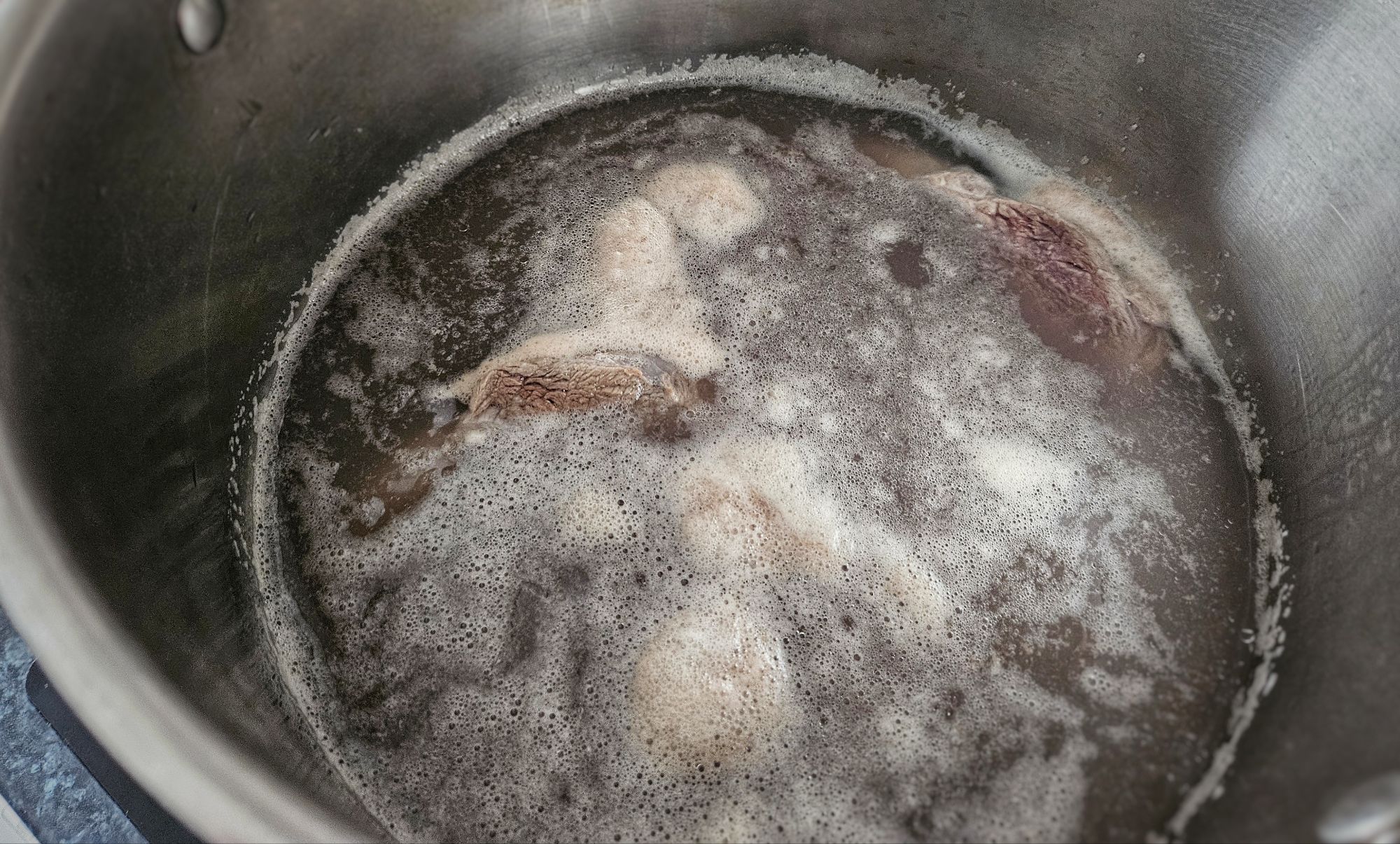
Place the braising steak in the bottom of a stockpot, pour in the water and add two teaspoons of the salt. Cover, set the heat to medium and allow it to come to a bare simmer. The slower you do this the better. As it reaches simmering point, some grey and unappetising scum might float to the top. It is normal for this to happen; simply skim it off with a spoon or drainer. Turn the heat down so that the meat simmers gently for one hour.
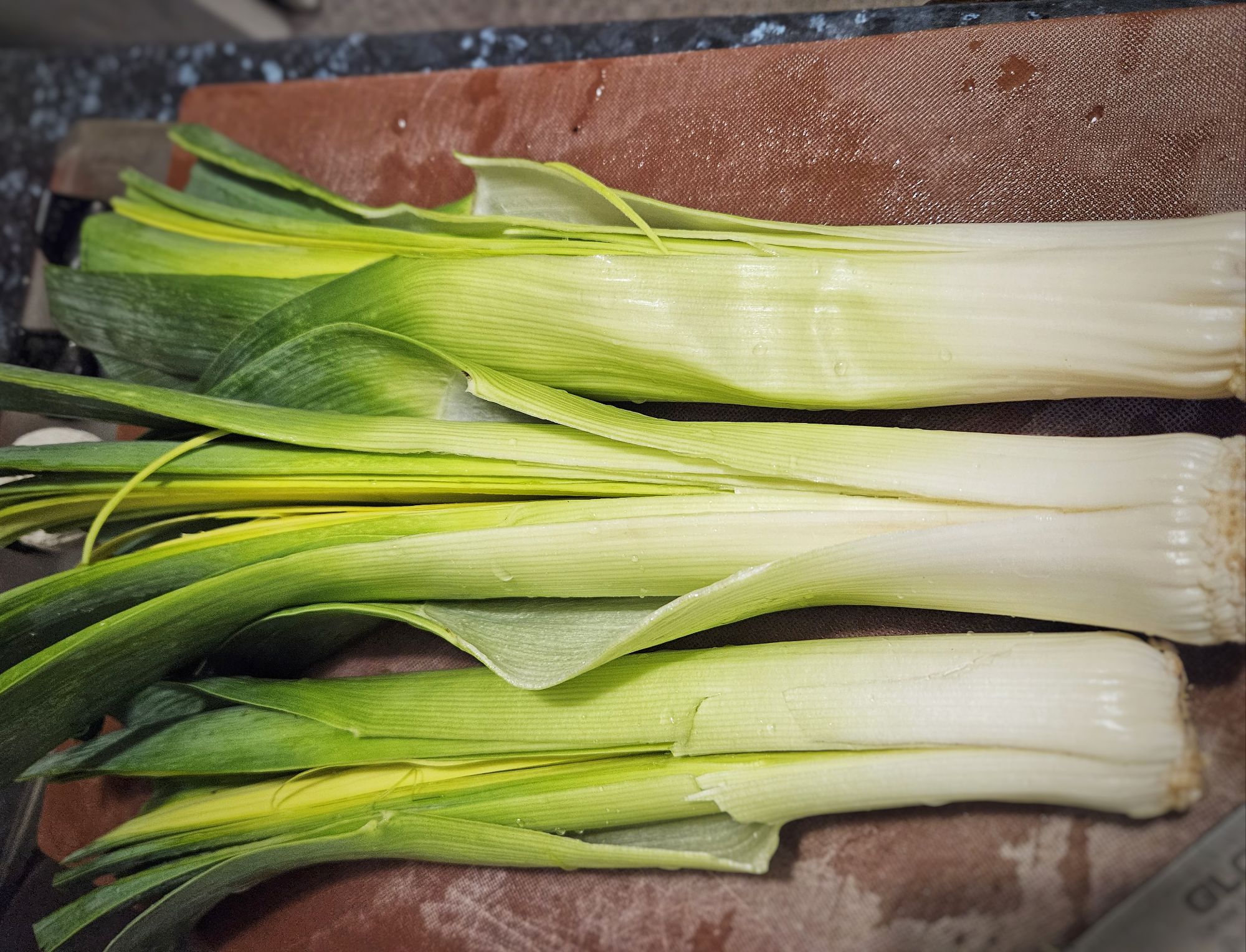
Meanwhile, take the chicken out of the fridge (if you haven’t done already). Prepare the leeks by trimming away any tatty pieces of green, then split them lengthways around halfway down and rinse them under the cold tap, then leave them to drain upturned in the sink. Once they have drained for around 20 minutes take half of the leeks and tie them together with a piece of string. When the hour is up, add them, the chicken and the prunes, the rest of the salt and a good few turns of the pepper mill.
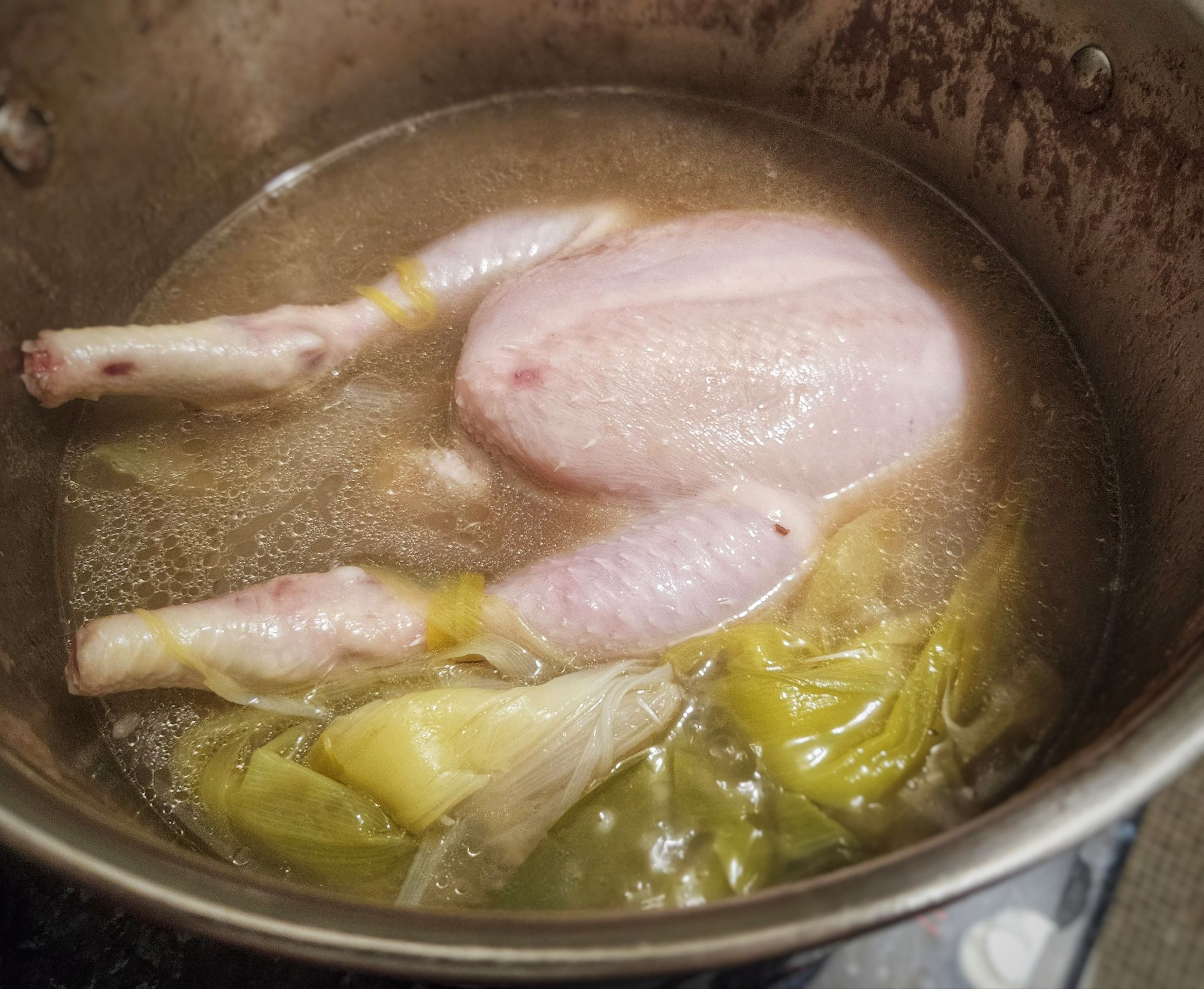
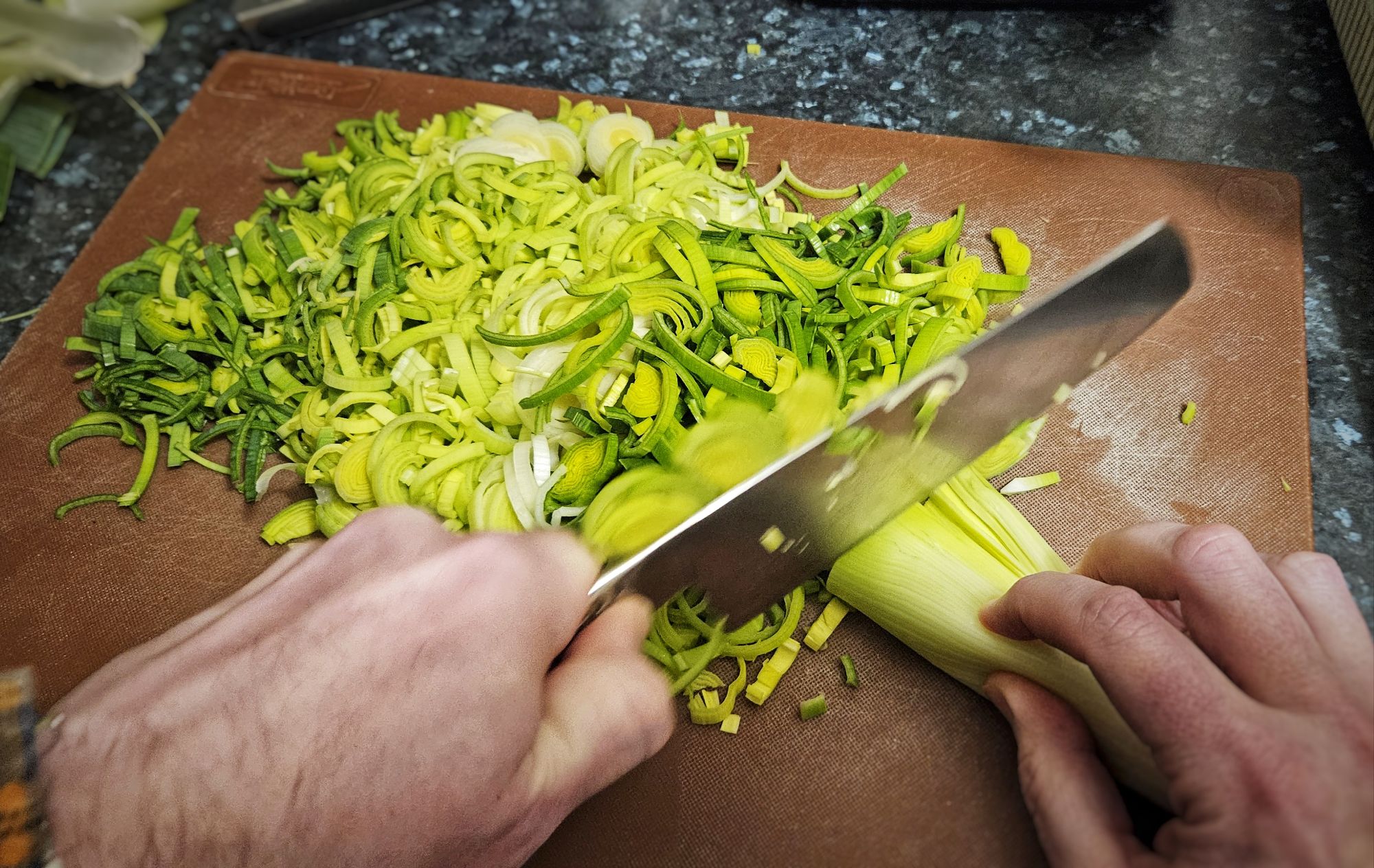
Cover, bring the water back to a simmer and cook gently for another hour. Meanwhile, slice the remaining leeks very thinly.
When the second hour is up, remove the leeks (all of their flavour will now be in the stock), taste and check the seasoning – you may need a little more salt. Add the thinly sliced leeks and simmer for 5 minutes only – you want them to remain a little crisp.
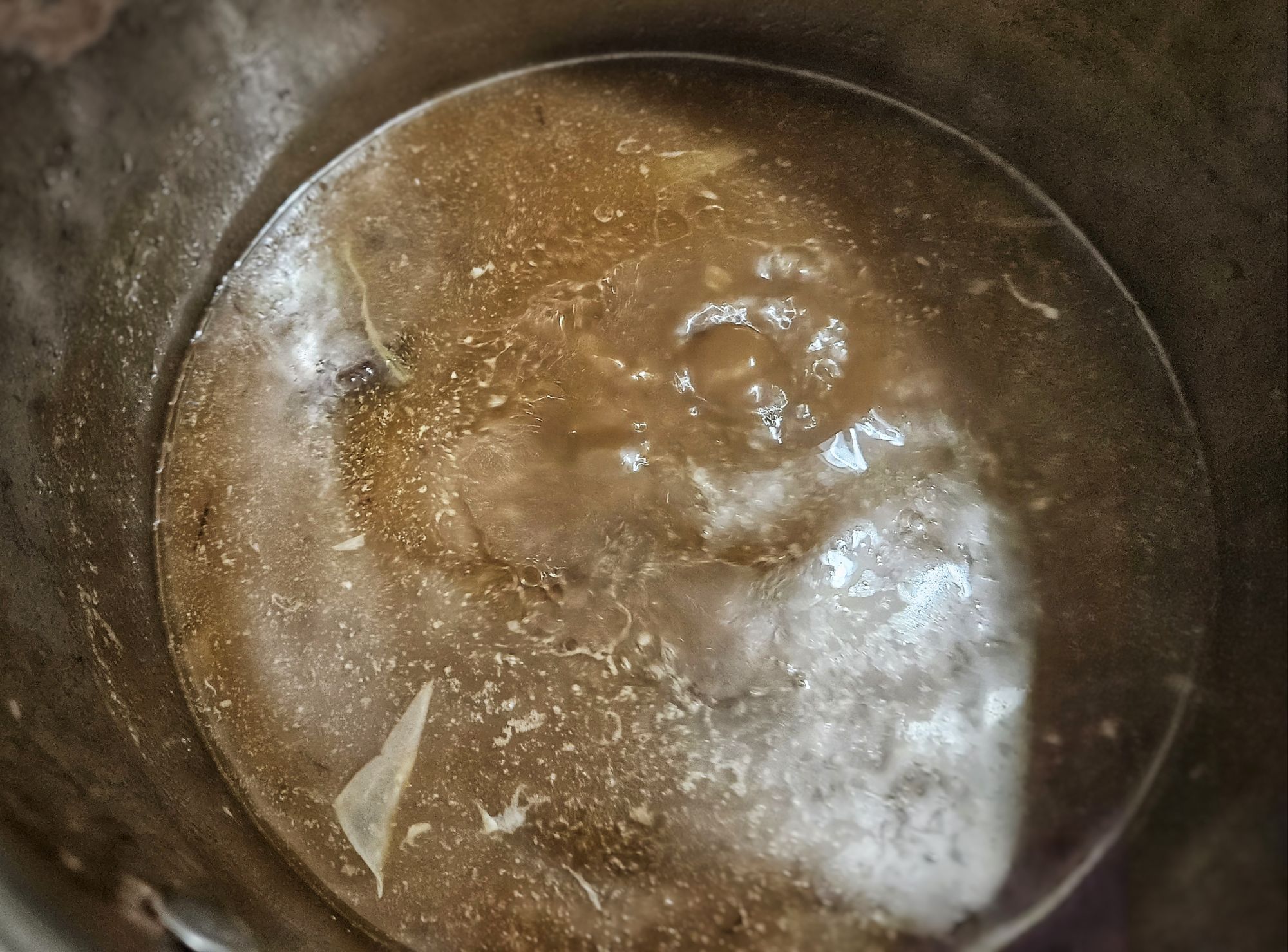
Now serve the soup: gingerly fish out the chicken and carve it. It’s important to leave it for a good 15 minutes, covered, so it can cool a little bit before you attempt this. Inspect the chicken carcass for any other decent meaty bits. Then fish out the beef and cut that into good-sized pieces. You can return the prepared meat to the soup and have everyone help themselves, or arrange some pieces of carved meat at the bottom of several soup bowls and then ladle the soup over them.
Notes
[1] Dods, M. (1847) The Cook and Houswife’s Manual. 8th ed. Oliver & Boyd. Alan Davidson was of the opinion that the soup may have its origins in the Middle Ages as a soup of chicken, onions and raisins. Davidson, A. (1999) The Oxford Companion to Food. Oxford University Press.
[2] McNeill, F.M. (1968) The Scots Kitchen: Its Lore & Recipes. 2nd ed. Blackie & Son Limited.
[3] Soyer, A. (1855) A Shilling Cookery for the People: Embracing an Entirely New System of Plain Cookery and Domestic Economy. Geo. Routl. Geo. Routledge & Co.
[4] Cassell (1883) Cassell’s dictionary of cookery. Cassell, Petter, Galpin & Co.
[5] Hartley, D. (1954) Food in England. Little, Brown & Company.
[6] Grigson, J. (1992) English Food. Third Edit. Penguin.


Very interesting recipe.
How sweet does this taste, with all those prunes?
LikeLiked by 1 person
I think the prunes make it really delicious and give the broth a smoothness. Definitely not too many!
LikeLike