Category Archives: cooking

‘Knead to Know: A History of Baking’ talk now on YouTube

Hello everyone. I do hope your Bank Holiday Weekend is going swimmingly and that you are enjoying the sunshine (& showers!).

I have uploaded my ‘Knead to Know’ Zoom talk from September last year to my YouTube channel. I know there were several people who couldn’t make it on the night. It’s completely unedited except for the Q&A section at the end.

I talked about how I approached writing Knead to Know: A History of Baking by asking myself, “What is baking?”, a trickier and more philosophical question than you might think; the origins and history of the very first bakers; Early Medieval bread and bakers; Yorkshire Christmas Pyes; and the Denby Dale Pie.

I’ll be adding more content to my channel throughout the year, so please give it a follow if you are a YouTube user: click here to view and follow the channel.

Knead to Know: A History of Baking is published by Icon Books and is available from all good bookshops.


If you like the blogs and podcast I produce and would to start a £3 monthly subscription, or would like to treat me to virtual coffee or pint: follow this link for more information. Thank you.


Leave a comment

Filed under baking, Books, bread, cooking, food, General, history, Teatime

Four Scone Recipes

You know what it’s like; you go to the home baking aisle of the supermarket and pick up a bag of flour, thinking ‘I’m sure I’m running low’, buy a bag, only to find there is, in fact, a large bag sitting, unopened, in the pantry. Unsure what to do with them, I asked social media whether I should make some scones, saffron buns or lardy cake with it (three recipes I have been meaning to post for years now). The answer came in: 3-way tie. I shall endeavour to do all three for you over the next month or so.

Up first, then, are scones, the must-have for a modern Cornish or Devonshire cream tea. I have written about cream teas both on the blog and in my book Knead to Know, the excerpt of which you can find on my YouTube Channel.

This is the recipe I used when I had both my restaurant and artisan market stall, so it is very tried-and-tested. I have provided some variations for you beneath the method: cranberry and orange, cheese, and walnut and Stilton. When the restaurant was open, we served a savoury cream tea using a cheese scone, swapped clotted cream for cream cheese and exchanged the jam for curried beetroot chutney or onion marmalade.

Classic recipes – especially Scottish and Irish ones – use buttermilk instead of plain milk. As buttermilk is increasingly difficult to get hold of these days, I’ve used milk, but you can swap the two. If you do, use 15 g bicarbonate of soda instead of 25 g baking powder. One final thing: I use strong white flour instead of plain to give the scones a boost in the oven, again, not traditional; in fact, it was a trick picked up from Paul Hollywood in his book 100 Great Breads. This doesn’t mean you can knead the dough roughly as though it is for bread; you still have to use a light touch with mixing, rolling and cutting out. Hopefully, my method will help you achieve great results.

I’ll follow soon with a post on the history of scones.


If you like the blogs and podcast I produce and would to start a £3 monthly subscription, or would like to treat me to virtual coffee or pint: follow this link for more information. Thank you.


Basic Scones

A note on measuring liquids: 1 ml of milk weighs 1 g, so it’s easier – and much more accurate – to weigh it on scales rather than reading the graduations on the side of the measuring jug.

Makes 12 to 15 scones.

500 g strong white flour, plus extra for dusting

30g baking powder

½ tsp salt

75g butter

75g caster sugar

80g quartered glacé cherries, raisins or currants (optional)

200 ml/g whole milk

2 medium eggs

Egg wash: 1 egg or egg yolk beaten with ½ tsp salt

Granulated or Demerara sugar for sprinkling

Preheat your oven to 200°C.

In a bowl, mix flour, baking powder and salt and rub in the butter – you can use the flat beater attachment on your mixer with this, or good old fingertips. Stir in the sugar and fruit (if using).

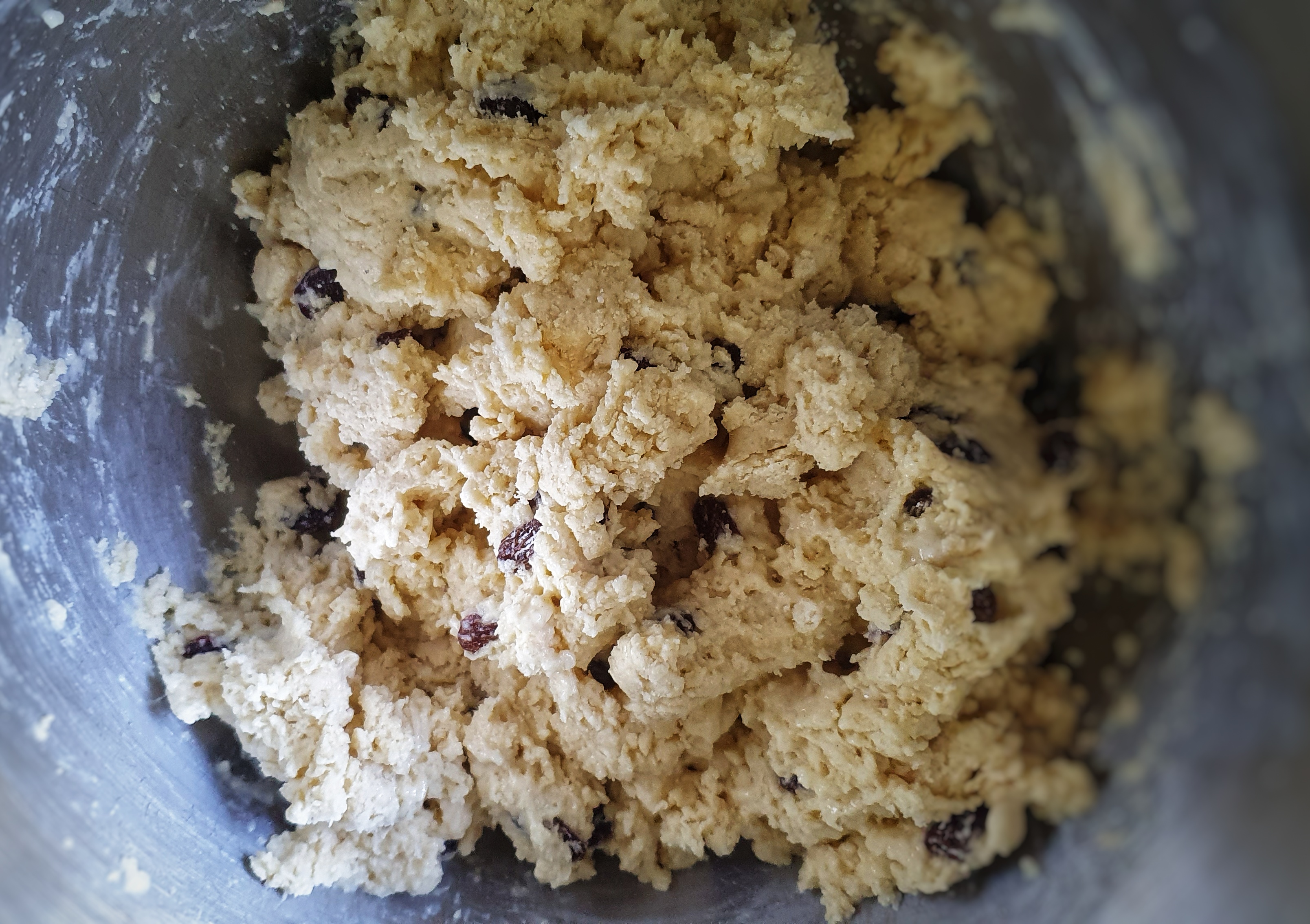
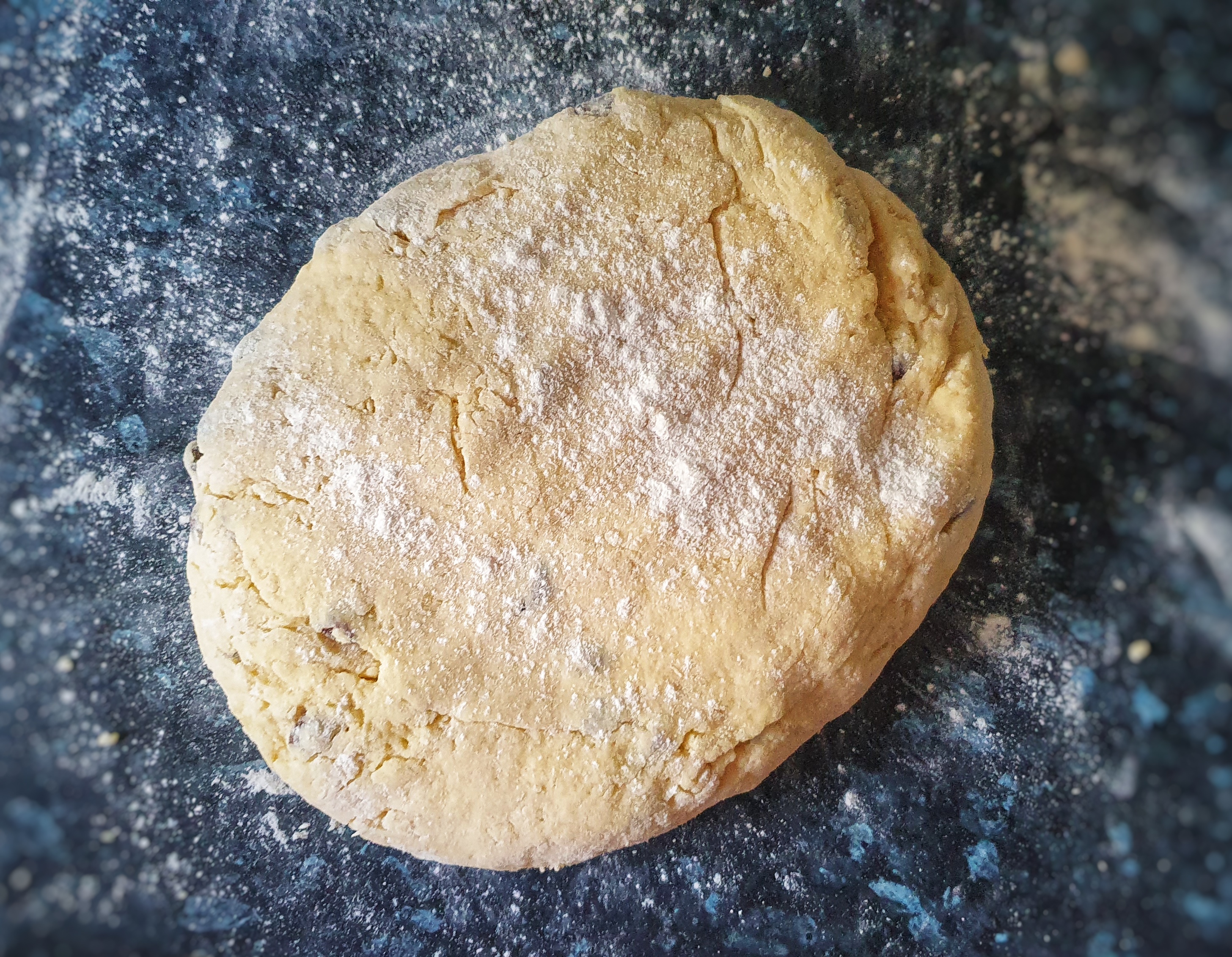
Beat the eggs with the milk, and steadily mix the liquids into the dry ingredients. If using a mixer, keep it at a slow speed. Make sure all the flour is incorporated, bring the dough together and give it a brief knead on a floured worktop until the dough is smooth.

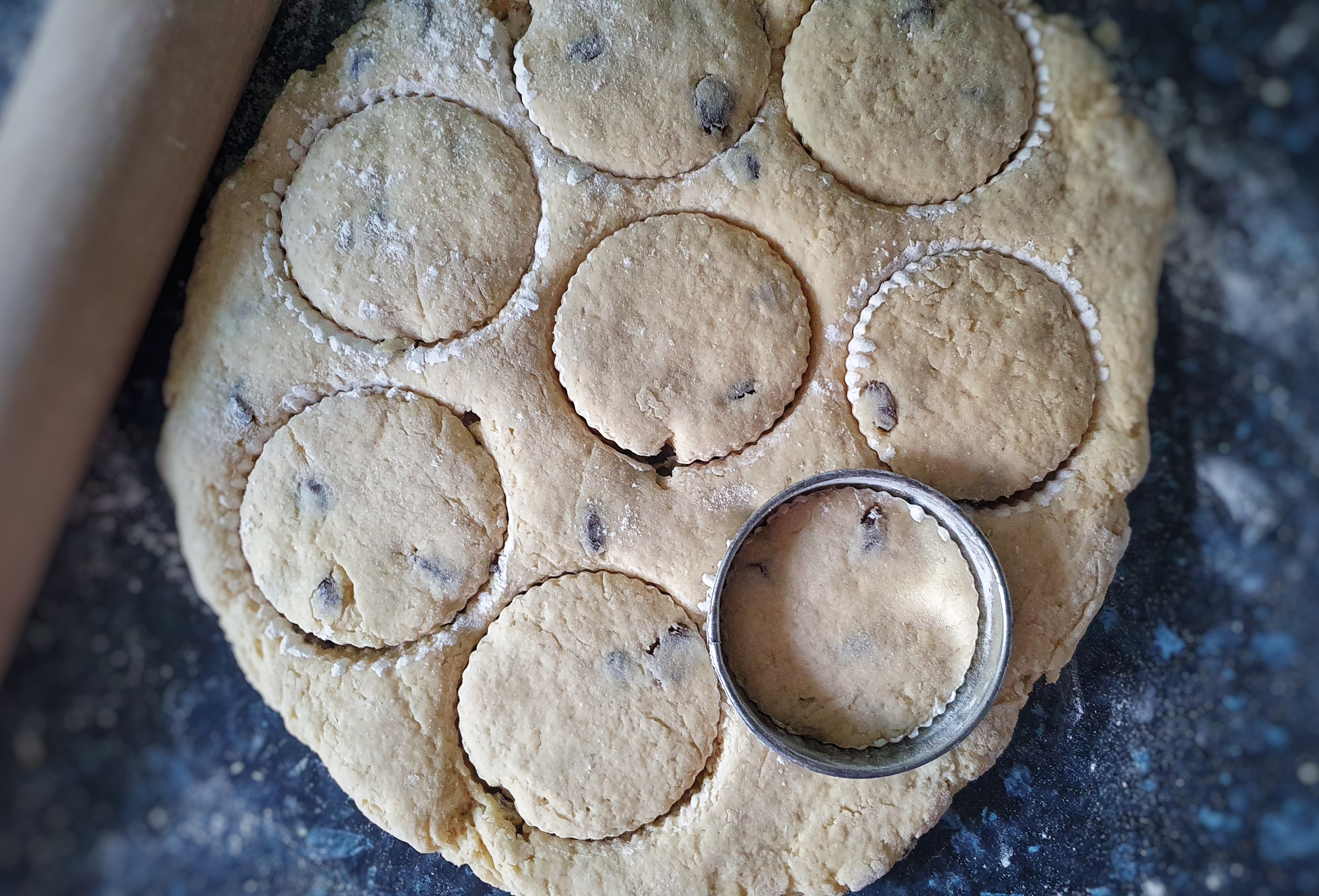
Keeping your worktop floured, roll out the dough to a thickness of 1.5 to 1.75 cm (a generous ½ inch), and cut out into rounds. I normally use a cutter of a diameter between 7 and 8 cm. It is important to take care when cutting: make sure you dunk your cutter in more flour and tap off excess before cutting. This is important because if there are splodges of sticky dough on the cutter, it will seal the edges of the scones, preventing a good rise. Also, don’t be tempted to twist your cutter, as this will have a similar effect. Arrange the cut-out scones on 2 lined baking sheets.

Bring the leftover dough together with your hands to form a cohesive dough without kneading it too much – we don’t want tough scones! Roll out again and cut out. Repeat until all of the mixture is used up.

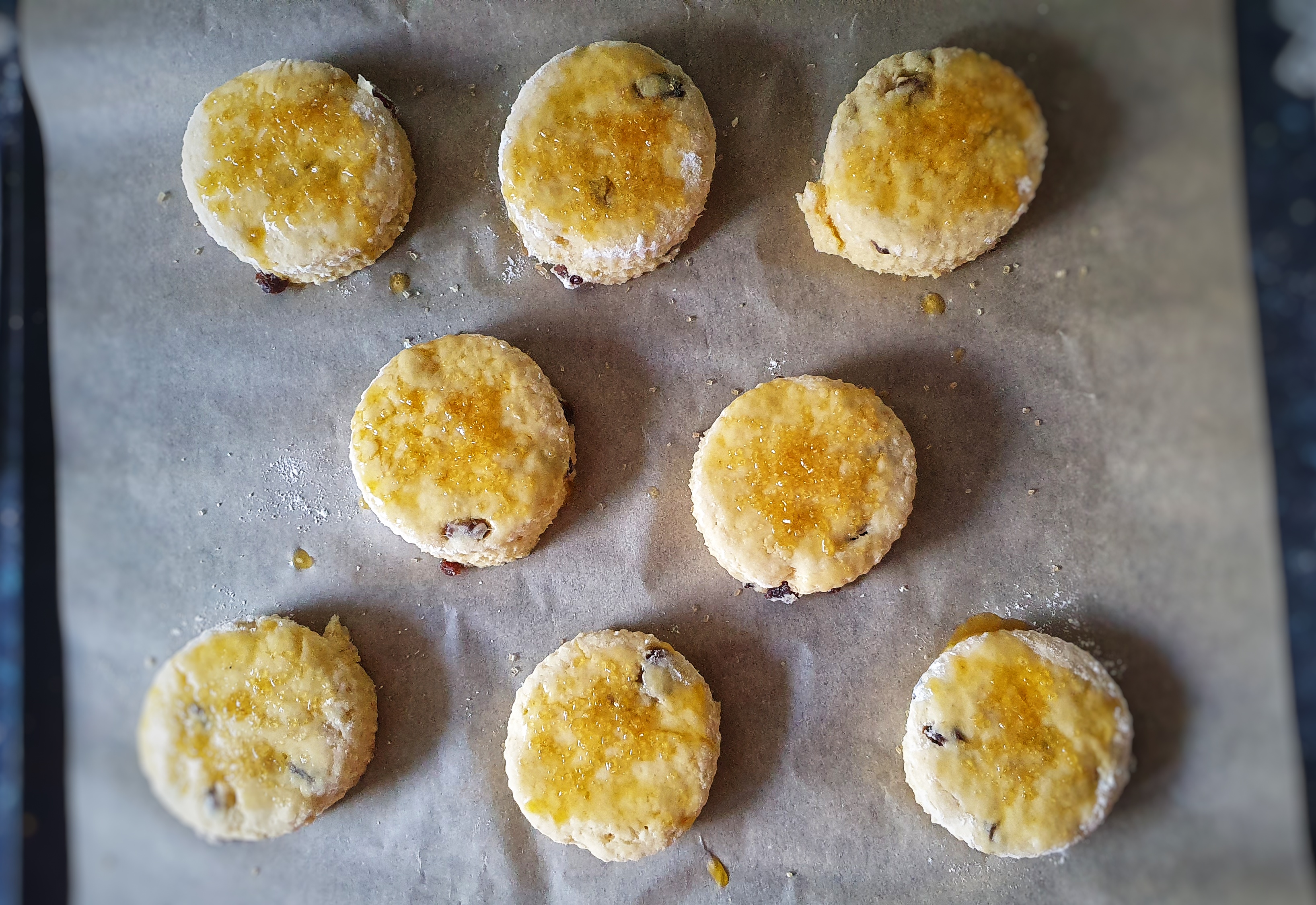
Brush with egg wash being careful not to let any dribble down the sides – again, this will hamper the rising of the dough – then sprinkle with sugar. Bake for 15-20 minutes until golden brown and well risen. If there is uneven browning at the 10-minute mark, switch the trays around in the oven.

Cool on a rack.

Scones are best enjoyed on the day or the day after they are made. They do freeze well. Enliven them by popping them in the microwave for 10 to 20 seconds.

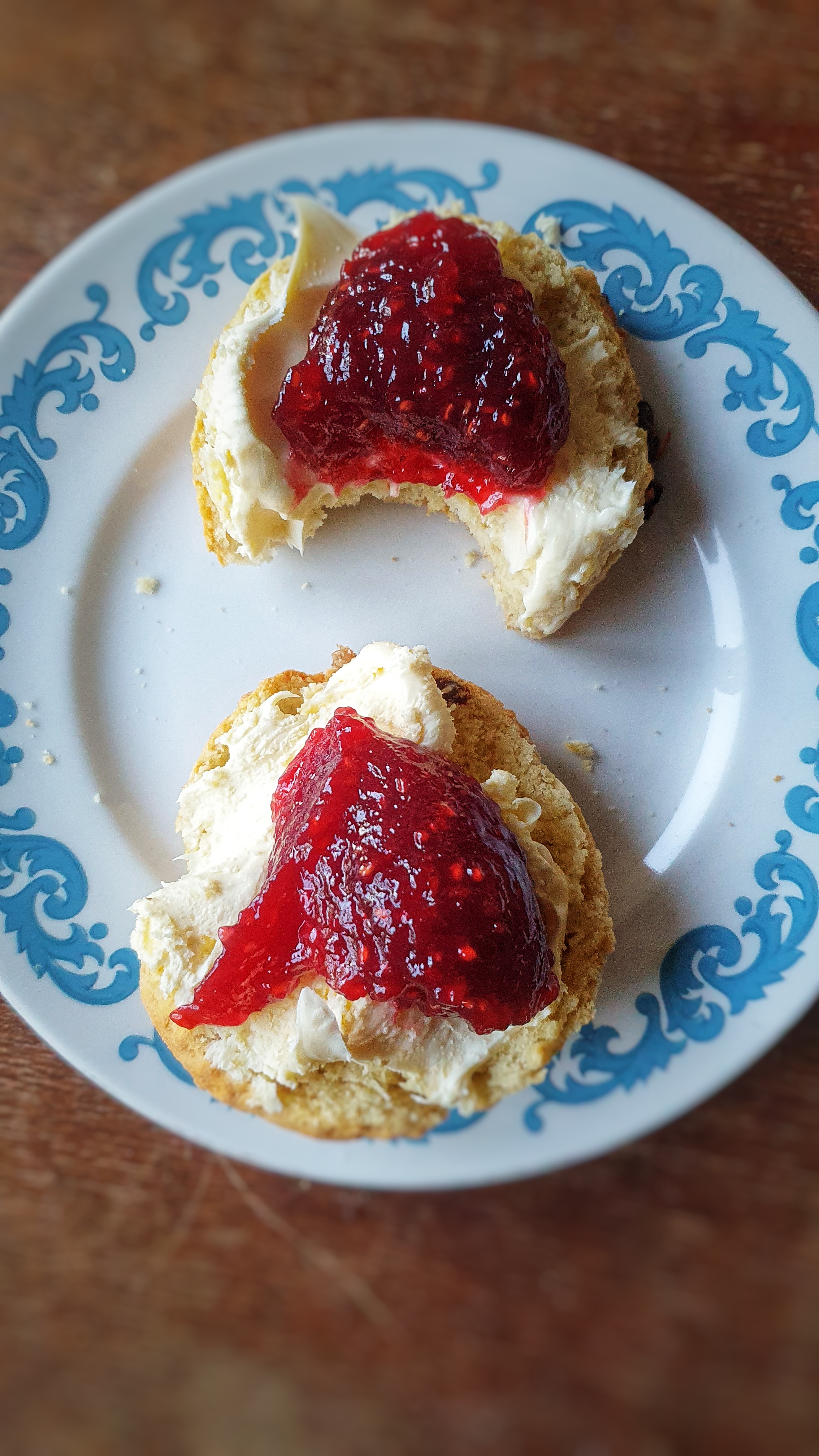
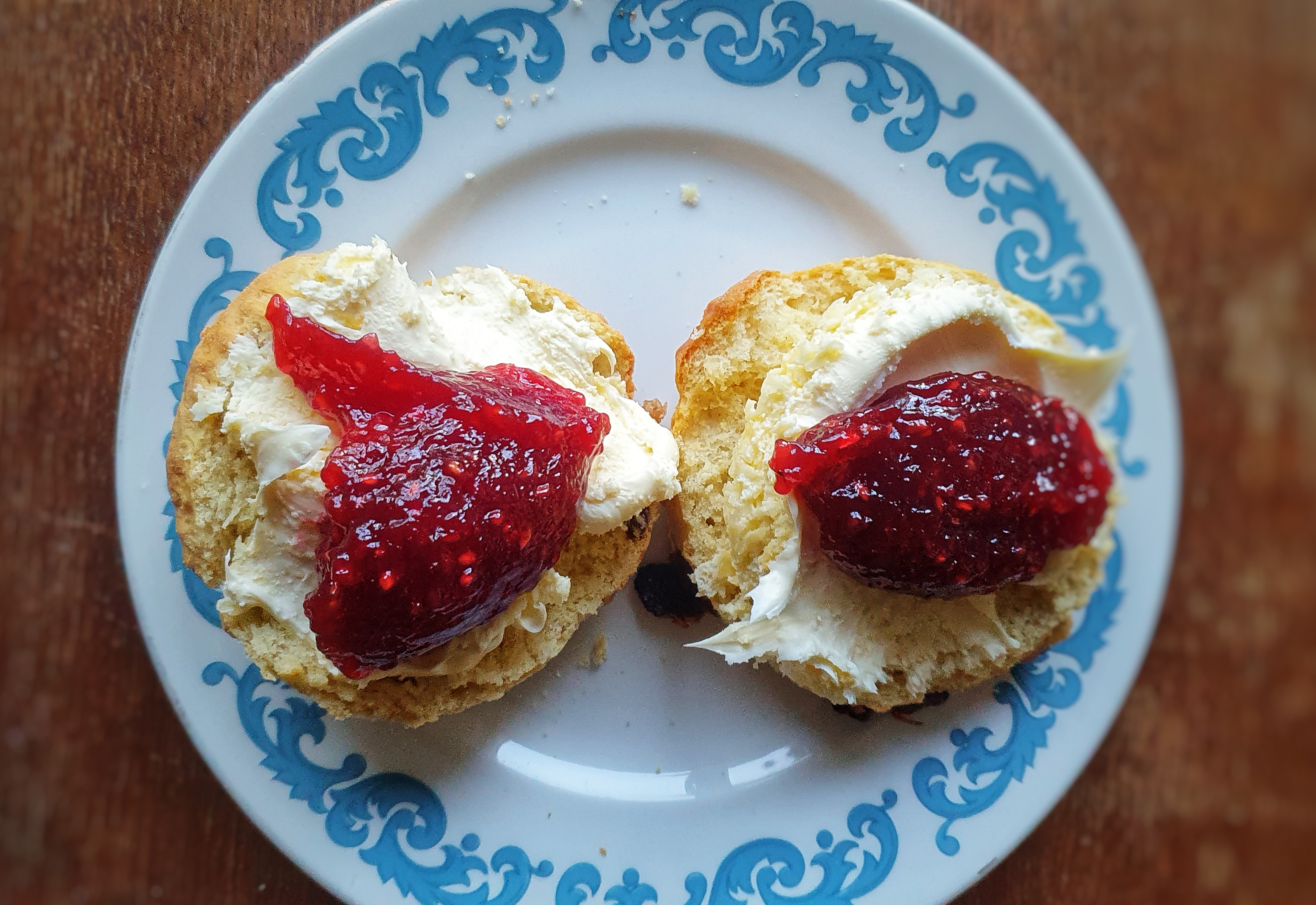
Eat with butter or clotted cream and jam.

Variations

Cranberry and Orange

Make as above, but add the zest of two oranges to the dry ingredients, and use dried cranberries instead of raisins or currants. Juice the oranges, pour into a measuring jug and top up with milk to 200ml/g.

Classic cheese scones

Use just 25 g caster sugar, and add 100 to 125 g grated Cheddar cheese once the flour has been rubbed in. If you like, you can add ½ teaspoon of dried herbs and a good pinch of Cayenne pepper. Use 230 g/ml of milk instead of 200 g/ml. Sprinkle some finely grated cheese (Parmesan is good) over the egg-washed scones before they go in the oven.

Walnut and Stilton scones

As above, but use 100-125 g grated Stilton and 80 g chopped walnuts

7 Comments

Filed under baking, cake, cooking, food, General, Recipes, Teatime, Uncategorized

Season B of ‘A is for Apple’ has begun!

Hello everyone, hope your February isn’t looking too gloomy. Here’s something to cheer you up: news that season B of A is for Apple: An Encyclopaedia of Food & Drink has kicked off.

For those not in the know A is for Apple is a podcast hosted by Sam Bilton, Alessandra Pino and me. Each season we take a letter and focus on it; last time we did A, so now we are doing B. We all present a very short piece about our chosen topic and then discuss it. There’s usually a theme to the episode, but Sam (who was the head host in episode 1) was kind and gave us a free choice. I chose berries, Sam chose the Banting diet, and Alessandra bananas. It’s available to listen to on all podcast apps, just search for “A is for Apple” and hit subscribe. If you’re not a podcasty person, here’s a Spotify inbed for you:

For my piece I interviewed Rachel Webster, Curator of Plants at Manchester Museum, and quickly following episode 1 was the uncut interview talking about berries, flowers and fruits – and comes with some gob-smacking facts! Listen here:

You can also follow the podcast on Substack for free: click this link to check it out. There are bonus recipes and other bits and bobs to be found there.

Next episode Alessandra is in the driving seat and she gave us a theme: Places. What places beginning with B would you choose!?

Leave a comment

Filed under cooking, food, General, history, Podcast, Uncategorized

To make a Bakewell tart

At the end of 2024, I gave you my recipe for Bakewell pudding. The plan was to follow with my recipe for Bakewell tart. Alas, life, Christmas and then a holiday to New Zealand got in the way.

But I always get around to things eventually and I give it to you today!

The Bakewell tart, despite it being dearly loved by Brits, was originally made as a cheap, dumbed-down version of the rich Derbyshire pudding: the puff pastry swapped for shortcrust, and the buttery almond filling swapped for an almond-flavoured sponge cake.

I write about the histories of the Bakewell pudding and tart in Knead to Know: A History of Baking, so pick up a copy if you want to know more.

I have been using this recipe for years now and it’s a real crowd-pleaser. When the restaurant was open, I served this tart warm with a lemon-flavoured cream and received a big bear hug from a diner: there could have been no better seal of approval in my book! The secret to its success is that I make a frangipane rather than a sponge cake filling, bound together with just a tablespoon of flour.


If you like the blogs and podcast I produce and would to start a £3 monthly subscription, or would like to treat me to virtual coffee or pint: follow this link for more information. Thank you.


Recipe

Makes 1 x 21 cm/8 inch tart

For the sweet shortcrust pastry:

200 g plain flour

100 g salted butter, diced (or half-and-half butter and lard)

50 g caster or icing sugar

1 egg, well beaten

Cold water (see recipe)

For the filling:

100 g salted butter, softened

100 g caster sugar

2 eggs

100g ground almonds

30 g self-raising flour

¼ tsp almond extract

3 or 4 tbs raspberry jam

30 g slivered almonds

First, make the pastry: Place the flour and fat(s) in a mixing bowl and rub the fat in until the mixture resembles fresh breadcrumbs. You can do this by hand using fingertips or with the flat beater of a stand mixer on a slow speed. Make a well in the centre and add most of the egg. If using a stand mixer, slowly mix it in, pouring more egg into any dry patches. If doing by hand, use a butter knife to mix (this prevents overworking of the dough). You should have a cohesive dough that can be brought together with your hand – if it does seem dry, add a tablespoon of cold water.

Knead briefly, cover and allow to rest in the fridge for 20 to 30 minutes. Meanwhile, preheat your oven to 180°C and place a baking tray on the centre shelf

On a lightly floured work surface, roll out the pastry to the thickness of a pound coin, and use it to line an 8”/20 cm loose-bottomed tart tin or ring.[1] Prick the base with a fork and place it back in the fridge to firm up.

Now make the filling: using a hand beater or stand mixer, beat together the soft butter, caster sugar, eggs, almonds, flour and extract until smooth.

Take the pastry out of the fridge and spread jam over the bottom leaving a centimetre gap all around the inside edge. Spoon or pipe the mixture first around the edges and then the centre (this stops the jam from rising up the sides of the pastry lining), levelling off with a spatula.

Sprinkle with the slivered almonds and slide the tart onto the hot baking sheet and bake for 40 minutes, turning the heat down to 160°C if the top gets too brown. Cool on a rack, and remove from the tin when just warm.


[1] You will find that there is excess pastry – make some nice jam tarts or turnovers.

10 Comments

Filed under baking, Britain, cooking, food, General, Puddings, Recipes, Teatime

Recipe: Brussels Sprouts with Bacon and Prunes

Subscribe to get access

This post and it’s accompanying podcast episode are for £3 monthly subscribers. If you would like to become a subscriber and access this post and all the other premium content on the blog click this link.

As a £3 monthly subscriber you get access to my Easter eggs page, special premium blog content, receive a monthly newsletter, and – most importantly – you support the running of my podcast and blog.

1 Comment

Filed under Britain, Christmas, cooking, Festivals, food, General, Recipes, Uncategorized

My Foolproof Roast Potatoes

I told my social media followers that my Christmas recipe this year was going to be roast turkey and I said that I would also provide the recipes for two sides. I provided four options: roast potatoes, Brussels sprouts, bread sauce and cranberry sauce/jelly. Roast potatoes received the most votes so here we go.[1]

I believe that the roast potatoes are almost as important as the roast meat, perhaps more important. Whether it’s the Christmas dinner or the weekly Sunday roast, if you mess up the roasties, everyone will be sad, and there’s a good chance you’ll be forever shunned by friends and family.

So I provide you with my method. It’s tried and tested and I reckon foolproof! Don’t worry about precise weights/volumes of ingredients or sizes of roasting trays; this recipe is most adaptable so use what you have. What is important, however, is the type of potato used and the fat or oil in which they are cooked.

The potatoes must be of the floury type: Maris Piper, King Edward and Albert Bartlett varieties are easy to find in the supermarkets, but for me the supreme variety of spud when it comes to roasting is the Alouette. It’s technically a waxy potato, but when roasted the centre is like the creamiest mashed potato. It’s not widely available in supermarkets, but keep a look out at greengrocers and farmers’ markets; you will not be sorry should you happen upon some and buy a kilo or two. I bought mine from Unicorn in Manchester.

Next, we need good fat or oil. I used approximately equal amounts of lard and rapeseed oil. All solid animal fats are good: beef dripping, goose fat and duck fat are great alternatives – they all have high smoking points and make for a crisp potato. As for plant-based oils, you must avoid olive oils completely and go for high smoke point ones like rapeseed, groundnut or sunflower. Avoid the solid, white vegan fats, they are bad for you and the environment. You don’t have to go half and half either, you can use all oil or all animal fat: I vary it depending on what oils and fats I have in the store cupboard/fridge.

Anyway, let’s get to it.


If you like the blogs and podcast I produce and would to start a £3 monthly subscription, or would like to treat me to virtual coffee or pint: follow this link for more information. Thank you.


Recipe

Make sure to use a deep roasting tin and that it is big enough to fit all of the potatoes in a single layer. Notice too there are no herbs thrown in, but if you want to add some be my guest.

If making roasties for the Christmas dinner, you can slide the tray of oil or fat into the oven as soon as the turkey comes out.

Good, floury potatoes, peeled

Salt

Plant-based oils and/or solid animal fats

Preheat your oven to 190°C (if you followed my turkey recipe, the oven will already be at this temperature). Add enough oil or fat to the tin so that it comes to a depth of between 0.5 to 0.75 centimetres. Slide it into the oven to get nice and hot.

Angular cuts make for crispier roasties

Cut your potatoes into good-sized pieces[2] making cuts at angles so that there are sharp, angular pieces: the pointier, the crispier; the crispier the better.

Get a large pot of water that had been liberally dosed with salt boiling and add the potatoes. Cover and bring back to a boil, and once boiling again, set a timer for 6 minutes.

When the time is up, strain the cooking water and allow the potatoes to steam dry for a few minutes, then place them back in the pan, cover the lid and give them a good shake to fluff up the edges (wear oven gloves, don’t get a steam burn). Leave the lid off the spuds again so that they can steam a little longer. You can do this stage well in advance if you like – even the previous day.

Fluffed and ready for the oven!

Gingerly remove the roasting tin and place the potatoes in the oil, spacing them out in a single layer. Use a pair of tongs to help. Slide the roasting tin back into the oven. After 15 minutes turn them over, and keep turning them every 15 minutes or so until crisp on the outside and cooked through the centre. It will take around an hour.

Using tongs, place in a warmed serving dish or bowl and serve.


Notes

[1] Sprouts came second – recipe coming very soon.

[2] I’m not going to dictate to you what a good size is; it’s all down to personal preference, but as a guide, medium potatoes get cut into quarters or sixths, and larger ones into eighths.

1 Comment

Filed under Britain, Christmas, cooking, food, General, Recipes, Uncategorized

Roast Turkey and Giblet Gravy

A very bronzed roast Copas turkey: butter is the only way to get this deep, delicious colour.

This blog post complements the recent episode of The British Food History Podcast called Turkey with Tom Copas.

If you feel inspired to order a Copas turkey, you need to get your order in by 16 December to avoid disappointment.

In the episode, we discussed the best way to roast turkey and we concluded that as long as you baste the bird and calculate the cooking time properly, it will be delicious. Tom even says that there’s no need to cover the turkey with bacon. While I agree with him, I do like the crispy bacon and the delicious, perfectly seasoned juices that come from the roasting turkey. My way of roasting turkey is very similar to how I cook a chicken.

What we didn’t discuss is the giblets! Please don’t waste them, they can be turned into lovely rich gravy when combined with the roasting juices. It’s important to get the giblet stock on about 45 minutes before the turkey goes in the oven (or you could prepare it in advance).

If you want to stuff the turkey, I suggest you stuff the neck only because an empty cavity means quicker cooking and a more succulent turkey.

Right, let’s get to it.


If you like the blogs and podcast I produce and would to start a £3 monthly subscription, or would like to treat me to virtual coffee or pint: follow this link for more information. Thank you.


To Roast a Turkey

You don’t have to use bacon if you don’t want to, but butter is essential. It adds richness, helps the bird keep moist and gives the skin a lovely deep brown colour.

1 free-range turkey

250 g salted butter, softened

Freshly ground black pepper

Around 14 rashers of dry-cured streaky bacon (optional)

Stuffing (optional)

Halved or quartered carrots and parsnips (optional; see recipe)

As soon as you get up on Christmas morning, take the turkey out of the fridge, untruss it, and when it’s time to cook the turkey, preheat your oven to 190°C.

Sit the turkey on a board, legs facing towards you, then make a tear in the skin where the breast starts and lift the skin away from the breast. Don’t rush – you don’t want to tear the skin. Put half the butter between the skin and breast and massage it as far back as possible. If you are using stuffing, add this under the skin too and tuck the flap of neck skin underneath. If there’s not much neck skin, don’t worry, it can be secured with a skewer.

Smear the rest of the butter over the outside of the turkey and season with plenty of black pepper, then lay the bacon over, overlapping each rasher only slightly.

Weigh the prepared turkey and calculate the cooking time: 30 minutes per kilo. A 4.5 kilo turkey will take 2 ½ hours. If cooking for more than 3 hours, cover the legs with foil.

Sit the turkey in its roasting tin, place it in the oven, and leave it for a good 45 minutes before doing anything at all. At the 45-minute mark baste the turkey with any juices; make sure to tip any juices in the cavity into the roasting tin.

Baste every 20 minutes or so. When the bacon is very crispy, remove it and set aside.

If you like you can add some carrots and parsnips, peeled and halved or quartered to braise in the juices. It’s best to do this when there are 90 minutes to go – don’t forget to turn the veg over each time you braise.

90 minutes to go, the bacon has been removed and the vegetables added to braise

When the time is up, you can test with a digital probe: 68°C is the temperature you are looking for. Take the turkey, place it on a carving board and cover with foil. It will happily rest for one to two hours.

When it’s time to carve, remove the legs and separate them into thighs and drumsticks. For the breast, I find the easiest way is to remove one side completely and then slice it thickly. These can be arranged on a warm serving plate, surrounded by the crisp bacon. Only cut into the second breast if the first one goes (it keeps better that way for leftover feasts).

I massaged the stuffing quite far into the turkey’s breast skin, protecting the meat and keeping it juicy

To Make Giblet Gravy

Don’t waste or fear the giblets! The giblets are the heart, neck, gizzard and liver.[1] Use your vegetable trimmings from the veg to make the stock: though avoid brassicas like sprouts.

For the stock:

Heart, gizzard and neck

A knob of butter

Leek greens, carrot peelings, and some celery trimmings, or 2 outer stems of celery

2 cloves of garlic, lightly crushed

Herbs: bay leaves, parsley stalks, rosemary or thyme sprig tied with string

175 ml white wine

Cold water

For the gravy

Giblet stock

Pan of turkey juices

1 tbs cornflour

To make the stock, first cut up the giblets into quarters.

In a saucepan, heat the butter until foaming, add the giblets and fry over a medium-high heat until brown – about 5 minutes. Now add the vegetable trimmings, garlic and herbs and wilt them. Cook until they have picked up a tinge of brown, then add the wine. Stir and scrape any nice burnt bits from the bottom. Add water to just cover the contents, put a lid on and bring to a simmer and cook for around 3 hours, then strain through a sieve into a clean pan (or into a tub if you’re making it in advance).

When it’s time to make the gravy, get the stock nice and hot. When the turkey is cooked and is resting on its board, pour the hot stock into the roasting tin and scrape off all the nice treacly burnt bits, then tip the whole thing back into your saucepan. Skim away most of the buttery juices.[2] Bring to a simmer and then add the cornflour which has been first slaked in a little cold water. Stir and simmer unlidded for 10 minutes.

Check the seasoning, though usually I find that the bacon and the salted butter from roasting the turkey have done it for me. Pour the gravy into a jug. You can pass it through a sieve, but I never do. Easy!


[1] Use the liver for the stuffing, or fry it and eat it on toast. You could devil it – recipe for devilling livers can be found here.

[2] But don’t throw the fat away, it can be used for frying vegetables for sauces or soup.

6 Comments

Filed under Britain, Christmas, cooking, Festivals, food, General, history, Meat, Recipes

To make a Bakewell pudding

I was at the Foyles Winter Evening on the 28th of November promoting The Philosophy of Puddings. It was at their flagship Charing Cross Road store, adjacent to Soho, and it was all very exciting. To draw folk in, I brought two puddings from opposite ends of the pudding spectrum: a nice, but very sweet, Bakewell pudding and a very savoury black pudding. I’m sure you can guess which was the most popular (by the way, tune into this podcast episode to hear about my gaff involving Rick Astley and the black pudding).

I promised I would post the recipe for a Bakewell pudding because it went down so well at the event. A Bakewell pudding is different from a Bakewell tart: the pudding is made up of a puff pastry case, a layer of raspberry jam, and then a sweet mixture of melted butter, eggs, sugar, and ground almonds. It’s very sweet and seems to be derived from a tribe of puddings called transparent puddings.[1]

The recipe for Bakewell pudding is a closely-guarded secret held by the several bakeries in Bakewell who reckon they have the original recipe. I won’t go into the history of the pudding here, it can all be found in the Philosophy of Puddings and Knead to Know.[2] However, Sheila Hutchins provides a recipe in her excellent 1967 book English Recipes and Others which she obtained from ‘Mr Oulsnam, the cook at the Rutland Arms in Bakewell where the pudding was said to be invented’.[3] There are recipes too in Jane Grigson’s English Food (1992) and Regula Ysewijn’s Pride and Pudding (2015). The first recipe appears in Eliza Acton’s Modern Cookery for Private Families (1845), and it doesn’t have a crust, and is made with egg yolks, not whole eggs.[4]

One of several bakeries in Bakewell that reckon they have the true original Bakewell pudding recipe

All of the recipes vary slightly, but I have gone with something that resembles the modern version, though my filling has a higher proportion of ground almonds than the Rutland Arms recipe (but not too much because it begins to veer on Bakewell tart territory. I feel I have the balance just right, but you can be the judge of that.

By the way, the finished pudding isn’t a particularly beautiful-looking thing, it won’t come out of the oven looking like French patisserie, it’s wonky and slightly scruffy but very delicious; as a pudding should be.

Apologies for the lack of a photo of the interior! I was stressed on the night and forgot to take one, but here I am with the pudding in Foyles.


If you like the blogs and podcast I produce and would to start a £3 monthly subscription, or would like to treat me to virtual coffee or pint: follow this link for more information. Thank you.


Recipe

My recipe makes 1 x 23 cm/9 inch (approx.) pudding in a round tin with sloping sides. The great thing about puddings is that they are very forgiving, so if your tin has straight sides or fluted edges, or not exactly the right dimensions, don’t worry, it will be fine.

The pastry is not blind-baked first. To avoid the dreaded soggy bottom put a baking tray in the oven so it can get nice and hot. When the pudding is ready to bake, sit it on the very hot tray which will help crisp it up before it starts to turn soggy.

1 batch of Quick and Easy Puff Pastry

120 g butter

120 g caster sugar

80 g ground almonds

2 eggs

A few drops of almond essence

2 to 3 dessertspoons of raspberry jam

Preheat your oven to 220°C and place a baking tray on the centre shelf.

Begin by rolling out the pastry to the thickness of a pound coin (3 mm approximately). Allow to rest for a couple of minutes before lining the tin with the pastry. Make sure the pastry is tucked into the edges properly and that there are no air bubbles. Trim with a knife or rolling pin (whichever is most efficient – depends upon your tin!) and prick the pastry all over with a fork so that it doesn’t puff up too much in the oven.

Place the lined tin in the fridge so the butter can harden up. Meanwhile, make the filling: slowly melt the butter in a saucepan, as you wait, mix the sugar and ground almonds in a mixing bowl, then the eggs and almond essence. When the butter is just melted beat it into the mixture.

Take the lined tin out of the fridge and spread with the jam, leaving a gap all around the inside edge.

Spoon or pour the mixture, first around the inside edge and then the centre, smoothing over any gaps.

Place in the oven on the now very hot baking tray for 25 to 35 minutes, turning the temperature down to 180°C when the top reaches a nice, deep golden brown (it was around the 20-minute mark for me).

When the centre is set, remove it from the oven and allow it to cool on a wire rack.


[1] Buttery, N. The Philosophy of Puddings. (British Library Publishing, 2024).

[2] Being a baked pud, Bakewell pudding gets mentioned in both The Philosophy of Puddings and Knead to Know: a History of Baking (though different aspects are discussed).

[3] Hutchins, S. English Recipes, and Others from Scotland, Wales and Ireland as They Appeared in Eighteenth and Nineteenth Century Cookery Books and Now Devised for Modern Use. (Cookery Book Club, 1967).

[4] Acton, E. Modern Cookery For Private Families. (Quadrille, 1845); Grigson, J. English Food. 3rd edition (Penguin, 1992); Ysewijn, R. Pride and Pudding: The History of British Puddings Savoury and Sweet. (Murdoch Books, 2015).

4 Comments

Filed under baking, Britain, cooking, food, General, history, Puddings, Recipes

Competition: Win a copy of my two new books!

It’s competition time!

Would you like to be in with a chance of winning a signed copy of both of my new books Knead to Know: A History of Baking and The Philosophy of Puddings? Well here is your chance.

It is very simple to enter: All you need to do is go to the foot of this post, “like” it and leave a comment declaring your favourite Christmastime dessert.

I will select one person at random on 2 December at 7pm GMT. That’s your deadline. Good luck!


If you like the blogs and podcast I produce and would to start a £3 monthly subscription, or would like to treat me to virtual coffee or pint: follow this link for more information. Thank you.


43 Comments

Filed under baking, Books, cake, cooking, Desserts, food, General, history, Puddings, Uncategorized

Two free talks this December (one online & one in person)

Hello there folks. A very quick post just to let you all know that I am giving two free talks this December.

The first is taking place at Manchester Central Library at 6pm on 5 December and is entitled The History of Pies & Puddings. Because it’s December I shall be looking at some festive examples but also a few other favourites. There will also be some of the library’s antiquarian cookery books to view as part of it. Book your spot here.

The second is a free Zoom talk on 17 December at 7pm (GMT) called The Philosophy of Puddings where I will look at the history of this very British food in the kitchen and in our culture. Will any of your favourites be mentioned? Book your spot here.

There are new events cropping up all of the time so make sure that you check the Upcoming Events tab regularly.

Looking forward to seeing some of you there!


If you like the blogs and podcast I produce and would to start a £3 monthly subscription, or would like to treat me to virtual coffee or pint: follow this link for more information. Thank you.


7 Comments

Filed under Books, Britain, cooking, events, food, General, history, Puddings, Teatime