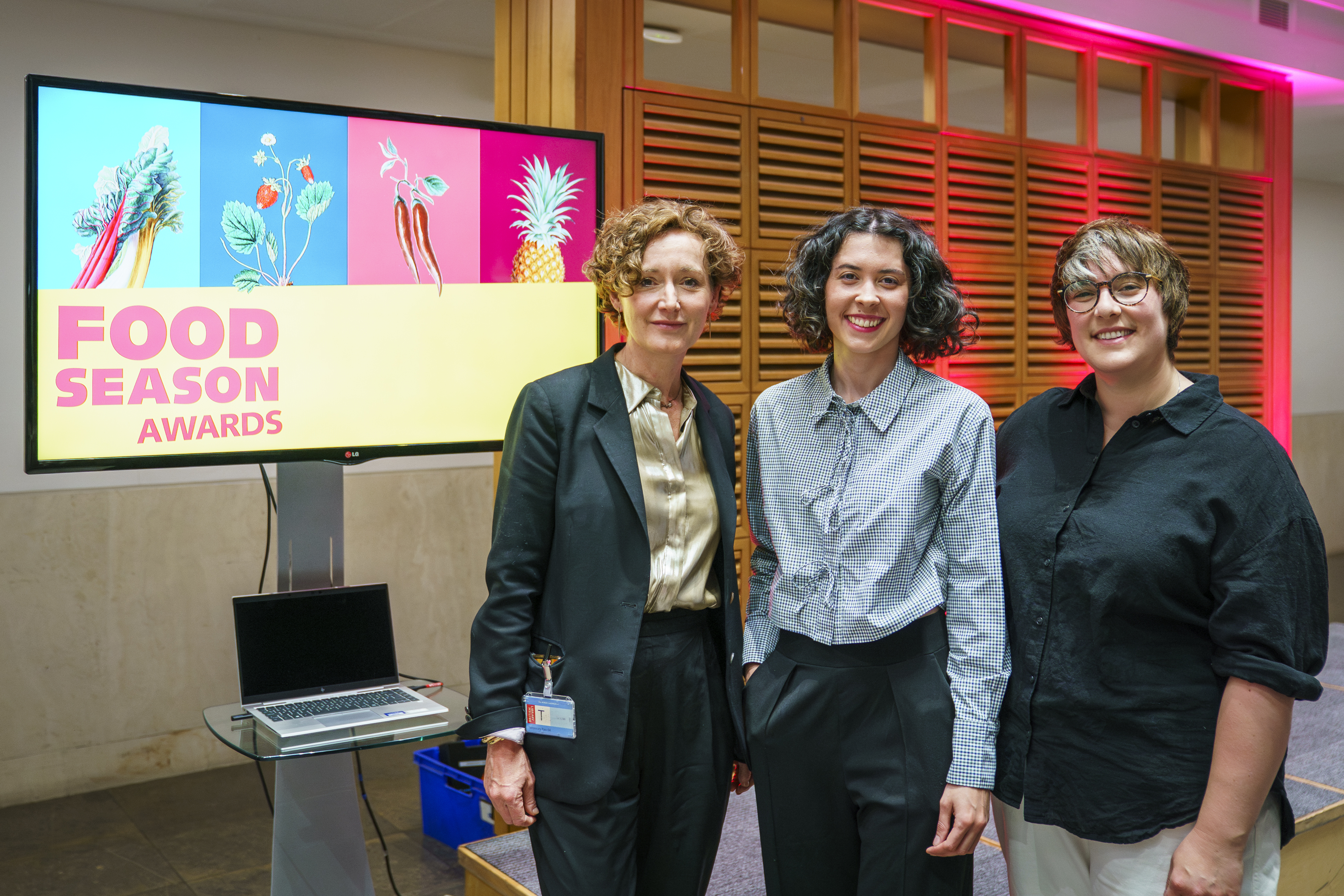
At the Awards! L-R: Nina Lewis, Neil Buttery, Kate Travers, Martin Driscol and Kirsty Hopkinson
I have some very exciting news to share! The project that I worked on with the Museum of Royal Worcester in 2023-2024 won the Food on Display award at the inaugural British Library Food Season Awards on the 9th of June.
The judges were chef, writer and television presenter Nadiya Hussain, Food Historian and Curator at the Library, Polly Russell, Scent Designer and Food Historian Tasha Marks and Elly Magson, Senior Interpretation Manager at the Library. A big thank you to all of them, and we’re so glad the project has been recognised in this way.
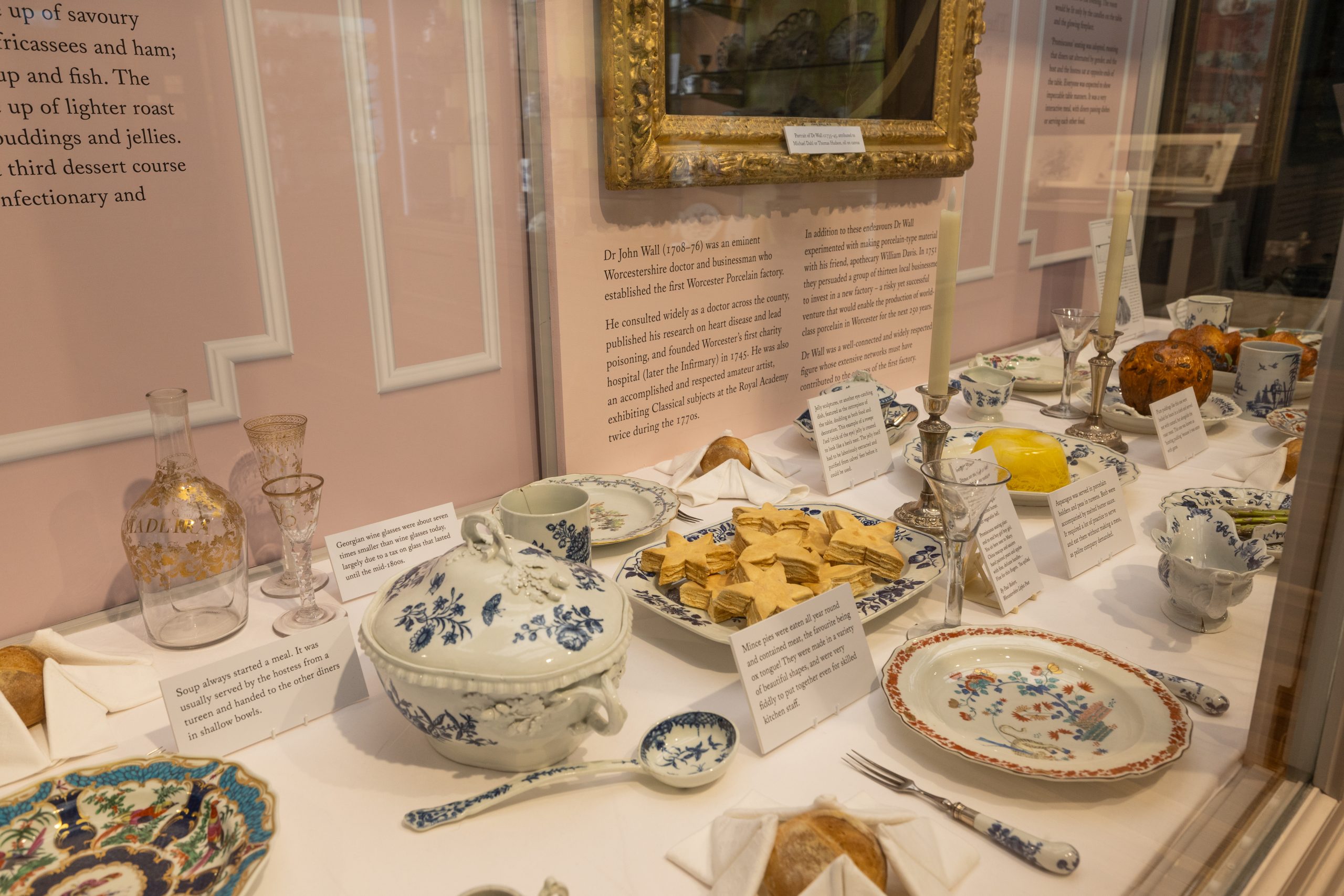
The judges were all drawn to the detail and creativity of Dr Wall’s Dinner at the Museum of Royal Worcester. The display and accompanying programme explored several interesting narratives around Georgian Dining, in a way that was both educational and visually striking. It was a wonderful example of how food can be used to animate a collection and reach different audiences.
Judges (L to R): Polly Russell, Elly Magson and Tasha Marks
There were several elements to the project, including the recreation of an 18th-century dining table, one that the founder of Worcester Porcelain – Dr Wall – might have enjoyed, including some very realistic fake food made by Kerry Samantha Boyes of the Fake Food Workshop in Kirkcudbright, Scotland. I also delivered some historical food workshops, making junkets with Key Stage 2 pupils; historical pies and pasties with the Hospitality & Catering students at the Heart of Worcester College; and plum pudding workshops with adults. A heady mix!
There was too the Worcestershire LitFest & Fringe, who, as a group, took inspiration and created original poems celebrating the ‘Language of porcelain and food’. Many of these are on display in the museum.
A huge thank you to everyone who was involved, especially Natasha Wilcockson who put in so much groundwork bringing together so many different people and keeping us all driving it forward.
The aim of the project wasn’t to show off the lovely porcelain – the museum was already a fantastic job – the aim was to explore the ways in which the porcelain was used and who was interacting with it: from the cooks in the kitchen to the guests sat around the table itself.
To kick off the project, I gave an online talk on the subject which can be watched here:
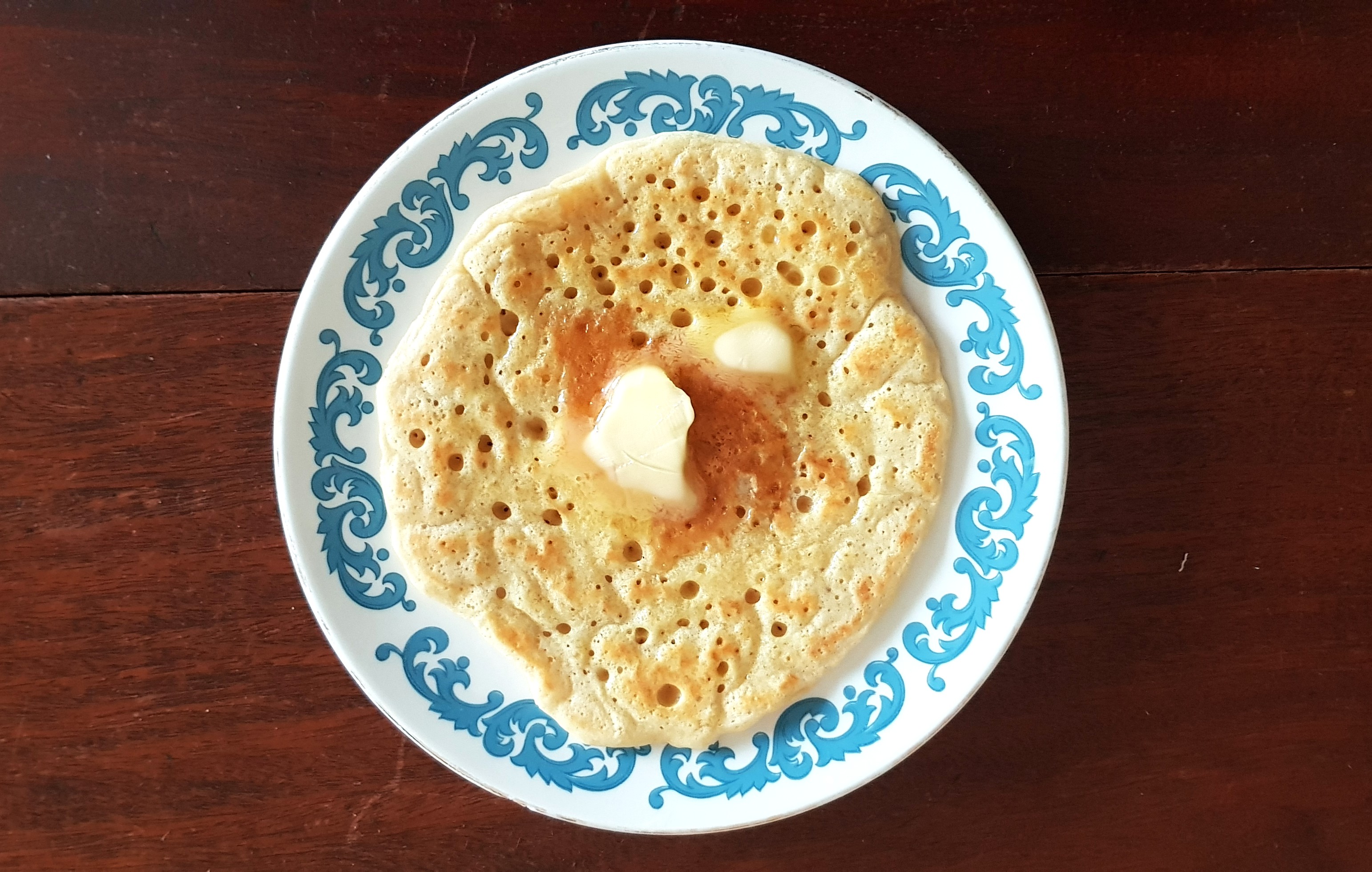
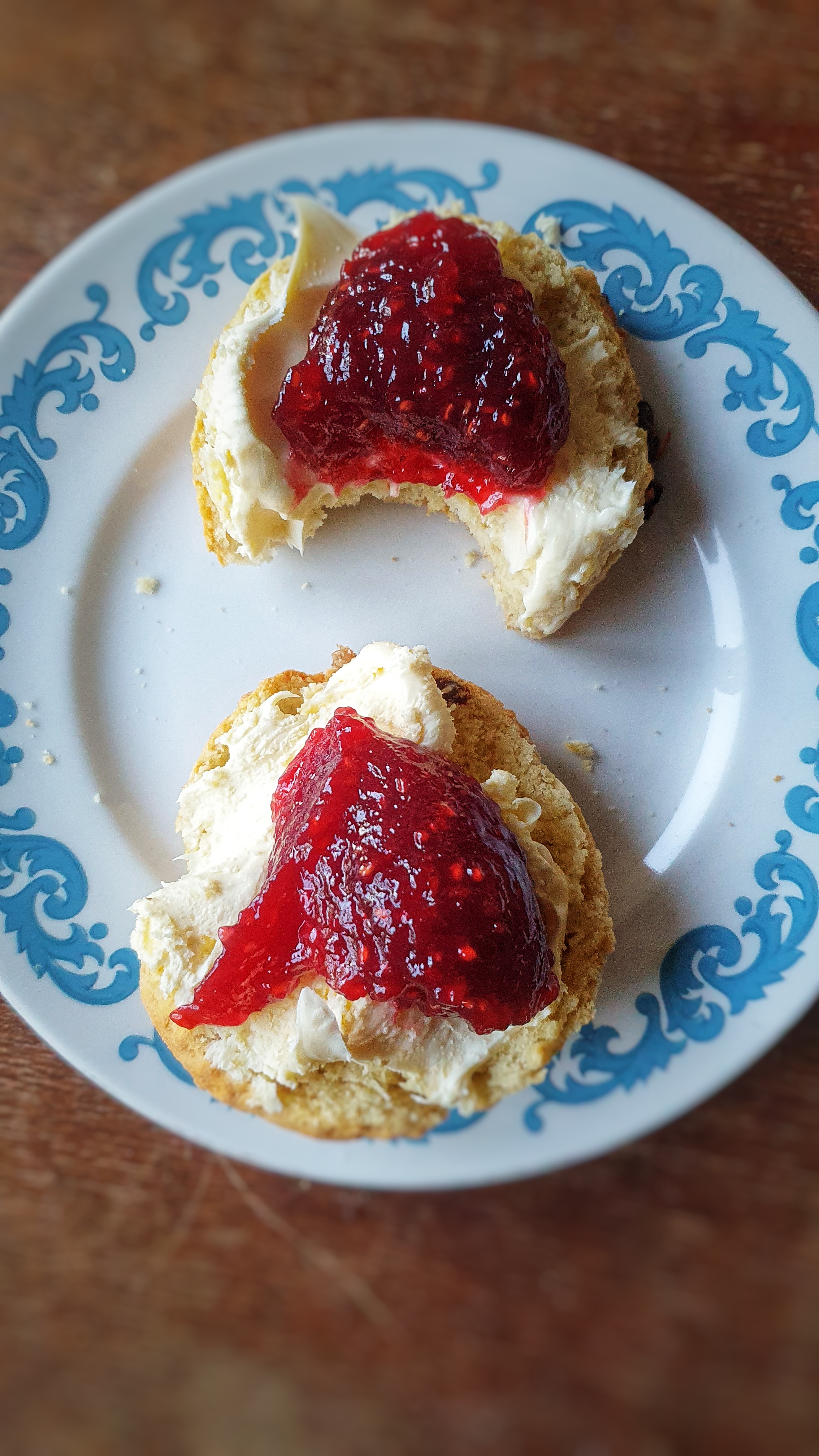
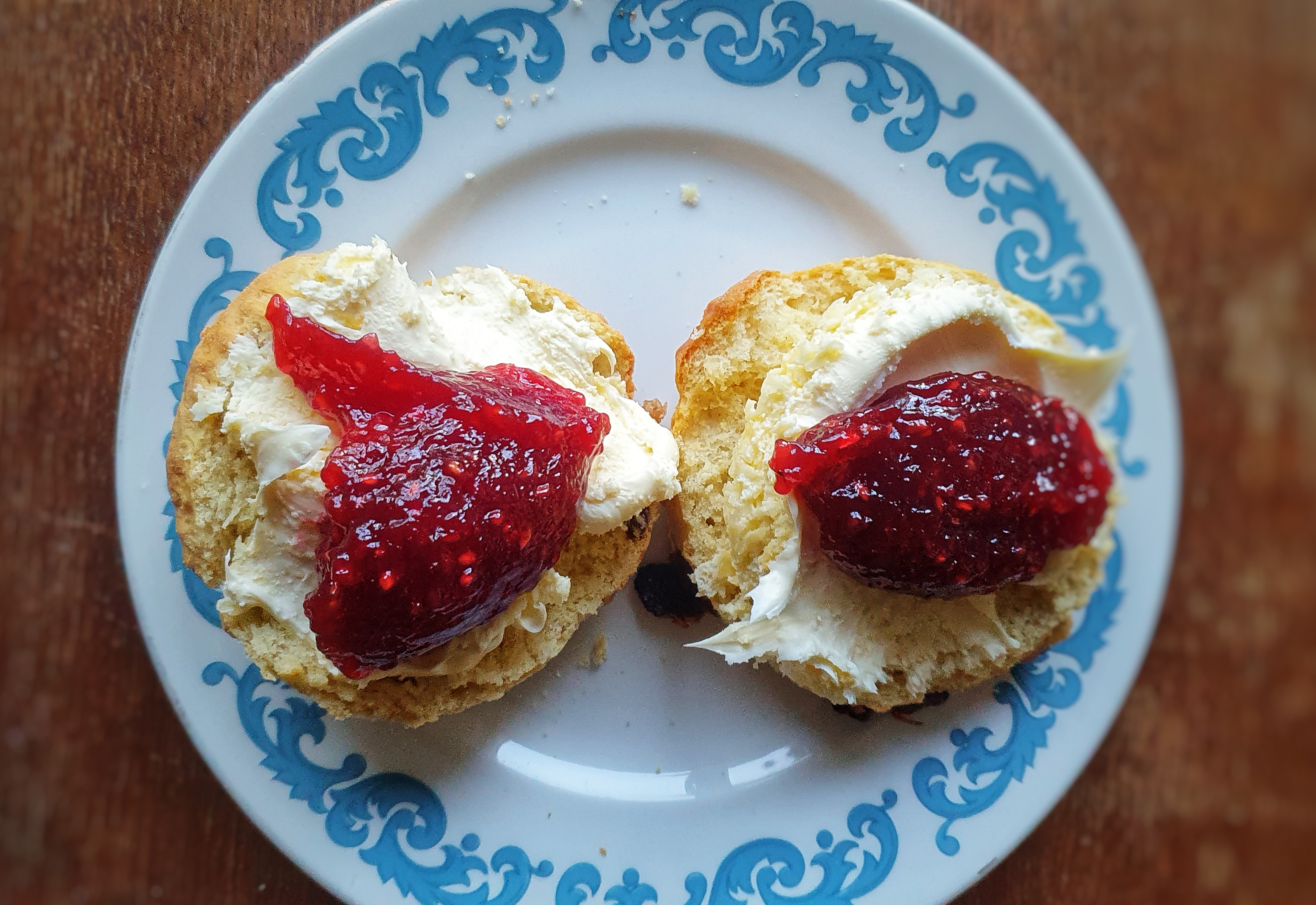
A couple of posts ago I gave you my recipe for scones. As with many foods, there is a variety of baked things that are called scones, which can cause a certain amount of confusion (see also: pudding[1], bun and cake[2]). My recipe is for what I think most people would consider a ‘proper’ scone: cakey, slightly dry and crumbly and therefore served spread with lashings of jam and butter or clotted cream. In other words, the scone one receives when ordering a cream tea. Despite its modern link with Devon and Cornwall, the scone most certainly originated in Scotland. These scones were baked not in ovens but on girdles/griddles or bakstones/bakestones, and there are two main types: those made from a runny batter and baked on a lightly greased griddle, often called drop scones today, or ‘Scotch’ pancakes outside of Scotland.[3] The second type is more cakelike; a dough that may be shaped into one large round and baked whole as a bannock, or cut into triangles as scones. The scones may also have been made by rolling out the dough and cutting out rounds. However they were shaped, these scones were cooked on a lightly-floured girdle.[4]
Wheaten bread may have been used in both types of scone, but more often they were made from oats or barley and sometimes peasemealin the very north of Scotland.[5] For delicious potato scones, some of the wheat flour is replaced with leftover mashed potatoes. Scones are typically chemically raised with bicarbonate of soda activated usually with soured buttermilk, but seeing as the word scone goes as far back as the early 16th century, this cannot have always been so; chemical raising agents were not widely available until the latter half of the 18th century. I do see recipes that use yeast and others with no leavening at all. I strongly suspect that the early scones would have been made with sourdoughs.
This is a sowans scone – made with the sour liquid poured off from fermenting sowans instead of the usual cultured buttermilk
Recipes begin to travel south and cross the border. Jane Grigson mentions a Northumbrian scone that is made with wholewheat flour and is leavened by yeast.[6] F. Marion McNeill, writing in the 1920s observes that ‘scones [are] popular in England now, but there are no recipes in Beeton’s book’, meaning – of course – the fantastically comprehensive Beeton’s Book of Household Management of 1861.[7] There are several recipes for scones in Cassell’s Dictionary of Cookery (1883) and Robert Wells’ Pastry & Confectioners’ Guide (1892).[8] Interestingly, none of them are baked in ovens despite many homes having ovens by this point in history.
However, in Good Things in England (1932), that wonderful collection of traditional English recipes by Florence White, there are recipes for scones baked both in ovens and on griddles. A variety of flours are being used too, including oatmeal and ‘Maize or Indian Meal’.[9] Baked scones – in England, at least – quickly take over and usurp not only the griddlecake variety of scones, but also the Devonshire/Cornish split in the cream tea.[10] But in the 21st century, these baked scones move even further away from their origins – egg is added for richness, milk is used over the now tricky to find buttermilk (in combination with baking powder).
For many folk, scones will be forever associated with the south-western peninsula of England, but it is important to remember, as Catherine Brown and Laura Mason put it in The Taste of Britain (1999): ‘Few English people would appreciate that [scones are] as Scottish as oatmeal porridge.’[11] I hope you appreciate it now!
If you like the blogs and podcast I produce and would to start a £3 monthly subscription, or would like to treat me to virtual coffee or pint: follow this link for more information.Thank you.
[2] These are discussed in my book Knead to Know: A History of Baking (2024).
[3] These griddlecakes are also the forerunner to the sublime fluffy American pancake
[4] Buttery, N. (2024). Knead to Know: A History of Baking. Icon Books; McNeill, F. M. (1968). The Scots Kitchen: Its Lore & Recipes (2nd ed.). Blackie & Son Limited.
[5] Buttery, N. (2018, April 17). Pease Pancakes. British Food: A History.
[6] Grigson, J. (1992). English Food (Third Edit). Penguin. I have – of course – cooked this recipe as part of my Neil Cooks Grigson project all the way back in 2008. I didn’t do a very good job of it and it requires a revisit. Read the original post here.
You know what it’s like; you go to the home baking aisle of the supermarket and pick up a bag of flour, thinking ‘I’m sure I’m running low’, buy a bag, only to find there is, in fact, a large bag sitting, unopened, in the pantry. Unsure what to do with them, I asked social media whether I should make some scones, saffron buns or lardy cake with it (three recipes I have been meaning to post for years now). The answer came in: 3-way tie. I shall endeavour to do all three for you over the next month or so.
Up first, then, are scones, the must-have for a modern Cornish or Devonshire cream tea. I have written about cream teas both on the blog and in my book Knead to Know, the excerpt of which you can find on my YouTube Channel.
This is the recipe I used when I had both my restaurant and artisan market stall, so it is very tried-and-tested. I have provided some variations for you beneath the method: cranberry and orange, cheese, and walnut and Stilton. When the restaurant was open, we served a savoury cream tea using a cheese scone, swapped clotted cream for cream cheese and exchanged the jam for curried beetroot chutney or onion marmalade.
Classic recipes – especially Scottish and Irish ones – use buttermilk instead of plain milk. As buttermilk is increasingly difficult to get hold of these days, I’ve used milk, but you can swap the two. If you do, use 15 g bicarbonate of soda instead of 25 g baking powder. One final thing: I use strong white flour instead of plain to give the scones a boost in the oven, again, not traditional; in fact, it was a trick picked up from Paul Hollywood in his book 100 Great Breads. This doesn’t mean you can knead the dough roughly as though it is for bread; you still have to use a light touch with mixing, rolling and cutting out. Hopefully, my method will help you achieve great results.
I’ll follow soon with a post on the history of scones.
If you like the blogs and podcast I produce and would to start a £3 monthly subscription, or would like to treat me to virtual coffee or pint: follow this link for more information.Thank you.
Basic Scones
A note on measuring liquids: 1 ml of milk weighs 1 g, so it’s easier – and much more accurate – to weigh it on scales rather than reading the graduations on the side of the measuring jug.
Makes 12 to 15 scones.
500 g strong white flour, plus extra for dusting
30g baking powder
½ tsp salt
75g butter
75g caster sugar
80g quartered glacé cherries, raisins or currants (optional)
200 ml/g whole milk
2 medium eggs
Egg wash: 1 egg or egg yolk beaten with ½ tsp salt
Granulated or Demerara sugar for sprinkling
Preheat your oven to 200°C.
In a bowl, mix flour, baking powder and salt and rub in the butter – you can use the flat beater attachment on your mixer with this, or good old fingertips. Stir in the sugar and fruit (if using).
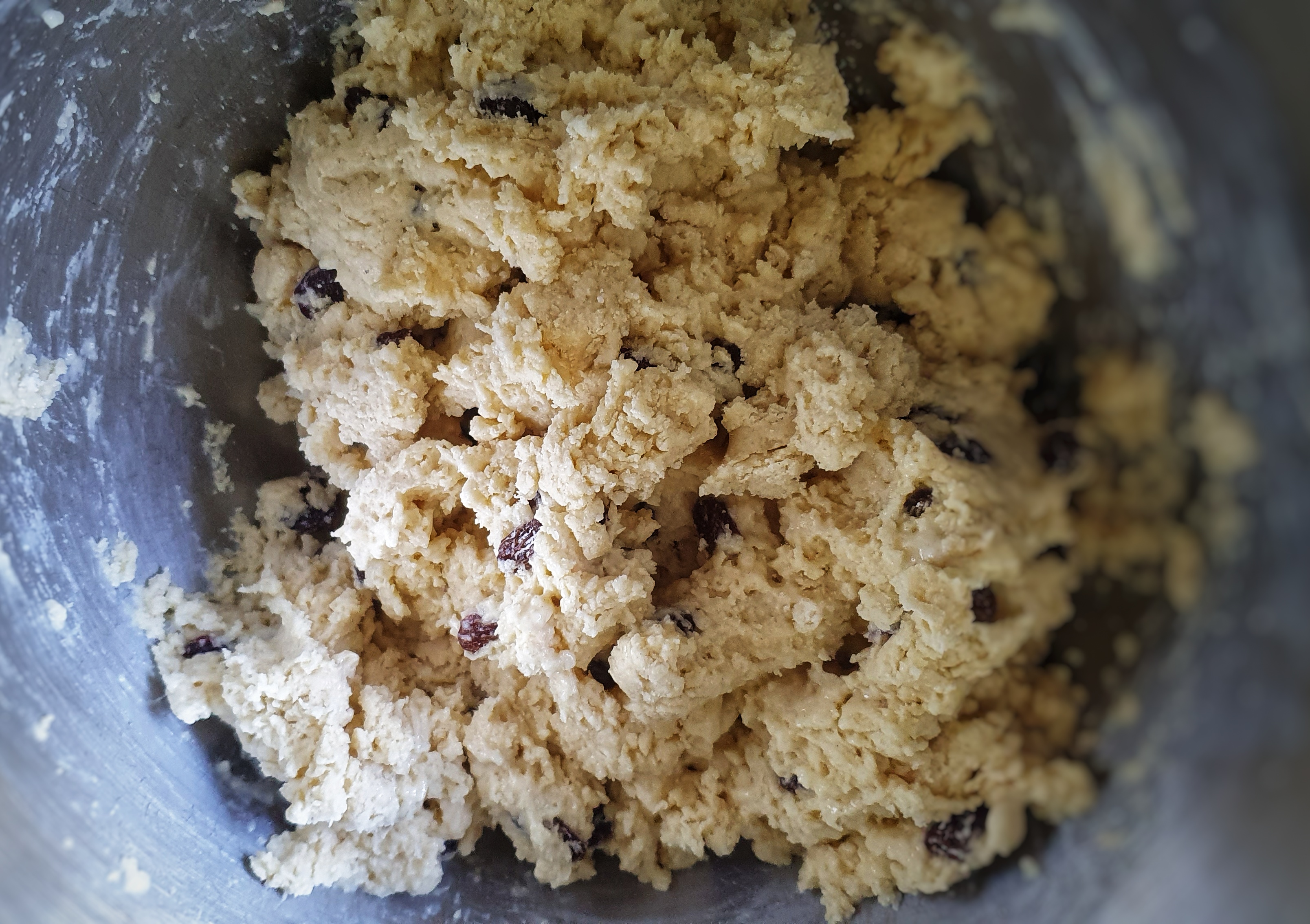
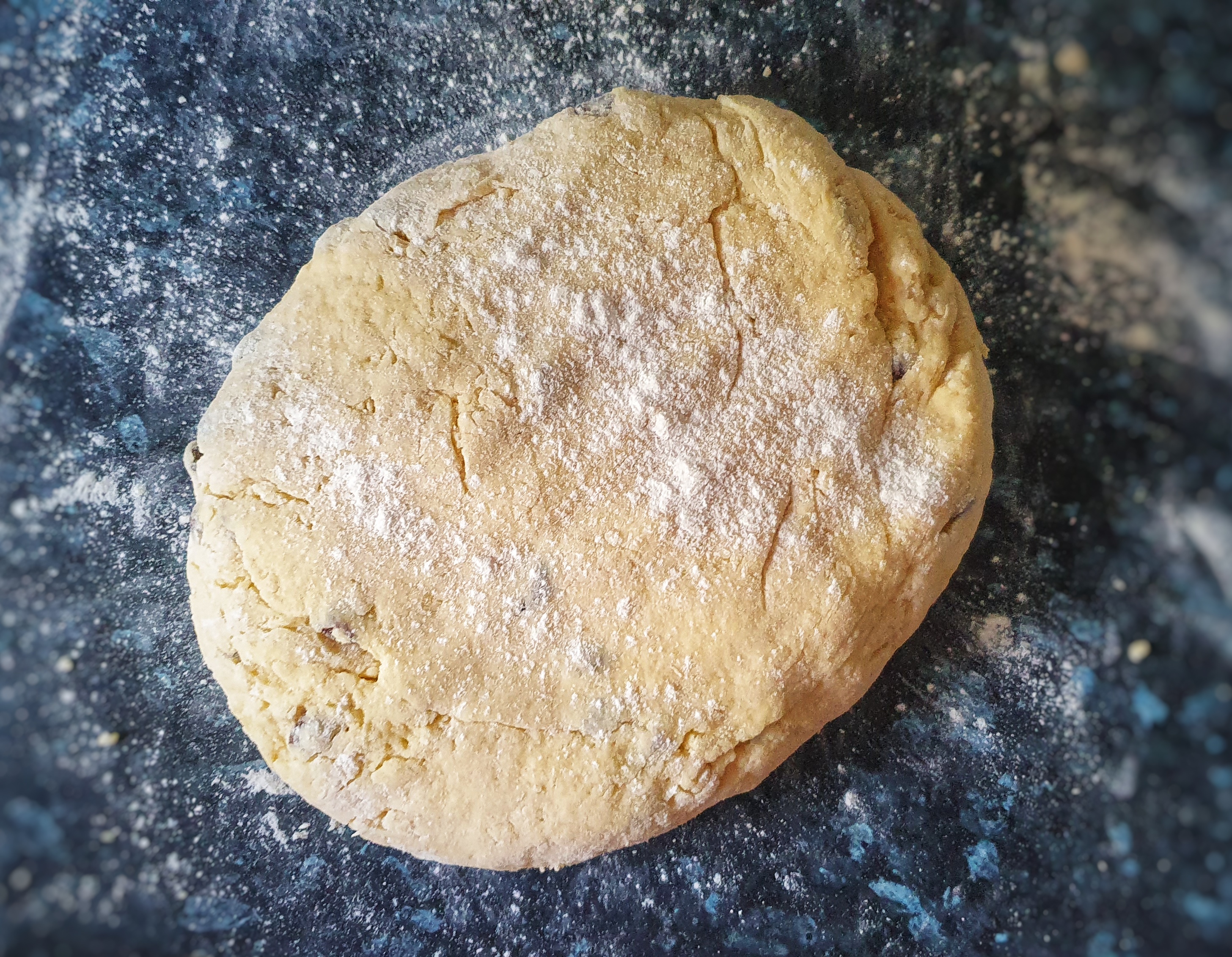
Beat the eggs with the milk, and steadily mix the liquids into the dry ingredients. If using a mixer, keep it at a slow speed. Make sure all the flour is incorporated, bring the dough together and give it a brief knead on a floured worktop until the dough is smooth.
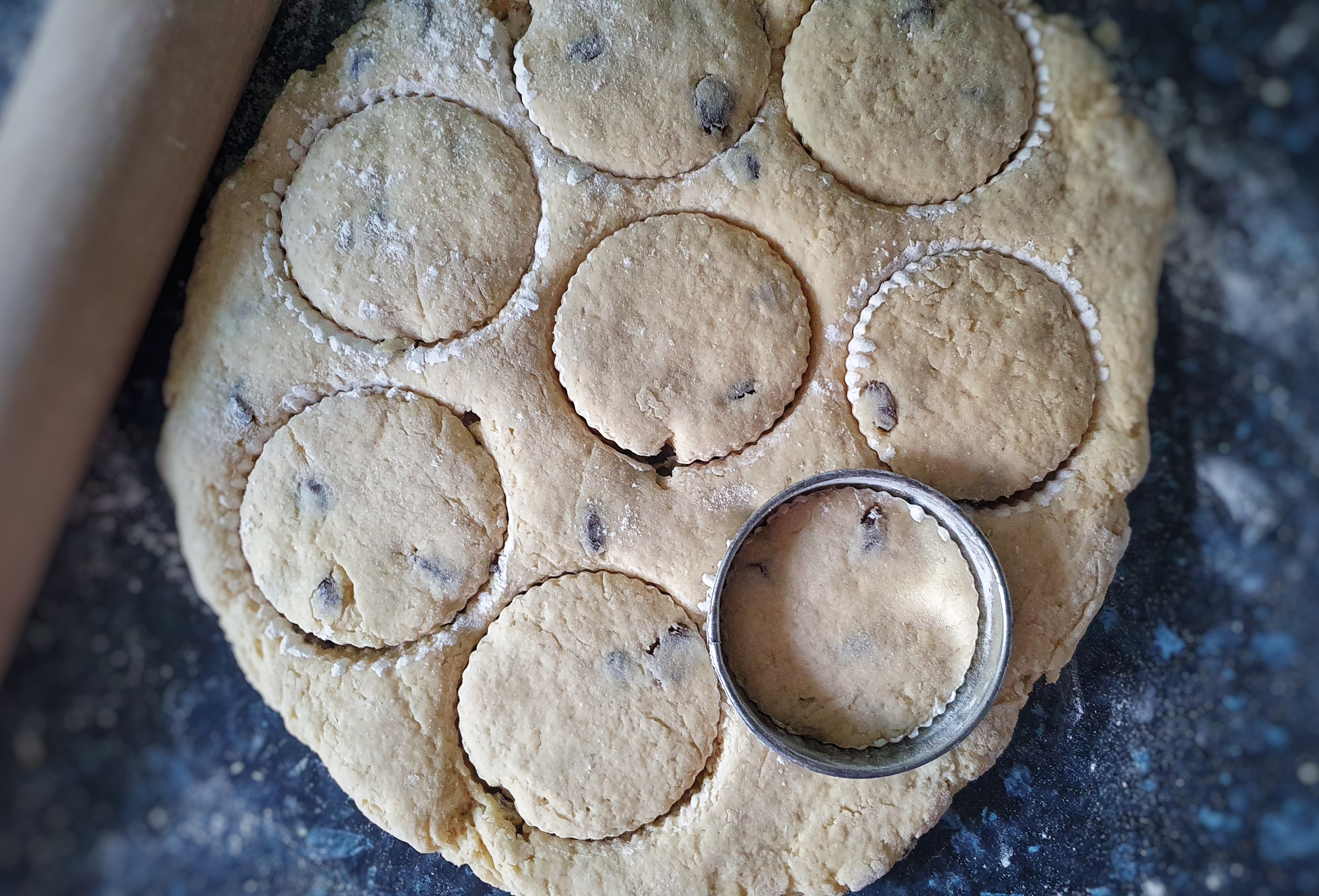
Keeping your worktop floured, roll out the dough to a thickness of 1.5 to 1.75 cm (a generous ½ inch), and cut out into rounds. I normally use a cutter of a diameter between 7 and 8 cm. It is important to take care when cutting: make sure you dunk your cutter in more flour and tap off excess before cutting. This is important because if there are splodges of sticky dough on the cutter, it will seal the edges of the scones, preventing a good rise. Also, don’t be tempted to twist your cutter, as this will have a similar effect. Arrange the cut-out scones on 2 lined baking sheets.
Bring the leftover dough together with your hands to form a cohesive dough without kneading it too much – we don’t want tough scones! Roll out again and cut out. Repeat until all of the mixture is used up.
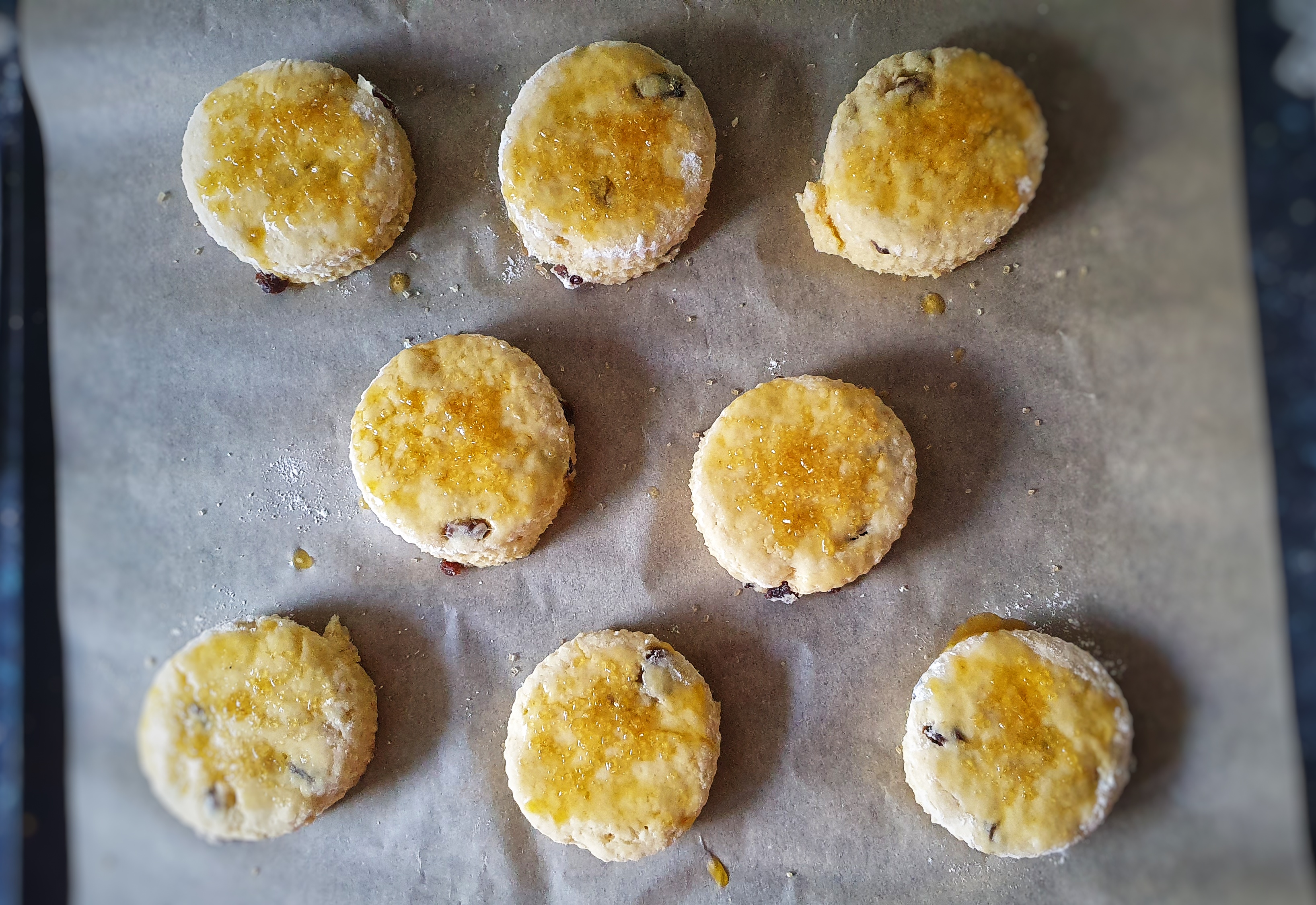
Brush with egg wash being careful not to let any dribble down the sides – again, this will hamper the rising of the dough – then sprinkle with sugar. Bake for 15-20 minutes until golden brown and well risen. If there is uneven browning at the 10-minute mark, switch the trays around in the oven.
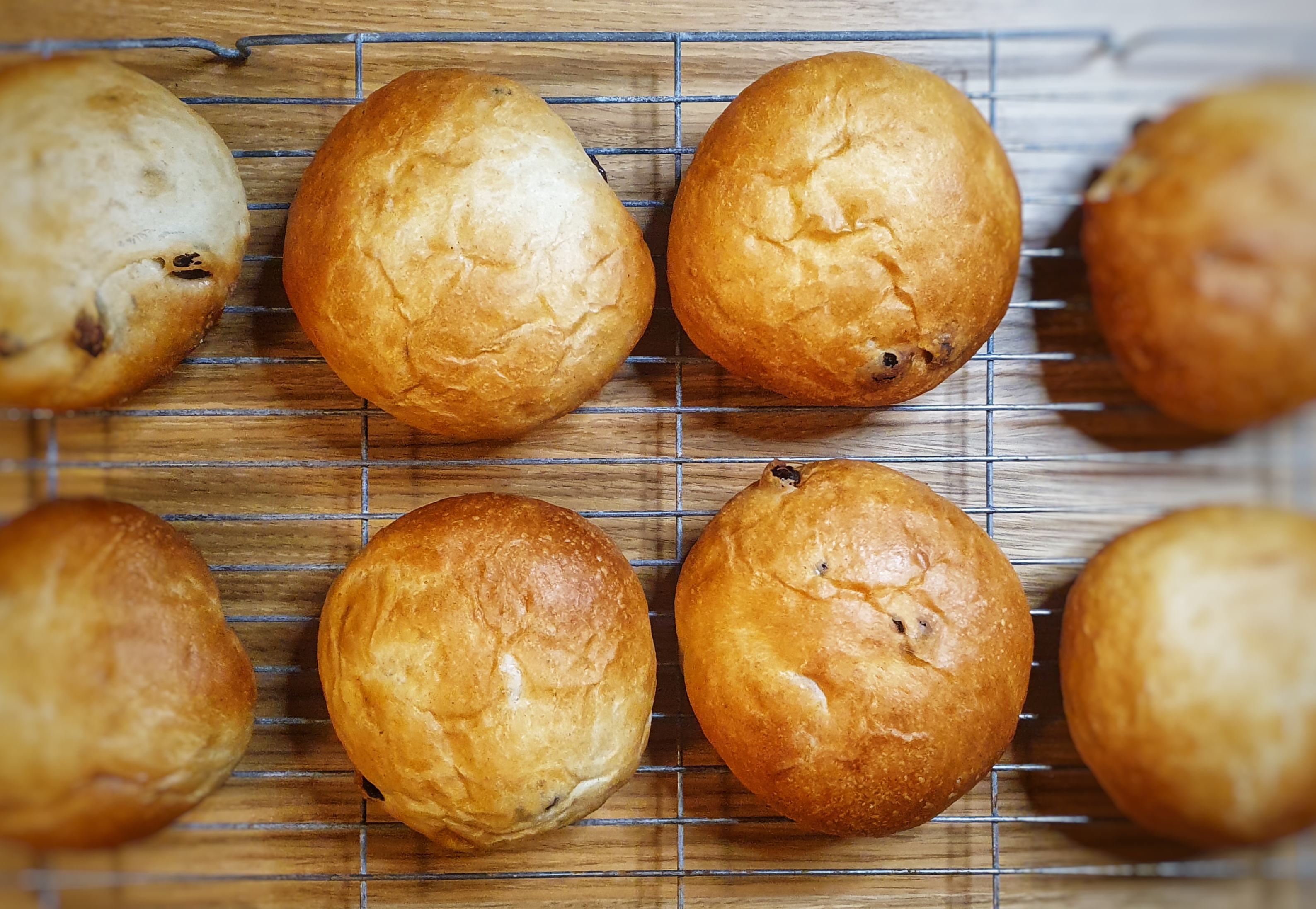
Cool on a rack.
Scones are best enjoyed on the day or the day after they are made. They do freeze well. Enliven them by popping them in the microwave for 10 to 20 seconds.
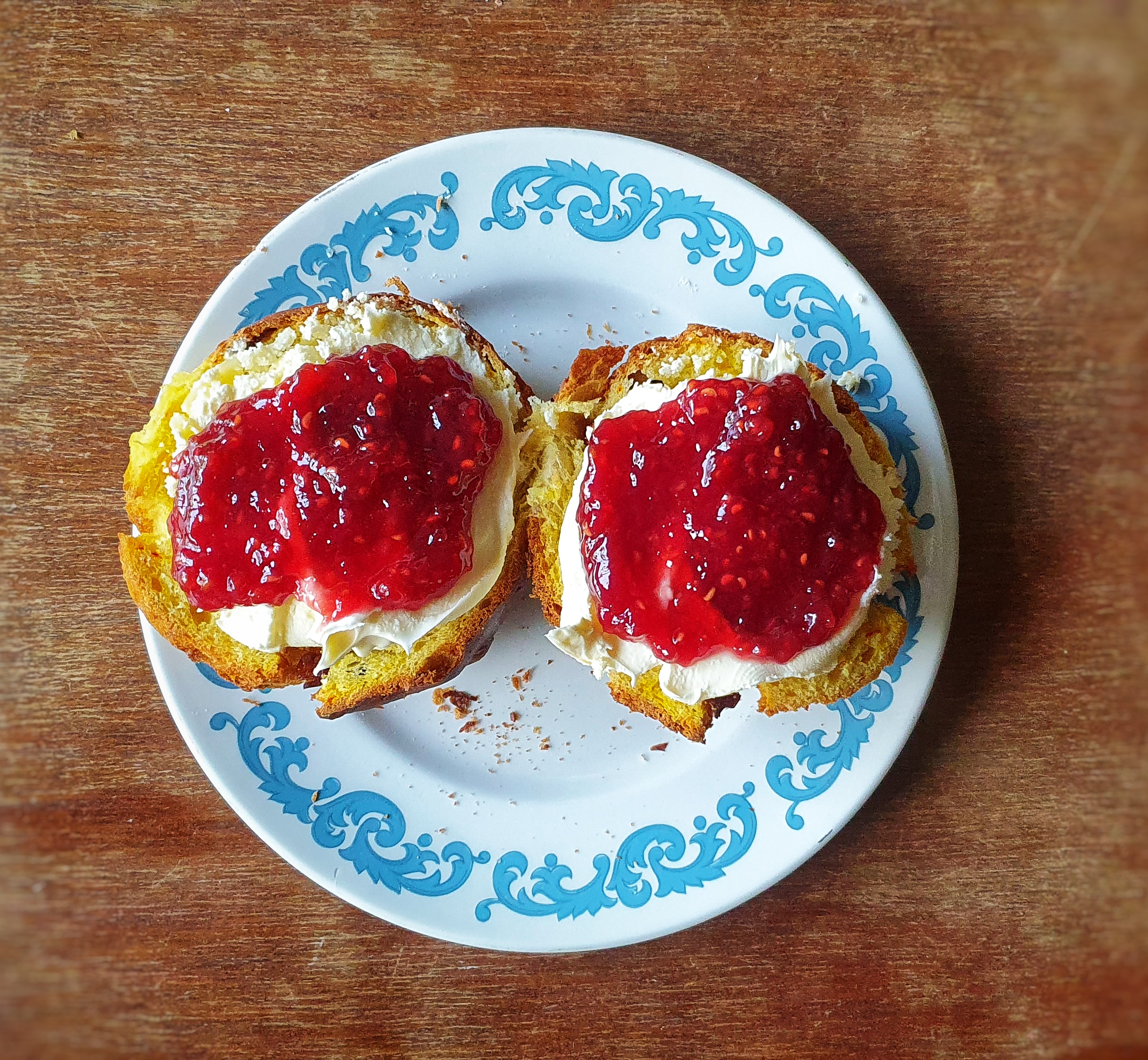
Eat with butter or clotted cream and jam.
Variations
Cranberry and Orange
Make as above, but add the zest of two oranges to the dry ingredients, and use dried cranberries instead of raisins or currants. Juice the oranges, pour into a measuring jug and top up with milk to 200ml/g.
Classic cheese scones
Use just 25 g caster sugar, and add 100 to 125 g grated Cheddar cheese once the flour has been rubbed in. If you like, you can add ½ teaspoon of dried herbs and a good pinch of Cayenne pepper. Use 230 g/ml of milk instead of 200 g/ml. Sprinkle some finely grated cheese (Parmesan is good) over the egg-washed scones before they go in the oven.
Walnut and Stilton scones
As above, but use 100-125 g grated Stilton and 80 g chopped walnuts
A hospitable Yorkshire housewife would consider her tea table was barely spread if it were not liberally supplied with these delicious cakes, constant relays of which should be served steaming hot.
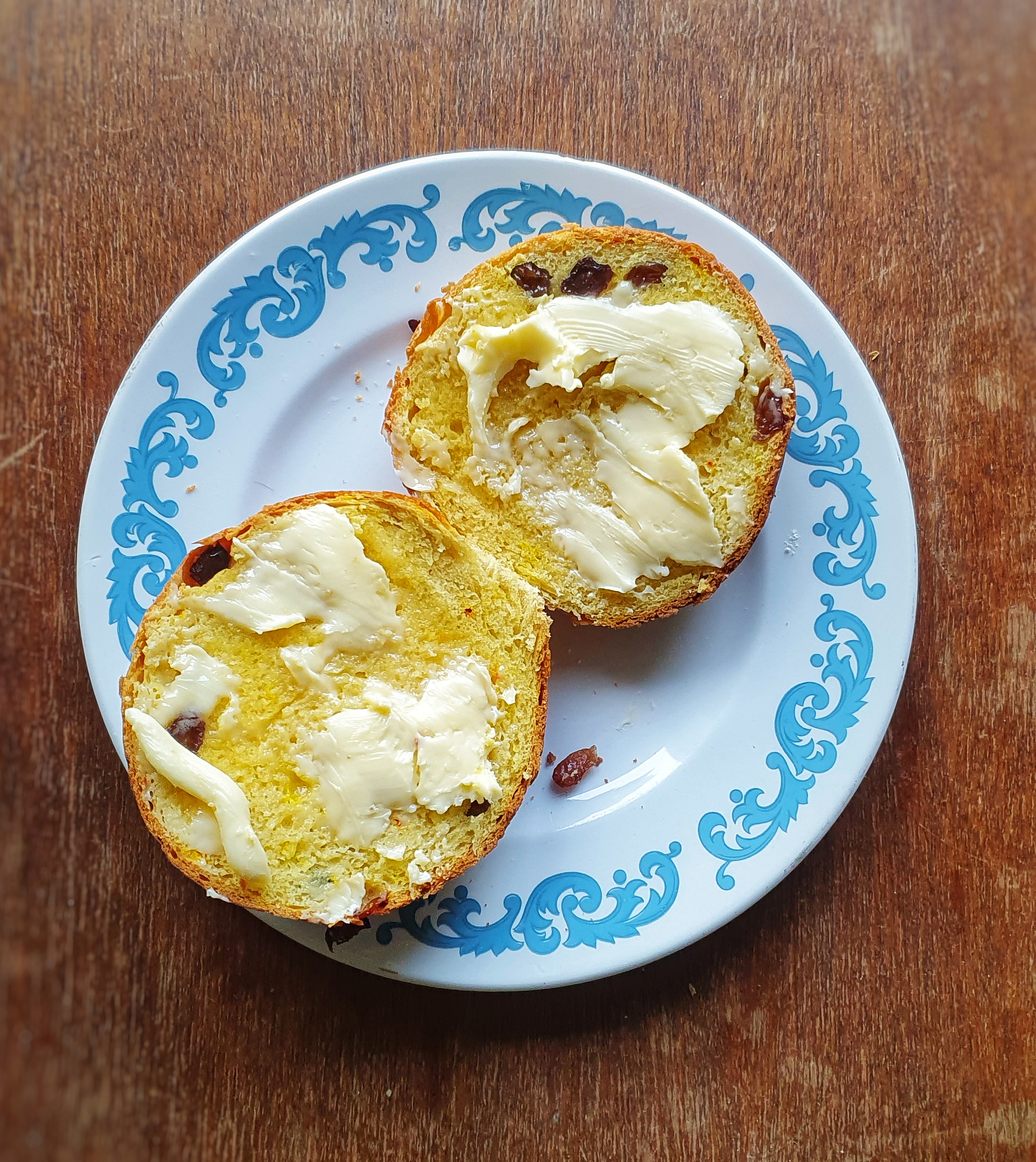
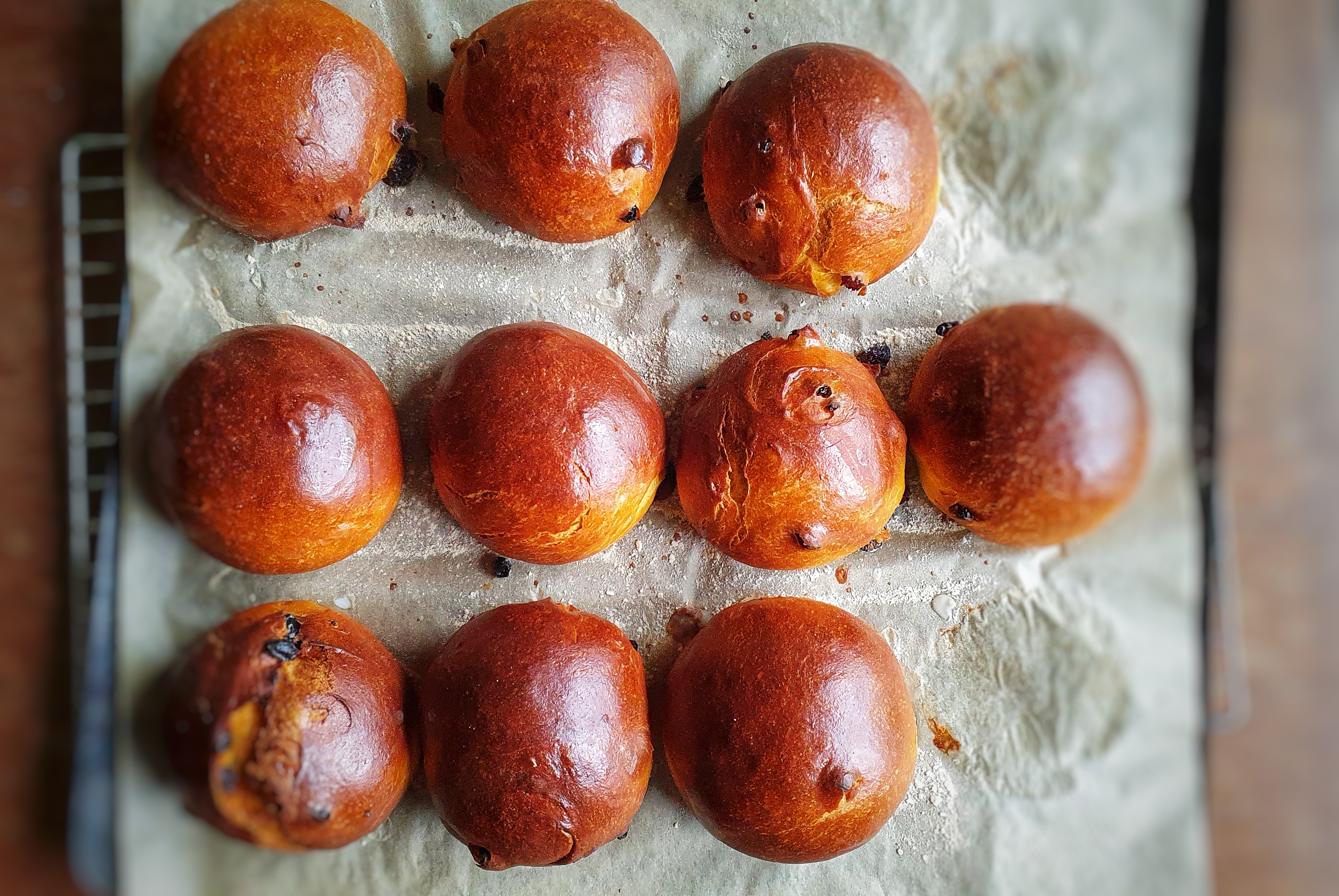
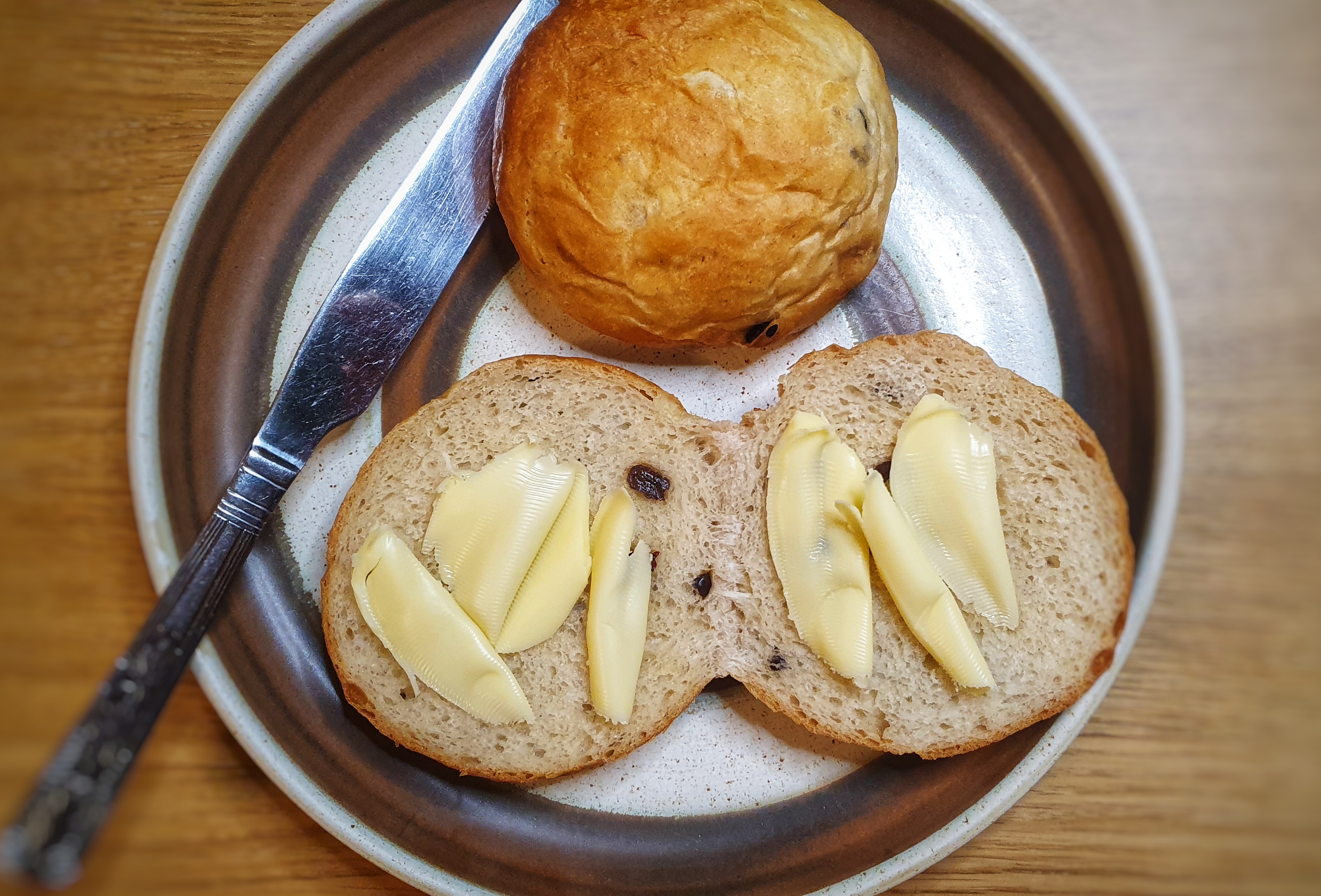
A split and toasted fruit teacake, liberally spread with melting salted butter is one of life’s simple pleasures. For those of you who are not already in the know, a Yorkshire teacake is a round, slightly flattened, enriched, soft breadcake usually containing a little sugar, spice, dried fruit, and candied peel. There was a time when England had scores of regional fruited or enriched bread cakes and loaves, but they have largely gone by the wayside. Others that spring to mind are Bath buns, Wiltshire lardy cakes and Lincolnshire plum bread.[2] These types of cakes and breads are much more appreciated in Wales, Scotland and Ireland, or so it seems. The Yorkshire teacake has escaped its regional roots, so much so that it has lost its Yorkshire identifier and is simply called a teacake by most people.
Just-baked teacakes with plenty of salted butter
Yorkshire teacakes can be traced back to the opening decades of the 18th century when they were called ‘Yorkshire Cakes’. They will have been very expensive because they are enriched with eggs, butter, milk, and plenty of sugar and dried fruits.[3] By the 1880s, they are called Yorkshire teacakes.[4]
Working-class families enjoyed them too, but there was invariably less fruit, just a touch of sugar, half-and-half milk and water, no eggs and lard instead of butter. I like this more austere version, though I do go will all milk (full fat, of course) and much prefer lard to often over rich butter. Looking through recipes, the amount of lard varies greatly from a knob to over five ounces per pound of flour.
It’s very important that the teacakes are nice and soft. To achieve this, heed this excellent advice from Florence White:
Immediately after taking from the oven, rub over with buttered paper, and cover with a light, clean blanket; this gives a soft skin.[5]
When they are freshly baked they are lovely eaten untoasted, but any older than that and they must be split and toasted (or if you want to go hardcore Yorkshire, strong Cheddar cheese[6]).
It occurred to me that I hadn’t baked a batch of teacakes for a good few years, and I was thereafter craving them, so I baked a batch. They are so worth making at home and I give you my recipe, should you fancy having a go yourself.
If you like the blogs and podcast I produce and would to start a £3 monthly subscription, or would like to treat me to virtual coffee or pint: follow this link for more information.Thank you.
Recipe
This is quite a sticky dough and I would recommend making this in a stand mixer with a dough hook, but they can be made without one; just be prepared to be very sticky in the first 10 minutes of kneading. If you prefer plain teacakes, omit the fruit and spice and add half the sugar.
Makes 8 teacakes:
500 g strong plain flour, plus extra for kneading and shaping
30 g caster sugar
1 tsp salt
1 tsp instant yeast
½ tsp mixed spice or ½ a grated nutmeg
80 g softened lard or butter, or a mixture
300 ml warm milk or half-and-half milk and water
Around 2 tbs vegetable or sunflower oil
80 g mixed dried fruit
30 g candied peel (optional)
Extra milk for brushing
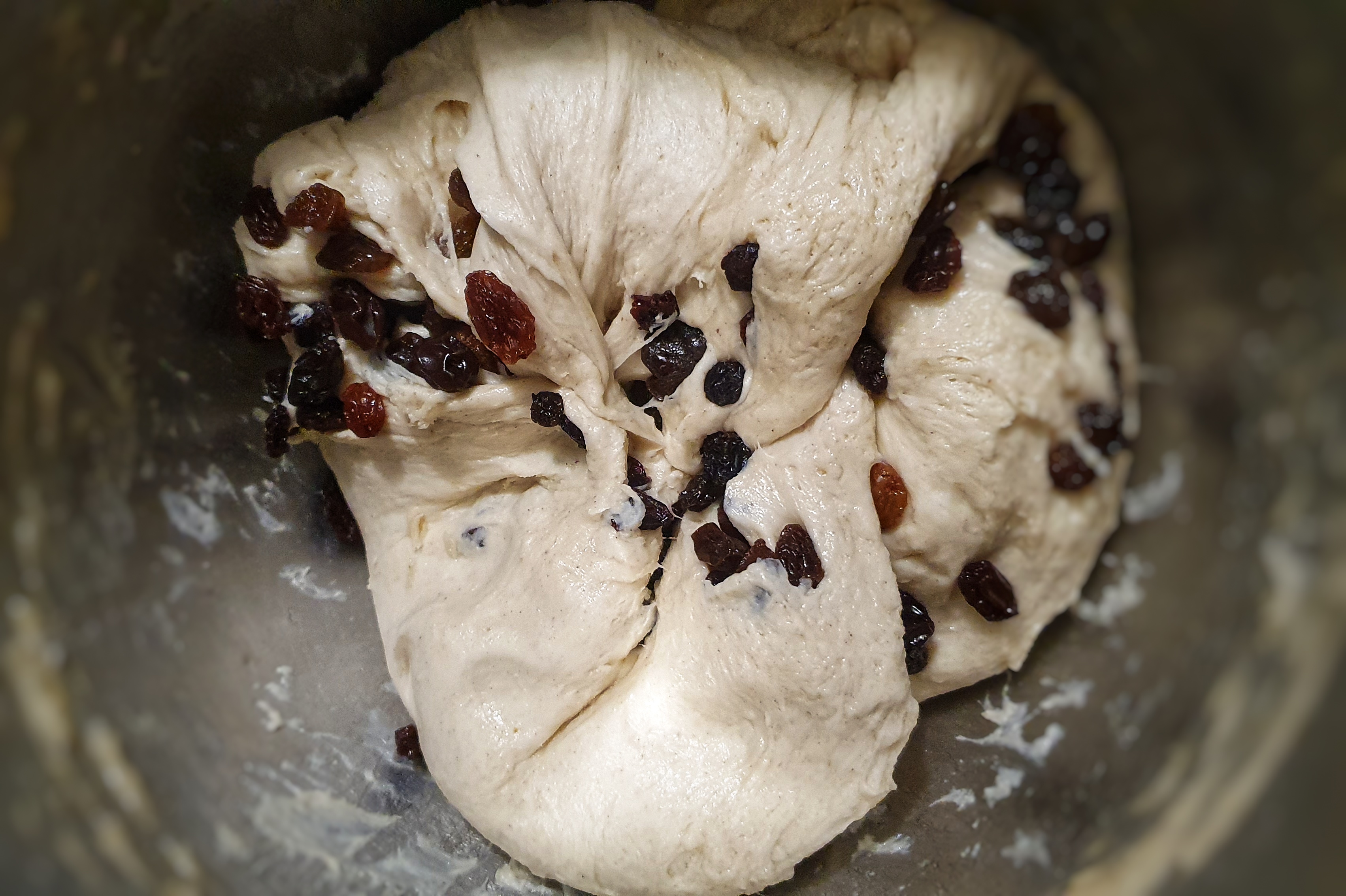
Add the flour, sugar, salt, yeast and spices to a mixing bowl, make a well in the centre and add the softened fat, then tip in the warm liquid. Using a kneading hook, mix the ingredients on a slow speed until everything has combined, then turn up the speed a notch or two and knead for about 10 minutes until smooth – it won’t be very elastic because of the lashings of lard.
If you want to do this by hand, mix the ingredients with a wooden spoon. When thoroughly mixed, leave it to stand for 15 minutes or so; this gives the flour to absorb some of the liquid making for easier hand kneading. Knead on a lightly floured surface for around 15 minutes.
Brush a clean mixing bowl with the vegetable oil, gather up the floppy dough as best as you can (oil your hands, it makes this bit much easier), tuck it into a ball and pop it in the oiled bowl. Cover with a tea towel or cling film until it has doubled in size. This will take a while; even sat close to the radiator, my dough took over two hours.
Now take two baking sheets and line them with greaseproof paper and set aside.
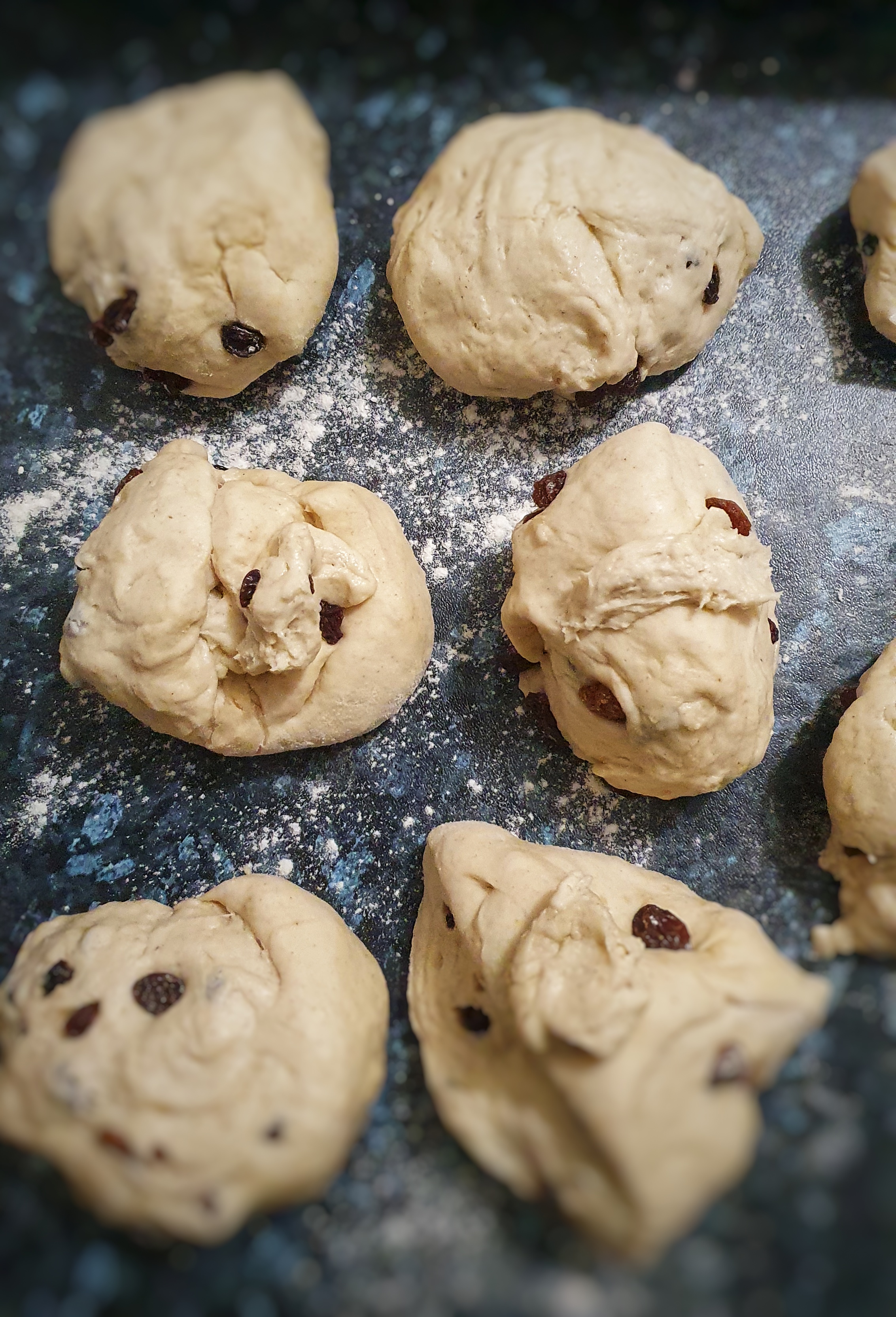
Tip the dough onto a floured worktop and press out into a square, add the fruit and knead it into the dough. You do this step in the oiled bowl if you like. When everything is reasonably equally distributed, cut the dough into 8 equal-sized pieces. Using just a very little flour roll the pieces of dough into tight balls, then roll them out into circles with a floured rolling pin so they are 4 to 5 cm thick. Sit them on your baking sheets as you make them.
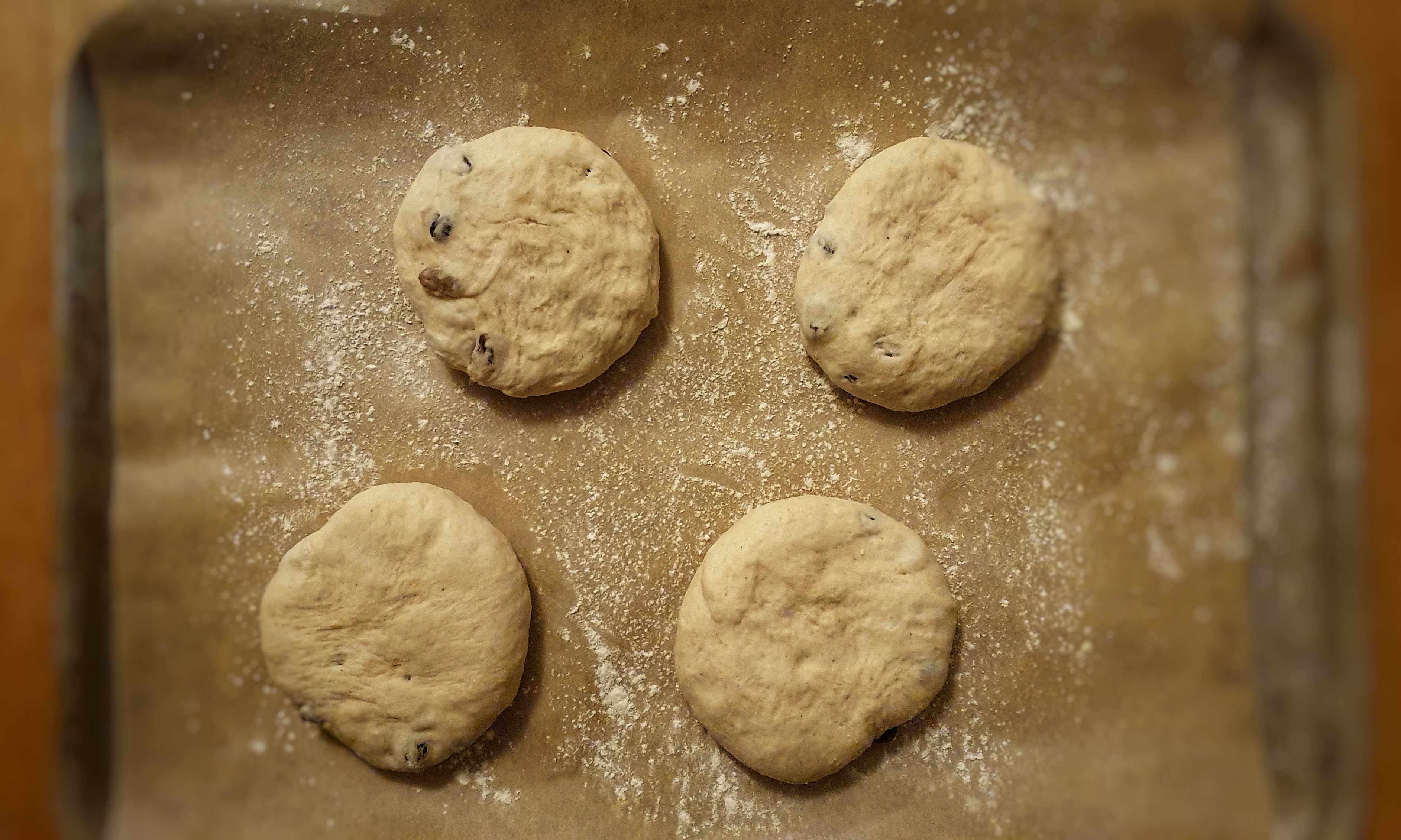
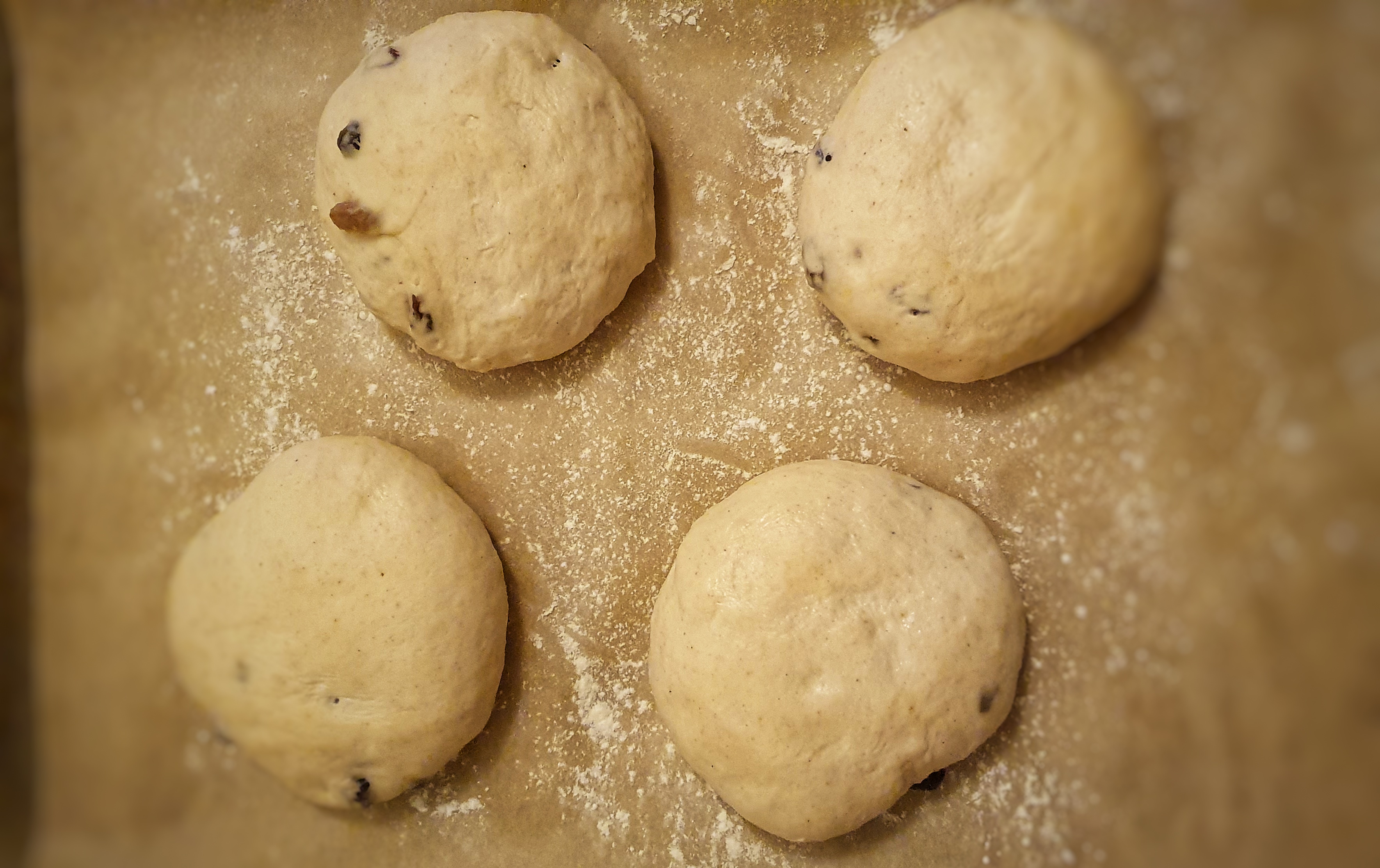
When you’ve done all 8, cover them with tea towels or place a container over them so they can prove again. In my experience the second proving takes about half the time of the first. As they prove turn your oven to 200°C fan (or equivalent). If you have a steam setting on your oven, use it. If you don’t, place a roasting tin in the bottom of the oven to heat up, and when you put your teacakes in the oven, tip some water into the now very hot tin and close the door.
Before and after the second proving
When they have doubled in size, brush them with milk and pop them in the oven. Bake for 15 to 20 minutes until golden brown. Test whether they are ready by tapping the base of one: it should sound hollow.
Remove the teacakes from the oven and immediately throw a double layer of tea towels over them to keep them soft as they cool.
Hello everyone, hope your February isn’t looking too gloomy. Here’s something to cheer you up: news that season B of A is for Apple: An Encyclopaedia of Food & Drink has kicked off.
For those not in the know A is for Apple is a podcast hosted by Sam Bilton, Alessandra Pino and me. Each season we take a letter and focus on it; last time we did A, so now we are doing B. We all present a very short piece about our chosen topic and then discuss it. There’s usually a theme to the episode, but Sam (who was the head host in episode 1) was kind and gave us a free choice. I chose berries, Sam chose the Banting diet, and Alessandra bananas. It’s available to listen to on all podcast apps, just search for “A is for Apple” and hit subscribe. If you’re not a podcasty person, here’s a Spotify inbed for you:
For my piece I interviewed Rachel Webster, Curator of Plants at Manchester Museum, and quickly following episode 1 was the uncut interview talking about berries, flowers and fruits – and comes with some gob-smacking facts! Listen here:
You can also follow the podcast on Substack for free: click this link to check it out. There are bonus recipes and other bits and bobs to be found there.
Next episode Alessandra is in the driving seat and she gave us a theme: Places. What places beginning with B would you choose!?
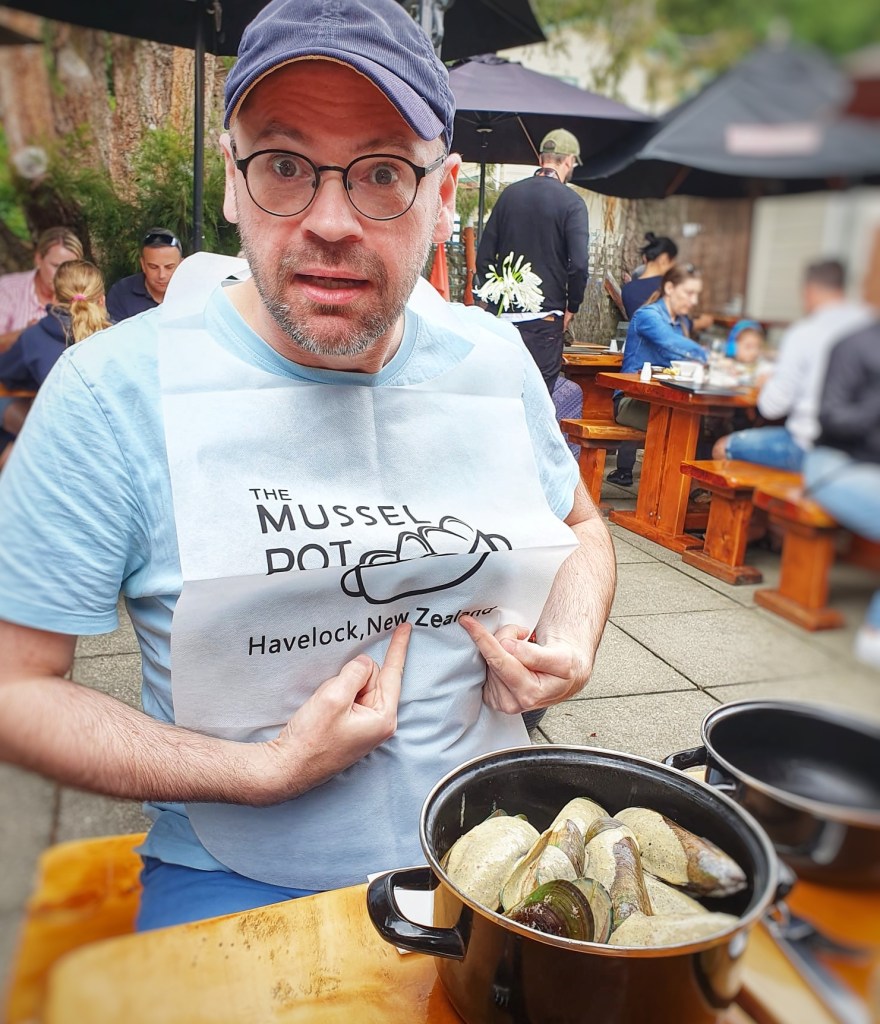
Happy New Year everyone! I do hope you have said cheerio to 2024 good and proper and that you are braced for what promises to be a rather colourful 2025. For a change I’m not in England to see in the New Year, but New Zealand! It’s a very beautiful place, but it seemed very odd wearing shorts for Christmas dinner. Alas, my usual New Year’s Eve pudding did not happen, but I absolutely promise that I will cook one up as soon as I get back.
My year has had its ups and downs from a personal point of view, but it has certainly been my best from the point of view of my writing: I wrote more pieces for Country Life (you can read them on my Media page), an article for BBC Countryfile magazine and even a piece for the Daily Express. my second book Before Mrs Beeton – a biography of food innovator and entrepreneur Elizabeth Raffald – won the Best Food Book Award at the Guild of Food Writer’s Awards 2024. I was not expecting to win, but I was very pleased about it as I’m sure you can imagine. But the biggest achievement was publishing two books in the same year! Knead to Know: A History of Baking and The Philosophy of Puddings have gone down well (thus far) and I am very pleased about that too! It may not surprise you to hear that I will have a bit of time off from writing books for the time being.
Not only that, but I started a second podcast with fellow food historians Sam Bilton and Alessandra Pino called A is for Apple: An Encyclopaedia of Food & Drink. We’re tackling it letter-by-letter so season one was really season A. We’ve already started recording season B so keep an eye out for that this January.
Working on two books at the same time meant that the blog didn’t receive as many posts as in previous years, but it has been by far the most successful from the point of view of hits: 45% more than the previous year. Absolute craziness. According to Spotify, my listenership for The British Food History Podcast has increased by 88%. I think it’s fair to say that things are very much going in the right direction.
I wouldn’t have been able to do all of this without you supporting me by reading and listening, it really does spur me on to keep on producing more content, so thank you all very, very much.
A very special shout out to everyone who supported the blogs and podcast financially by treating me to a virtual coffee or pint, or by becoming a £3 monthly subscriber. It’s becoming increasingly expensive just to have podcasts and blogs these days, so I really appreciate it.
If you like the blogs and podcast I produce and would to start a £3 monthly subscription, or would like to treat me to virtual coffee or pint: follow this link for more information.Thank you.
The blog was very much focused on baking and puddings (surprise, surprise) and I posted recipes that I have wanted to add to the blog for years, but never got around to. The books prompted me, I suppose. There were things like Chelsea buns, puff pastry, Bakewell pudding and Eccles cakes. There was some attention paid to the much underappreciated Madeira cake, the rather forgotten Northumberland griddlecakes known as singin’ hinnies, and a post about the risks of exploding flour in mills and bakeries.
This Christmas I also provided recipes for a complete Christmas dinner (something else I’ve been meaning to do for years as well) with recipes for roast turkey and giblet gravy, fool proof roast potatoes and Brussels sprouts(with bacon and prunes). As per usual there was a boozy recipe for Christmas and this year it was for Irish coffee.
There were 21 podcast episodes of The British Food History Podcast were published this year – a record I believe – and there were some great ones, but the highlight for me was my trilogy of episodes celebrating 50 years of English Food by Jane Grigson – especially the episode when I spoke to Jane’s daughter Sophie Grigson all about her mum and the writing of the book. A real highlight of my career – not just my year!
My trilogy of episodes celebrating 50 years of English Food by Jane Grigson.
The most popular episode with listeners was Medieval Meals & Manners with Danièle Cybulskie. Other popular episodes included Spices with Ian Anderson, The History of Food Waste & Preservation with Eleanor Barnett, Historical Cookery with Jay Reifel and Crisps with Natalie Whittle.
So that’s my look back at the year gone by and it is time to look forward to the new year: I will be working on my new book ideas, I will be finishing off season 8 of the podcast, recording the more A is for Apple and providing more recipes – if you have any suggestions for blog posts or podcast episodes do let me know.
Remember to continue to celebrate Christmas! It’s not over until the 5th of January, so please continue to feast away.
This post and it’s accompanying podcast episode are for £3 monthly subscribers. If you would like to become a subscriber and access this post and all the other premium content on the blog click this link.
As a £3 monthly subscriber you get access to my Easter eggs page, special premium blog content, receive a monthly newsletter, and – most importantly – you support the running of my podcast and blog.
I told my social media followers that my Christmas recipe this year was going to be roast turkey and I said that I would also provide the recipes for two sides. I provided four options: roast potatoes, Brussels sprouts, bread sauce and cranberry sauce/jelly. Roast potatoes received the most votes so here we go.[1]
I believe that the roast potatoes are almost as important as the roast meat, perhaps more important. Whether it’s the Christmas dinner or the weekly Sunday roast, if you mess up the roasties, everyone will be sad, and there’s a good chance you’ll be forever shunned by friends and family.
So I provide you with my method. It’s tried and tested and I reckon foolproof! Don’t worry about precise weights/volumes of ingredients or sizes of roasting trays; this recipe is most adaptable so use what you have. What is important, however, is the type of potato used and the fat or oil in which they are cooked.
The potatoes must be of the floury type: Maris Piper, King Edward and Albert Bartlett varieties are easy to find in the supermarkets, but for me the supreme variety of spud when it comes to roasting is the Alouette. It’s technically a waxy potato, but when roasted the centre is like the creamiest mashed potato. It’s not widely available in supermarkets, but keep a look out at greengrocers and farmers’ markets; you will not be sorry should you happen upon some and buy a kilo or two. I bought mine from Unicorn in Manchester.
Next, we need good fat or oil. I used approximately equal amounts of lard and rapeseed oil. All solid animal fats are good: beef dripping, goose fat and duck fat are great alternatives – they all have high smoking points and make for a crisp potato. As for plant-based oils, you must avoid olive oils completely and go for high smoke point ones like rapeseed, groundnut or sunflower. Avoid the solid, white vegan fats, they are bad for you and the environment. You don’t have to go half and half either, you can use all oil or all animal fat: I vary it depending on what oils and fats I have in the store cupboard/fridge.
Anyway, let’s get to it.
If you like the blogs and podcast I produce and would to start a £3 monthly subscription, or would like to treat me to virtual coffee or pint: follow this link for more information.Thank you.
Recipe
Make sure to use a deep roasting tin and that it is big enough to fit all of the potatoes in a single layer. Notice too there are no herbs thrown in, but if you want to add some be my guest.
If making roasties for the Christmas dinner, you can slide the tray of oil or fat into the oven as soon as the turkey comes out.
Good, floury potatoes, peeled
Salt
Plant-based oils and/or solid animal fats
Preheat your oven to 190°C (if you followed my turkey recipe, the oven will already be at this temperature). Add enough oil or fat to the tin so that it comes to a depth of between 0.5 to 0.75 centimetres. Slide it into the oven to get nice and hot.
Angular cuts make for crispier roasties
Cut your potatoes into good-sized pieces[2] making cuts at angles so that there are sharp, angular pieces: the pointier, the crispier; the crispier the better.
Get a large pot of water that had been liberally dosed with salt boiling and add the potatoes. Cover and bring back to a boil, and once boiling again, set a timer for 6 minutes.
When the time is up, strain the cooking water and allow the potatoes to steam dry for a few minutes, then place them back in the pan, cover the lid and give them a good shake to fluff up the edges (wear oven gloves, don’t get a steam burn). Leave the lid off the spuds again so that they can steam a little longer. You can do this stage well in advance if you like – even the previous day.
Fluffed and ready for the oven!
Gingerly remove the roasting tin and place the potatoes in the oil, spacing them out in a single layer. Use a pair of tongs to help. Slide the roasting tin back into the oven. After 15 minutes turn them over, and keep turning them every 15 minutes or so until crisp on the outside and cooked through the centre. It will take around an hour.
Using tongs, place in a warmed serving dish or bowl and serve.
Notes
[1] Sprouts came second – recipe coming very soon.
[2] I’m not going to dictate to you what a good size is; it’s all down to personal preference, but as a guide, medium potatoes get cut into quarters or sixths, and larger ones into eighths.
It is very simple to enter: All you need to do is go to the foot of this post, “like” it and leave a comment declaring your favourite Christmastime dessert.
I will select one person at random on 2 December at 7pm GMT. That’s your deadline. Good luck!
If you like the blogs and podcast I produce and would to start a £3 monthly subscription, or would like to treat me to virtual coffee or pint: follow this link for more information.Thank you.
In my book Knead to Know: A History of Baking, I made sure that there was a full chapter focussing on griddlecakes: food baked on hearthstones, bakestones and iron griddles. Of course, when writing the chapter, I took much inspiration from Jane Grigson’s baking recipes in English Food. I was surprised by the great variety. These days the English barely think beyond the crêpe.
It’s been a while since I posted a recipe for a griddlecake, and I have had this one, for singin’ hinnies, waiting in the wings for a while. These little cakes are a rather forgotten speciality of Northumberland. I first made these for the Neil Cooks Grigson project in its very early days and I didn’t do a great job of interpreting Jane’s recipe.[1] I have improved greatly since then. The real prompt to get this recipe out there was my conversation with Sophie Grigson, Jane’s daughter, for a recent episode of The British Food History Podcast all about Jane’s work. The topic of singin’ hinnies cropped up because Jane’s entry for it in English Food is particularly evocative. Listen to the episode here:
These griddlecakes, enriched with lard and butter and sweetened only by dried fruit, were eaten by all, and were especially at children’s parties where tuppeny and thruppenny pieces were hidden inside.[2] These once ubiquitous cakes were, for many families, sadly the ‘substitutes for the birthday cake [they] could not afford.’ The word ‘hinnie’ is a dialect one for honey, a term of endearment, and the ‘singin’’ refers to the comforting sizzle of the butter and lard from the cooking griddlecakes, although Jane does point out that ‘the singin’ hinnies made less of a song for many people as they could not afford the full complement of butter and lard.’[3]
I have found other mentions of singin’ hinnies elsewhere but recipes and descriptions are very vague. I did find two nineteenth-century descriptions that really emphasised their importance at the dinner tables of miners – Northumberland being very much a colliery county. The job required very calorific food, so these griddlecakes served an important function. One stated that ‘miner’s food consisted of plum pudding, roast beef and “singing hinnies”.’[4] Another, written by J.G. Kohl, a German travel writer, informs us that ‘[the colliers] even have dishes and cakes of their own; and among these I was particularly told of their “singing hinnies”, a kind of cake that owes its epithet “singing” to the custom of serving it hissing hot upon the table…They are very buttery, and must never be absent on a holiday from the table of a genuine pitman.’[5]
Jane reckons they are the second-best British griddlecake; for her, Welsh cakes take the top spot.
If you like the blogs and podcast I produce and would to start a £3 monthly subscription, or would like to treat me to virtual coffee or pint: follow this link for more information.Thank you.
Recipe
I give you my interpretation of Jane’s recipe with more precise ingredients and method. I have found all other recipes to be either too vague in the amount of liquid that should be added, or, when specific, far too dry. I do hope you find this recipe clear; I know it must work because the hinnies sing loud and true as they cook on the griddle.
A proper singin’ hinnie should be made with equal amounts of butter and lard. If you are vegetarian, avoid using shortening such as Trex, instead go posh and use all butter.
Makes 24 to 28 griddlecakes
500 g plain flour, plus extra for rolling
1 tsp baking powder
¾ tsp salt
125 g lard, diced
125 g butter, diced
180 g dried mixed fruit
220-240 ml milk
Extra lard for frying
Extra butter for buttering the insides of the singin’ hinnies
Mix the flour, baking powder and salt in a bowl, then rub in the lard and butter until the mixture resembles breadcrumbs, then add the dried fruit and mix again.
Make a well in the centre, add most of the milk and mix to make a nice soft dough – it’s a good idea to use the old-fashioned method of combining everything using a cutting motion with a butter knife; that way you ensure the liquid is combined with the other ingredients without overworking the gluten in the flour. Add the remaining milk should there be any dry patches.
Lightly flour your worktop and knead the dough briefly so that it becomes nice and smooth. Let it rest as you get your bakestone, griddle or pan ready.
Place the bakestone on a medium heat and allow to get to a good heat; because there is no sugar in the mixture, the cakes don’t burn easily.
As you wait for it to heat up, roll the dough on a lightly floured surface to a thickness of around ¾ centimetre and cut out rounds. I used a 7-centimetre cutter, but 6- or 8-centimetre cutters will be fine. You might find it easier to cut them out if you dip your cutter in flour and tap away any excess. Reroll the pastry and cut out more.
Take a small piece of lard, quickly rub it over the surface of the bakestone and cook your first batch: mine took 5 to 6 minutes on each side to achieve a nice golden brown colour on the outside and a fluffy interior (I sacrificed one to check inside). Split each one with a knife and add a small pat of butter, close and keep them warm in the oven on a serving plate as you cook the rest.
Serve warm with your favourite toppings. I went with good old golden syrup (and an extra knob of butter).