Category Archives: history

Bath, Buns & Sally Lunns

No, I haven’t died, so cancel the wake. I’ve been a little busy of late and the poor old blog has suffered from scant postings. For that I apologise. I need to catch up with a heck of a lot of food stories, recipes and history with you all; I may not have been blog-writing, but I have been eating!

At the end of June, I popped down to the beautiful city of Bath for the weekend to visit friends and had a jolly old time. The great thing about Bath is that it has such history; you cannot help but find something to be amazed by at the turn of every street corner.

2013-06-28 16.25.28

Entrance to the Roman Baths

The spa at Bath has attracted people for millennia – there is archaeological evidence of human settlement going back 10 000 years. The city of Bath itself was founded in 863BC by a chap called Bladud. Suffering from leprosy, he had been ostracised from society and found that bathing in the warm, muddy springs, after seeing pigs doing the same, cured him. It must have put him in fine fettle because he later went on to become the ninth King of the Britons and to father King Lear.

2013-06-28 16.25.58

Of course it was the Romans that really transformed the place, creating Aqua Sulis with the baths that are still there today in fine working order.

From the point of view of food, however, Bath really came into its own in the eighteenth and nineteenth centuries when it was deluged by the middle classes that wanted to get away. The Roman Baths and Pump Room were restored to their former glories after centuries of neglect, making Bath the best of all the spa towns. This wasn’t just because of its locality to London, or that it was in a lovely part of England; it was because Bath simply had the best of everything. Bath was a trade epicentre: excellent salt marsh lamb from Wales, a seemingly endless supply of fruit and vegetables from Tewkesbury, cider from Glastonbury, apricots, cherries and plums from the Cotswolds, cream and junkets from Devon and Somerset, excellent freshwater fish – especially elvers – from the Severn Valley as well as sea fish from the ports of Cornwall, all came to one place. And that was just British produce! I haven’t mentioned the French brandy, the Spanish wine or the exotic spices from further afield.

All this has made Bath what it is today. Its food heritage, however, seems to have been boiled down into two things: Bath buns and Sally Lunns.

2013-06-30 15.09.17

I’ve never seen either Bath buns or Sally Lunns anywhere other than Bath itself, which just goes to show that we still have regional cooking in an age with a seemingly swirling and mixing population. I like that you don’t see them everywhere; it makes eating one a rare treat to be relished. There are, of course, stories attached to the invention of these enriched breads which should be taken with a huge pinch of salt.

Bath Buns

A bath bun is a large fruit bun, made with dough similar to that of a Chelsea bun or hot cross bun. The bread dough is enriched with eggs, sugar and currants. At the bottom of each bun is a lump of sugar and the freshly-baked bun is finished with a sticky wash, extra currants and crushed loaf sugar or sugar nibs.

2013-06-30 15.16.46

Anatomy of a Bath bun

The Bath bun is said to have been invented by a doctor called William Oliver in the 18th century. After his patients visited the Roman baths he would give them a nourishing Bath bun. It was soon apparent that his plan was not working as he expected when he realised
his patients were getting somewhat portly. He withdrew the buns and replaced them with hard, dry water biscuits.

I must say that I would have become a hypochondriac if I was one of Oliver’s patients! I would have used any excuse to get my hands on one. They are so delicious – sweet and sticky and very bad for you. I can’t put the attractiveness of the Bath bun better than W Chambers, writing in his Edinburgh Journal of 1855:

The Bath-bun is a sturdy and gorgeous usurper – a new potentiate, whose blandishments have won away a great many children, we regret to say, from their lawful allegiance to the plum-bun. The Bath-bun is not only a toothsome dainty, but showy and alluring withal. It was easier for ancient mariners to resist the temptations of the Sirens, than it is for a modern child to turn away from a Bath-bun…Large, solid, and imposing, it challenges attention, and fascinates its little purchasers.

We can see from this quote that the Bath bun was popular, not just in Bath, but England and Scotland, so what happened to it? Enriched breads are still pretty popular in Britain, even with the advent of comparatively modern chemically-aerated sponge cakes. Strange.


If you like the blogs and podcast I produce, please consider treating me to a virtual coffee or pint, or even a £3 monthly subscription: follow this link for more information.


The Sally Lunn

2013-06-30 15.07.17

Oh no she didn’t!

A Sally Lunn is a large, round enriched bread, much plainer than a Bath bun, rather like French brioche. The story of its invention goes something like this:

A young French immigrant lands in Bath during the 17th century and gets herself a job in a bakery where she shows off some of her recipes and one in particular becomes very popular indeed. Her name? Solange Luyan.

2013-06-30 15.07.37

The recipe went missing in the 1800s, but was apparently found during the 1930s when it was discovered in a ‘secret cupboard’ in her original home. The owner of the house then decided to open up the original Sally Lunn Tea Room.

This is, of course, all complete nonsense. The most likely explanation is that Sally Lunn is a corruption of the French solielune, or sun and moon cake.

I visited the tea rooms and ate a delicious lightly-toasted Sally Lunn spread with sweet cinnamon butter and it was delicious. Like the Bath bun, its popularity had faded in the rest of the country.

2013-06-29 11.24.11

3 Comments

Filed under baking, bread, Britain, cooking, food, General, history, Teatime, Uncategorized

Asparagus

asparagus plate

A botanical plate showing the life cycle of the asparagus plant

Asparagus season in the UK very short, going from only May until June. Of course, these days we are no longer a slave to the seasons and can have fresh asparagus that has been grown in Peru or Kenya whenever we like. I love the stuff, but I do feel that our food loses some if its magic when seasons no longer matter. It is for this reason I only buy British asparagus.

Asparagus has been eaten in Ancient Egypt, Greece and Rome and has been loved in France for many centuries, and it is the carefully cultivated and selected French type of asparagus that made its way to Britain in the seventeenth century, a time of great ‘vegetable improvement’, and it is still grown here today. This does not mean that prior to this date we did not eat it or try to cultivate it.

The etymology of asparagus is interesting – many people think that it was called sparrow grass, but the upper class thought it a vulgar term and subtly changed its name to asparagus to make it sound more posh. This is not quite true: it actually began life as asparagus coming from Mediæval Latin, then it was shortened to sparage in Late Old English and then further modified to asperages in Middle English. It was anglicised to sperach or sperage in the 16th century, but strangely it was officially spelled as asparagus to be in line with Latin. The word asparagus became associated with “stiffness and pedantry”, and the “folk-etymologi[s]ed” sparrow grass arose in reaction to these Latin throwbacks. All this information came from the wonderful Online Etymological Dictionary. I love the Old English word – eorðnafela – sounds like some kind of elf queen from a Tolkien book.

There are three main types of asparagus which all come from the same plant: there are the common all-green tender spears that have very good flavour, and then there is white asparagus, made by ‘forcing’ the spears to grow in the absence of light by earthing up around and over tips. These are not typically grown in Britain, though you do spot them from time to time, though they have usually come from Holland or Belgium, where white asparagus is popular. Lastly, there is lavender-tipped asparagus which is simply white asparagus that has been allowed the see the sun again and just colour slightly. White and lavender-tipped are much more fibrous than the green but have a much more delicate flavour.

Asparagus is also infamous for a certain side-effect after it has been eaten and digested: the distinctive smell it leaves in our urine, which is liked by some, but hated by others:

[Asparagus] cause a filthy and disagreeable smell in the urine, as everybody knows.

Louis Lemery, Treatise of All Sorts of Food, 1702

all night long after a dinner at which I had partaken of [asparagus], they played (lyrical and coarse in their jesting as the fairies in Shakespeare’s Dream) at transforming my chamber pot into a vase of aromatic perfume.

Marcel Proust, In Search of Lost Times, 1913

[Proust always overdid things – have you ever read his description of madeleines?]

The chemical in question is called asparagusic acid, though not everyone has the ability to produce it (though most do) and not everyone has the ability to smell it (though most can).

Proust

Big ponce: Proust


If you like the blogs and podcast I produce, please consider treating me to a virtual coffee or pint, or even a £3 monthly subscription: follow this link for more information.


Preparing Asparagus.

It is very straight-forward to prepare asparagus. You first need to remove the woody part at the base of the stem. You can do this with a knife, but this involves guess-work, so it is easier to break the spears one at a time because they have a natural snap point where the woodiness lessens. You can trim the ends of course if you want to be fancy. If you have very thin young spears, you may not have to snap them at all. Along the stem of the plant there are strange little leaves that lie flat against the stem; you can remove these if you like, but I tend not to unless the spears are particularly thick.

Asparagus and Eggs

Asparagus needs little cooking: just a few minutes steaming is required. Traditionally it is cooked in a tall asparagus pan so that the spears can be boiled upright. Here’s how I like to cook mine – it shows off the flavour of asparagus cooked simply.

Prepare your spears and place them in a pan in just a few tablespoons of water and a knob of butter. Cover so that the asparagus part-boils and part-steams. Check if they are cooked by probing the thickest part of a spear – it should be nice and tender. Asparagus spears of a middling thickness will take no longer than four minutes, and will most likely be done in three. Once cooked, season with salt (if needed) and black pepper.

Serve on toast with some of the asparagus-flavoured butter and poached eggs.

8 Comments

Filed under Britain, cooking, food, General, history, Recipes, Uncategorized

Have a Heart?

I am aiming to write at least one recipe on every cut of meat, cheap or expensive, regular or odd (see here for the main post). At Levenshulme Market a few months ago, I came across a calf’s heart at the dairy farm Wintertarn’s stall, so I bought it and stole it away in my freezer until I found a recipe I wanted to try.

Heart crops up in many recipes such as pork faggots or haggis, but these days is rarely eaten as a cut of meat in its own right. In the war-time home stuffed pig’s or lamb’s hearts were pretty popular because offal cuts were not rationed. This naturally has damaged the reputation of the heart as something that is good eating. Prior to the 20th century, heart was a very popular cut of meat, even with the middle and upper classes. I like this recipe that appears in Elizabeth Raffald’s book The Experienced English Housekeeper (1769) ‘To make a Mock Hare of a Beast’s Heart’:

Wash a large beast’s heart clean and cut off the deaf ears [see below], and stuff it with forcemeat…Lay a caul of veal…over the top to keep in the stuffing. Roast it either in a cradle spit or hanging one, it will take an hour and a half before a good fire; baste it with red wine. When roasted take the wine out of the dripping pan and skim off the fat and add a glass more of wine. When it is hot put in some lumps of redcurrant jelly and pour it in the dish. Serve it up and send in redcurrant jelly cut in slices on a saucer.

elizabeth raffald

Elizabeth Raffald

I think this sounds like a delicious recipe to try, and perhaps I will when I come across a large beast’s heart in the butcher’s shop window. However, it might be a little bit of a challenge for someone not used to eating such things. Instead, I give a recipe for a delicious and simple marinated calf’s heart, as a good introduction to the texture of heart which is not as tough as old boots as you may first expect, but firm and has the familiar taste of meat.  However, before you cook a heart, you need to know how to get it ready.

Preparing Heart

FxCam_1358467420942

The hearts of small animals such as ducks and chickens can simply have any large blood vessels removed and you are done.

Preparing a larger heart such as calf, ox, lamb or pig might appear to be a little daunting at first, but it is really quite simple. First of all the large blood vessels as well as the two large flaps that used to be known as ‘deaf ears’ are trimmed away from the top of the heart as well as any obviously sinewy parts. This should leave the heart looking neat with two cavities within. If you want, trim away the fat, but if it is to be roasted, the fat provides a natural basting. In fact, there is so little fat within the heart itself that often it needs to be larded with strips of fatty bacon. Large ox hearts are often quartered and frozen away to be used over several meals.

Pop the heart in some salted water until you are going to cook it.

Grilled & Marinated Calf’s Heart

This recipe is a modern one and it comes from the Nose-to-Tail chef Fergus Henderson. It is very simple and very healthy – pieces of calf’s heart that have been marinated in Balsamic vinegar, quickly griddled then served up with a nice salad.

For four

Ingredients

1 calf’s heart

around 6 tbs Balsamic vinegar

salt

pepper

1 tbs chopped fresh thyme

First of all prepare the heart: trim it as explained above and remove any thicker pieces of fat. In this case, the heart is cooked quickly, so it doesn’t require the fatty basting. Cut it open and lay it out flat and cut into 2 or 3 centimetre (1 inch) squares.

FxCam_1358467450898

You need each piece of meat to be about half a centimetre (¼ of an inch) thick, so some very thick parts, such as the ventricles, will need to be sliced horizontally. Tumble the pieces of heart into a bowl along with the vinegar, salt, pepper and thyme, making sure everything gets coated well. Cover and marinate for 24 hours.

FxCam_1358468271386

To cook the meat, you need a red-hot griddle – either on a barbeque or over a hob – that has been lightly greased with some rapeseed oil. Place pieces of heart on the griddle and turn after 2 or 3 minutes and cook the same time on the other side.

Serve straight-away with ‘a spirited salad of your choice’, says Mr Henderson, ‘e.g. waterctress, shallot and bean, or raw leek.’

FxCam_1358535726575

If you like the blogs and podcast I produce, please consider treating me to a virtual coffee or pint, or even a £3 monthly subscription: follow this link for more information.


4 Comments

Filed under Britain, cooking, food, General, history, Meat, Recipes, Uncategorized

Pompion (Pumpkin) Bread

I was recently bequeathed a lovely home-grown organic pumpkin from my good friends Simon and Rachel Wallace – they are slowly but surely building up a small-holding on a farm in the Derbyshire country. They are living the dream, and I am more than a little jealous. Anyway, I wanted to do the lovely pumpkin justice and make some nice meals. I remembered a recipe for pumpkin bread that appears in English Bread and Yeast Cookery by Elizabeth David. She takes it straight from the original manuscript, an 18th century periodical called The Family Magazine. Back then pumpkins were more commonly called pompions, and it is more like some advice rather than a recipe:

Slice a pompion, and boil it in fair water, till the water grows clammy, or somewhat thick; then strain it through a fine cloth, or sieve, and with this make your Bread, well kneading the dough; and it will not only increase the quantity of it, but make it keep moist and sweet a month longer than Bread made with fair water only.

The Family Magazine, 1741

It funny that the British have always had a thing for bread that stays ‘fresh’ for as long as possible; the French, for example, expect the opposite and buy there’s once or twice daily . It goes back to the days when the old brick bread ovens were lit but once a week so the bread – and other goodies – had to last. This love for bread with a long shelf-life is also often blamed for our love of the moist mass-produced packaged breads that go mouldy before they go stale, but I digress.


If you like the blogs and podcast I produce, please consider treating me to a virtual coffee or pint, or even a £3 monthly subscription: follow this link for more information.


I thought I would give this pompion bread a go, but I felt that boiling the poor thing to death was a bit wasteful, and I wanted the bread to have some pumpkin flavour so I roasted it, mashed it up and added it to a basic bread dough along with a little sugar and some mixed spice. It turned out to be delicious so I thought I’d give you the recipe to try. I don’t think it resembles the original recipe, but it certainly inspired me to make it. By the way, it doesn’t stay fresh for a month, but it is very much moist and edible five days later. It goes great with soup and stews or with jam or just butter spread on it.

This recipe makes 2 good-sized loaves.

What you need:

600g piece of pumpkin or other squash, deseeded weight

500g (1 lb 2 oz) strong white flour

50g (2 oz) fine oatmeal

1 ½ tsp mixed spice

25g (1 oz) fresh yeast, or 1 tsp dried instant yeast

2 tsp salt

50g (2 oz) sugar

25g (1 oz) softened butter or olive oil

225g (8 oz) warm water

olive oil

extra flour

extra oatmeal


What you do:

Begin by roasting the pumpkin in a little olive oil until soft – around 30 minutes at 180⁰C (350⁰F). When cooked, remove from the oven, cool, remove skin and mash to a pulp.

FxCam_1360684693650

Mix the flour, oatmeal, mixed spice and sugar in a bowl, then crumble the fresh yeast on one side of the bowl, and spoon the salt one the opposite side. Make a well in the centre and pour in the water along with the olive oil. Notice that I have given the weights of liquids here – I’ve taken to doing this with all my baking recently; you can be much more accurate that way. (For most water-based liquids one millilitre weighs one gram. You can thank Elizabeth David for that one.) Lastly, add the cool pumpkin.

Using you hand, mix everything to a sticky dough – it will be very sticky but don’t worry.

FxCam_1360685406730

Rub a teaspoon or two of olive oil on your work surface and turn out your dough onto it; the oil makes it easier to knead without it all becoming a hideous sticky mess. Keep kneading and adding more oil if need be. If all this seems like too much effort and mess, use the dough hook on a food mixer instead.

When the dough is smooth, do a final kneading on a little flour, then pop into a clean bowl that has been lightly coated with oil to prevent sticking. Cover with Clingfilm (other plastic wraps are available) and allow to ferment away until it has at least doubled in size.

Knock back the dough and shape into two loaves – you can do round cobs on a greased baking sheet or in greased tins, whichever you prefer. i used two cake tins so that my cobs would keep some shape.

FxCam_1360697841988

Cover and allow to prove. Make appropriate cuts and dustings of flour or oatmeal. When doubled in size put into a cold oven. Set the temperature to 220⁰C (425⁰F) and leave for 15 minutes. Turn the heat down to 180⁰C (350⁰F) and bake for a further 15 minutes. Allow to cool on a rack completely before breaking into it.

FxCam_1360707421659

6 Comments

Filed under baking, bread, Britain, cooking, Eighteenth Century, food, history, Recipes, Vegetables

Elvers in the Gloucester Style


Want to know more? This podcast episode complements this blog post:


As promised on the last post on eel conservation, a recipe for a dish that on no accounts must you make unless the elver (glass eel) population has reached at least somewhere close to their population size in days of yore.

elver fisherman

An elverer on the River Severn

This is a recipe that I think I remember Keith Floyd cooking elvers still wriggling as he scooped them straight out of the River Severn in a pillowcase and  tipping them straight into a hot frying pan. I’ve tried to find the clip on the web, but alas it is nowhere to be found. I did find, however a clip of Gordon Ramsay cooking freshly-caught elvers on the banks of the river. I should warn you that elvers are cooked live, so if you are at all squeamish you might not want to see the video:

www.youtube.com/watch?v=07_IkrNy4cU

Elvers in the Gloucester style is essentially scrambled eggs with elvers and it comes from Jane Grigson’s English Food and it is one recipe that I will probably never cook for my other blog Neil Cooks Grigson where I’m trying to cook every single recipe from the book. She points that back in the years of elver plenty, ‘several tons of elvers are caught between Sharpness and Tewkesbury on the Severn’. Also, interestingly, ‘elvers are the only fish fry which may be legally caught as food.’

Well that probably won’t be true for very long.

Jane Grigson

Jane Grigson

Jane’s recipe asks for 500g of elvers so if you are a little evil and know where to get them prepare to pay – they’ll cost you at least £100!

It must have been very exciting going down the banks of the river at night to see a huge dark swathe of elvers migrating upstream safe in the knowledge that there’ll be a delicious dinner in store.

‘For 4

500g (1 lb) elvers

8 rashers fat streaky bacon

A little bacon fat or lard

2 eggs, beaten

Salt, pepper

Wine vinegar

‘When you go to buy elvers, take along an old pillowcase so that the fishmonger can tip them straight into it.

‘At home, add a handful of kitchen salt to the elvers and swish them about, still in the pillowcase, in plenty of water. Squeeze them firmly to extract as much water as possible, then repeat the washing process again with some more salt. This gets rid of the sliminess. You may need to rinse them again and pick out any tiny twigs, leaves and pieces of grass.

‘To cook the dish, fry the bacon until crisp in a little bacon fat or lard. Remove it to a serving dish, and turn the levers into the bacon fat which remains in the pan. Stir them about for a few seconds until they become opaque, then mix in the beaten egg and cook for a few seconds longer. The important thing is not to cook for too long. Taste and add seasoning. Put the elvers on top of the bacon, and sprinkle with a little vinegar. Serve very hot.’

We we’ll just have to take her word for it, I suppose.


If you like the blogs and podcast I produce, please consider treating me to a virtual coffee or pint, or even a £3 monthly subscription: follow this link for more information.

17 Comments

Filed under Britain, food, history, Recipes, Uncategorized

The Eel Paradox


Want to know more? This podcast episode complements this blog post:


Around a year ago I wrote a post about jellied eels and eel, pie and mash houses in London and I have been meaning to write a sequel on the subject of eel fishing and conservation for a while, as well as looking at some traditional recipes for the slippery fish.

The European eel Anguilla anguilla is a threatened species; the IUCN has put it on its Red List as a Critically Endangered animal, yet it is perfectly legal to eat them – and fish for them if you have a licence – the funny thing is adult stocks of eel has remained stable for the last few decades. So why has the eel been given this Critically Endangered status? Well it is because the young eels – known as elvers in Britain, but more commonly known as glass eels – have had the drastic drop in population. Some of these populations have crashed by 95% in some areas. The paradox is: how can the adult population be stable whilst the young have diminished in number so much?

german eel

Well the short answer is that we don’t know! Elvers resupply our rivers of stock eels after a long migration from the Sargasso Sea where they were born. Understandably, this part of the life cycle is poorly understood, and all scientists and conservationists can do is count the number reaching our estuaries and rivers and monitor them carefully.

In Britain, the main inlet for elvers is the River Severn; indeed there are still a decent number of elvers swimming into its mouth every year. However, the population has dropped overall in Europe by 75% and so the spectacle of the great migration is no longer what it was:

In the month of April; the shores of the Severn are annually darkened with innumerable quantities of elvers, which are seen fringing the sides of the river a black ascending line, which appears in constant motion…When the elvers appear in the river they are taken in great quantities with sieves of hair cloth, or even with a common basket, and after being scoured and are offered for sale. They are either fried in cakes, or stewed, and are accounted very delicious.

Illustrations of the Natural History of Worcestershire, Dr Hastings c.1830

Elvers were an essential food source in more ways than one according to Andrew Kerr of the Sustainable Eel Group: ‘entire communities would live on them; indeed … they were even used to fertilise the fields.’

elvers in the Severn

A smaller-scale version of what Dr Hastings saw on the River Severn

See the story and video here: http://news.bbc.co.uk/local/gloucestershire/hi/people_and_places/nature/newsid_8864000/8864173.stm

The UK ‘elvering’ season is from February to May with its peak in April and it is legal to fish for them if you have the appropriate license; and it can be big business when they sell for £200 a kilo. They go for these huge prices because they are snapped up by the Chinese in order to restock their fisheries.

Elver fishermen have an obligation to fulfill if they want to go fishing for glass eels – 35% of their catch must be relocated upstream. Tiny elvers entering estuaries are often impeded from reaching rivers because of flood barriers. By physically moving them upstream they can do as nature intended and live their lives in British freshwater before slipping back to the Sargasso to breed. This seems to be working – numbers of elvers in the River Severn are on the up, though this could just be population fluctuation.

elver net

The Environment find a poacher’s oversized elver fishing net (from The Guardian 2010)

The ethical elverer after relocating a third of his catch, then sells the remainder to eel farms. The nearest ones to Britain are in Ireland and Holland. This is what the people at the Sustainable Eel Group say is the sustainable thing to do. Unethical elverers sell their catch on to people that have a penchant for elvers. He also uses huge oversized nets and trawlers – some nets can be up to 18m; compare this to the legal 2.5m net. (Amazingly trawling for elvers is still legal in Britain, though the number of eel fishing licenses are restricted.)

Have a look at this BBC report about elver poaching:

http://news.bbc.co.uk/local/gloucestershire/hi/people_and_places/nature/newsid_8708000/8708514.stm

So what do we conclude here? Well jellied eels are not to be consigned to the history books – with careful monitoring there should be well-stocked eel fisheries. It’s simple: only buy farmed eels, not wild, and on no account never buy elvers.

The following two posts will be some eel recipes (some you should try and some you should not!)


If you like the blogs and podcast I produce, please consider treating me to a virtual coffee or pint, or even a £3 monthly subscription: follow this link for more information.

elvers


15 Comments

Filed under Britain, food, General, history, natural history, nature, Uncategorized

The Original (Quince) Marmalade

As I mentioned in my previous post about Seville oranges that the original marmalade was in fact made from quinces and not oranges, I thought I would give you a recipe that I have recently used for the stall. It’s a recipe that appears in Eliza Acton’s 1845 book Modern Cookery. It’s an easy recipe that would be a good one to start with if you have never made a sweet preserve as you don’t need to mess about with sugar thermometers and setting points. One of the great things about making preserves with quinces is the glorious colour they go. A relatively brief boil transforms them from a pale apple-yellow to a vibrant orange-coral.

The tricky thing is getting your hands on some quinces they are available from October, but I have recently seen some organic ones in the Manchester organic grocers Unicorn. If your local greengrocer doesn’t have them on their shelves, it is worth asking if they can get them. My grocer was very happy to get me a full tray for just a tenner, so I was very pleased with that.

I have recently found another slightly more complicated version of this recipe but I have not tried it – we’ll have to wait for next autumn for that one!


If you like the blogs and podcast I produce, please consider treating me to a virtual coffee or pint, or even a £3 monthly subscription: follow this link for more information.


Eliza Acton’s Quince Marmalade

2kg (4 1/2 lbs) quinces

water

granulated sugar

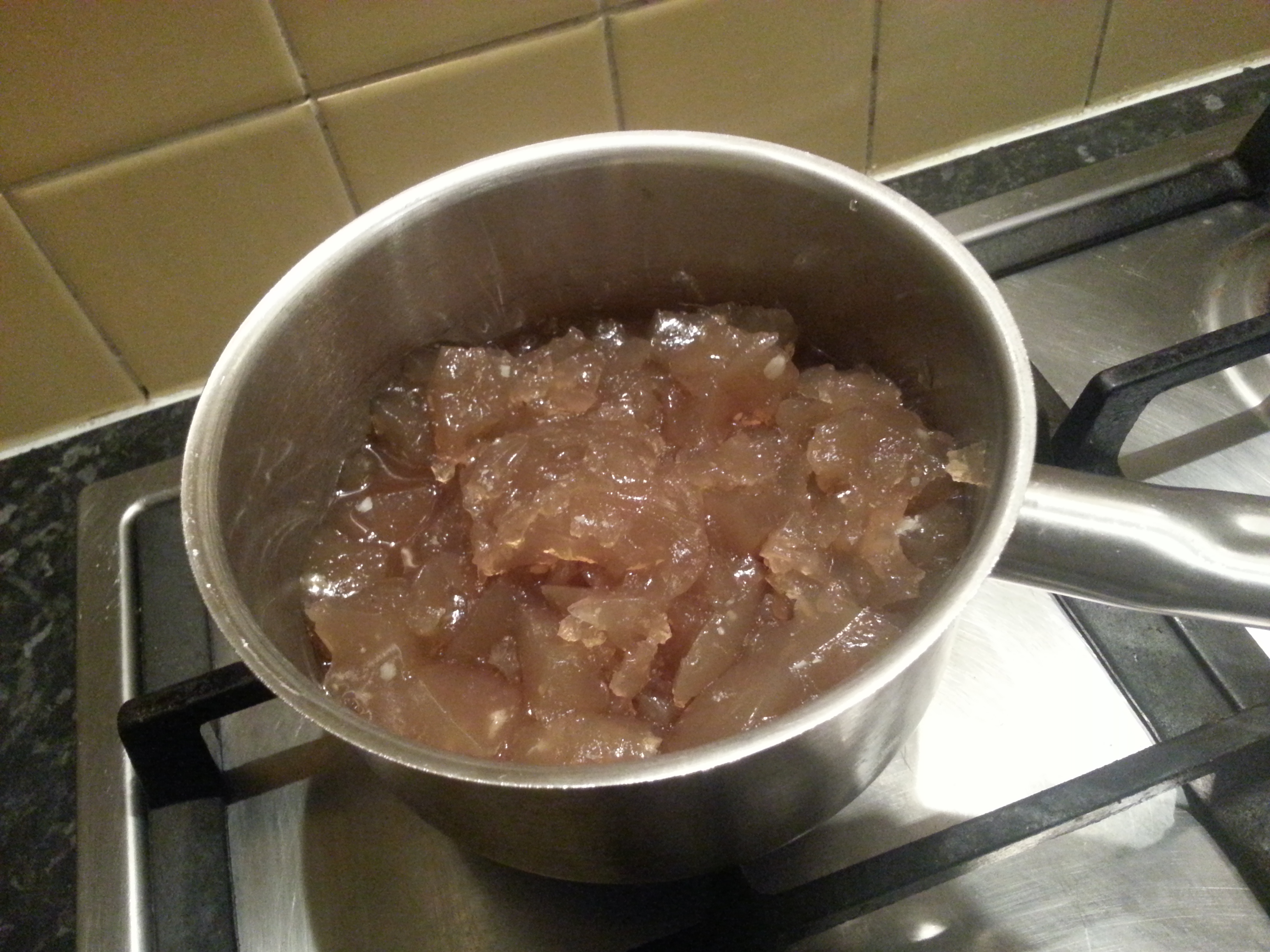
Wash and scrub any fluff of the quinces, then peel and core them. Place them in a large pan and pour over enough water to almost cover. Turn up the heat and when it begins to boil, turn heat down to a simmer and stew 35-45 minutes until the fruit is soft. Strain and pass fruit through a mouli-legumes.

2012-11-19 23.49.01

Put the pulp back in the pan with the strained juice and add 280g sugar for every 500ml juice or, 1 ½ lbs sugar for every pint of juice). Stir and dissolve under low heat then, simmer until it resembles ‘thick porridge’ and begins to leave the side of the pan when you stir it.

2012-11-20 00.37.10

Pour the marmalade into sterilised pots. It is very good as a jam on toast, with cheese or as an accompaniment to hot or cold meats.

2012-11-20 00.52.23

27 Comments

Filed under Britain, cooking, food, Fruit, General, history, Nineteenth Century, Preserving, Recipes, Uncategorized

Seville Oranges and Seville Orange Marmalade

The weather outside may be miserable and the evenings still long, but luckily there is a little fleeting  sunny surprise popping up in grocers around the country that can perk us up no end; at least if you know where to find them. It is Seville orange season and a small window of just a few weeks is all we have to cook with this delicious fruit.

FxCam_1357492834789

The Seville orange is very bitter and is only really grown in Spain for us British to make our Oxford marmalade. What a treat home-made marmalade is; oranges, water and sugar that is all that are needed to produce such a delightful, very British preserve. If you have never made your own, have a go before they are all disappear again.

Like all citrus fruits, the Seville orange comes originally from China. It was imported on trade routes via Italy, to the Mediterranean countries of Europe. All of these original orange trees were bitter in flavour like the Seville. In the first half of the 17th century, sweet orange trees were delivered to the Portuguese coast by ship. These sweet oranges quickly superseded the bitter ones, that is for that small area of Spain that still grows them.

The flowers of Seville oranges are also used to make orange flower water, another of my favourite ingredients.

Seville and game painting

Rabbit with Red Legged Partridge and Seville Orange by Jean-Baptiste Chardin 1728-29

Below is a recipe for  Seville orange marmalade, but it is useful to know that the zest and juice of these oranges go very well with game and some shellfish such as scallops as the above painting shows.


If you like the blogs and podcast I produce, please consider treating me to a virtual coffee or pint, or even a £3 monthly subscription: follow this link for more information.


Seville Orange Marmalade

Oddly enough, marmalade was not made from Seville or any other orange at first, but quince (a knobbly cousin of apples and pears). It did come from Spain though, in fact the Spanish word for quince is marmalada. Every day’s a school day.

This recipe is Jane Grigson’s and it is a good strong bittersweet ‘Oxford’ style marmalade.

Ingredients

3 ¼ litres water

1 ½ (3 lb) Seville Oranges

3 kg (6 lb) granulated sugar

Give your oranges a good scrub and place them in a preserving pan or large stockpot with the water. Bring to a boil and simmer for about 1 ½ hours until the oranges are tender.

FxCam_1357499871481

Take them out with a slotted spoon. They will probably collapse in on themselves, but don’t worry about that. Let them cool a little, then halve them and scoop out their innards. Tie up the scooped-out pulp in a piece of muslin. If you want a soft set, just put the bag of pulp straight into the pan, if you want it well set, give it a good squeeze to get as much pectin out of the pith and into the liquor as possible (I’m a soft set man).

FxCam_1357502382790

Next, shred the peel, you can be as careful as you want, and you can cut them as thick as you want. You can do this by hand or in the food processor by blitzing them using the pulse setting – be careful though, you don’t want a load of slurry. I’m usually dead against using food processors for this sort of thing, but I quite like the irregular pieces you get with this method. Tip them into the pan along with the sugar. Over a medium heat, stir until the sugar dissolves.

FxCam_1357505465756

Now you need to be brave and bring it to a full rolling boil for at least 15 minutes , you need it very hot so that the marmalade can set. You have several options to test for a set, but I use a combination of a sugar thermometer and the wrinkle test. Pectin – a chemical that essentially glues plant cell walls together – will set to a gel at 105⁰C (221⁰F), so a thermometer is crucial if you want to know if you are getting close. It can take a while because water needs to evaporate to get five degrees above boiling point. Keep a close eye on it and when it gets close do the wrinkle test. For this test put a side plate in your freezer a little while before you want to make your marmalade, and when you’ve achieved 105⁰C (221⁰F), turn off the heat and spoon out a little of it onto your cold plate. Return it to the freezer for a couple of minutes. Push the jelly; if it wrinkles up, your pectin is set. If not, boil up again and retest after 10 minutes.

FxCam_1357586951956

When ready, turn off the heat and allow it to cool for 15 minutes – this important step will stop your peel from floating to the top in a single layer – then pot into sterilized jars (bake them and their lids for 25 minutes at 125⁰C or 250⁰F).

IMG_2702

33 Comments

Filed under cooking, food, Fruit, General, history, Preserving, Recipes, Uncategorized

Syllabubs

Today the syllabub is rather an unfamiliar dessert but from the 17th and early 20th centuries it was a pudding staple. It has gone through some minor changes along its way but its essence has remained the same. Originally milk was sweetened and mixed with cider sack – a sweet fortified beer not unlike sherry – and left to curdle and treated as a drink served hot or cold. At the same time at more solid version was being made with cream and wine and spirits. More recently less alcohol and more cream was used producing a dessert that could stand in a cool place that would remain delicious, soft and fully whipped – this was known as an ‘everlasting syllabub’.

The Sense of Taste Philip Mercier (1680-1760)

Detail of The Sense of Taste by Philip Mercier (1680-1760) showing a salver of syllabubs

The word syllabub comes from the name Sille, an area in the Champagne region of France that made the eponymously named wine, and the word bub, an Elizabethan slang word meaning a bubbling drink, hence Sille bub – wine mixed with a frothy cream. In fact it was a case of the frothier the better, and the best way to achieve this is to spray milk straight from the udder (which has a natural froth) into the wine, this kind of syllabub was also called ‘Hatted Kit’ and a recipe appears for it in Elizabeth Raffald’s 1769 book The Experienced English Housewife:

“To make a Syllabub under the cow

Put a bottle of strong beer and a pint of cider into a punch bowl, grate in a small nutmeg and sweeten it to your taste. Then milk as much milk from the cow as will make a strong froth and the ale look clear. Let it stand an hour, then strew over it a few currants well washed, picked, and plumped before the fire. Then send it to the table.

elizabeth raffald

 Elizabeth Raffald

Charles II found this sort of syllabub so delicious that he kept cows at the palace in case he got a hankering for some Hatted Kit – he would walk up to one and squirt some milk into his flagon of wine, sack or cider.

If you are a tee-totaller, don’t worry because Sir Kenholm Digby, writing in 1669, gives recipes for syllabubs flavoured with plum juice, cherry syrups and Seville orange.

By the 19th century, the syllabub was generally made from whipping cream together with sweetened wine. The wine was flavoured with lemon and fortified with a little brandy, and it is a recipe for one of these everlasting syllabubs that I give below. It comes from Elizabeth David’s 1969 pamphlet Syllabubs and Fruit Fools (which can be found in her book An Omelette and a Glass of Wine).

Elizabeth David’s Everlasting Syllabub with Almond Biscuits

Elizabeth David

The ingredients of a syllabub, we find, are simple and sumptuous. The skill demanded for its confection is minimal, the presentation is basic and elegant.

Elizabeth David


If you like the blogs and podcast I produce, please consider treating me to a virtual coffee or pint, or even a £3 monthly subscription: follow this link for more information.


These syllabubs were the original topping to trifles before plain whipped cream took over. They are often served with jellies or with sweet biscuits so I’ve given a recipe for some simple crisp almond biscuits too.

The most important ingredient here is the wine; you can use any sweet or dessert wine, by personal favourite being a nice Muscat. I managed to get hold of an excellent and very reasonably-priced organic free-trade one from Case Solved Wines in Manchester.

2012-12-29 20.42.01

This recipe makes between 4 and 6 servings

Ingredients for the syllabub

8 tbs sweet or dessert wine

2 tbs brandy

pared rind of one lemon

60g (2 oz) sugar

300ml (½ pint) double cream

freshly grated nutmeg

The day before you want to serve the syllabub, mix the wine and brandy in a bowl, add the lemon peel and steep overnight.

Next day, strain the wine into a large bowl and stir in the sugar until dissolved. Pour in the cream and whisk until thick. Be careful not to over-whip the cream. Spoon into glasses and scatter a few raspings of nutmeg over them.

For the biscuits:

100g (4oz) butter

50g (2oz) caster sugar

150g (6 oz) plain flour

50g (2 oz) ground almonds

Cream the butter and sugar together and then mix in the flour, and finally the almonds. Bring the mixture together with your hand to form a dough – it’ll be very ‘short’, i.e. crumbly, but it will come together – don’t be tempted to add any water or milk because it will result in a biscuit that is not crisp, and you don’t want that. Roll out the mixture to the thickness of a pound coin (about 3mm) and cut into rounds.

Bake for 8-10 minutes at 200⁰C (400⁰F) until tinged with golden brown. Cool on a wire rack and store in an airtight tub.

4 Comments

Filed under baking, Biscuits, Britain, cooking, Dairy, Desserts, food, history, Puddings, Recipes

Beetroot

Hello there everyone. Here’s just a quick post to prove that I am not dead, but still alive and kicking! I have had such a crazy couple of months getting this business of the ground whilst working at the University of Manchester and Manchester Metropolitan University. Phewee! There’s no rest for the wicked as they say (and if it is true then I must be extremely wicked indeed).

Anne Swan Beetroot

Ann Swan’s beautiful vegetable art

One vegetable that ranks very highly in my favourite foods is the humble beetroot; it would certainly be in my Top 10. Jane Grigson wrote a fantastic book called Good Things in which each chapter focusses on her favourite ingredients. If I were to write my own version, beetroot would be included. It’s that mixture of sweetness and earthiness that you can’t really get from anything else. Some people shudder at the thought of it as a vegetable in its own right – too much overcooked purple mush at school has not done it any favours – and only really eat it as a pickle.

It is actually a very versatile vegetable; you can boil it, roast it, pickle it, and by virtue of its sweetness, use it as a cake ingredient that surpasses the carrot.

Beetroot has been cultivated for centuries and its ancestor is the sea beet Beta marinama a rather common plant found around the coasts of Eurasia, especially along the Mediterranean Sea. It is from this plant we get today’s red beet (plus several other varieties like the golden beetroot) as well as sugar beet and the less well-known mangel-wurzel or mangold. The latter is used mostly as animal fodder, though it has been a food crop for people too in the past (for those of you that remember it, the scarecrow Wurzel Gummidge had a head made from mangel-wurzel). The history of sugar beet is very interesting and deserves a post all to its own. Oddly enough, the beet plant wasn’t cultivated for its sweet tap roots at first, but its leafy greens. Indeed, our Swiss chard is also of the same species as beetroot and sugar beet. Eating the root didn’t catch on until the 16th century.

There is loads of beetroot hanging around at the moment and it should be reasonably cheap in the greengrocer’s shop this time of year, so you should jump at the chance to having a go at preserving them. I got a huge batch from Manchester Veg People.

IMG_2525

I have already provided a recipe for curried beetroot chutney, but I thought I’d give you the recipe I use to pickle beetroot as well. I first came across it in Good Things (1932) by Florence White, who mentions that the recipe must be very old, though she mentions neither when it was written or by whom. I did find an almost identical recipe as I was flicking through a copy of Mrs Beeton’s Book of Household Management (1861; which can be read online; see this link here).

It is the inclusion of an infusion of black peppercorns and allspice that really makes this pickle special. You’ll never go back to buying jars of it ever again! It’s important to remember to not peel the beetroots before you cook them, otherwise their wonderful colour will be lost to the cooking water.

Pickled Beetroot

2 kg (4 ½ lbs) beetroot

1 ¼ litres (2 pints) cider vinegar

15 g (½ oz) peppercorns

15 g (½ oz) allspice berries

Top and tail but do not peel the beetroot, then simmer them in plain water for around 30 minutes until tender. Very large ones may take over an hour to cook. Meanwhile, boil up the vinegar with the spices and simmer for 10 minutes then strain. Let the beetroots and vinegar cool completely before peeling and slicing the beetroots.

IMG_2532

Put into sterilised jars and cover with the strained, cooled vinegar. In two weeks they’ll be ready to enjoy.

IMG_2533

If you like the blogs and podcast I produce, please consider treating me to a virtual coffee or pint, or even a £3 monthly subscription: follow this link for more information.


7 Comments

Filed under cooking, food, history, Preserving, Recipes, Vegetables