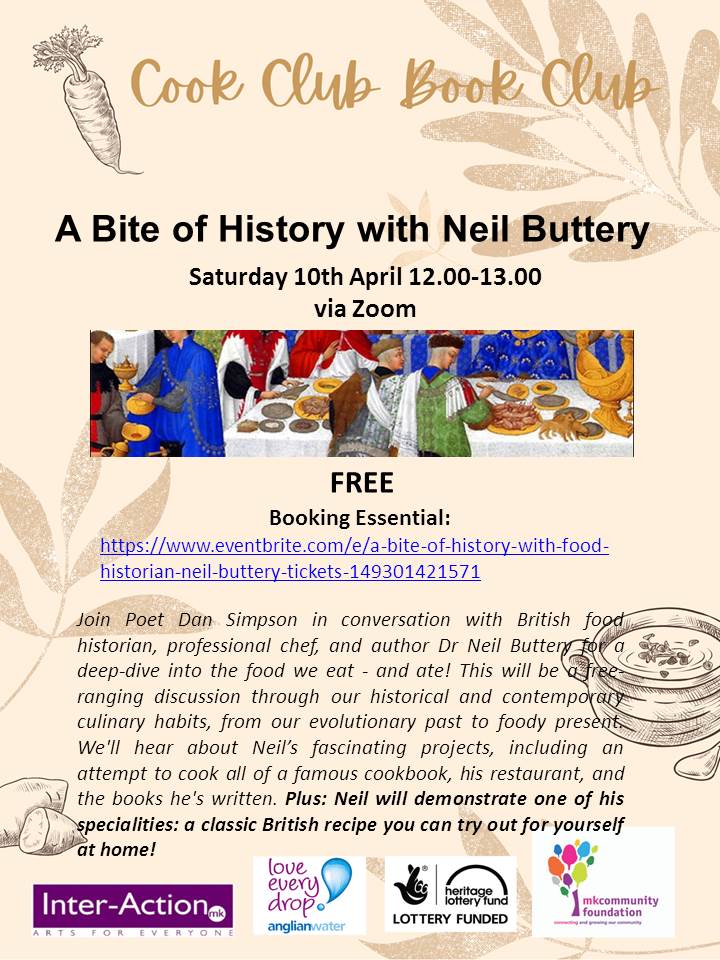
Hello all – a very quick post to let you all know that this Saturday 10th April at noon (GMT) I’m taking part in a free event called ‘A Bite of History’. I’ll be in conversation with poet Dan Simpson and we’ll be discussing allsorts of things: food history and historical cooking, the evolution of our never-sated desire for sugar, the trials of running a restaurant and of course the blog. There’ll be a Q&A session too, so if you have any burning questions I shall do my best to answer them.
I’m also going to attempt a live cook spot – what could possibly go wrong!?
The breakfast was delicious, consisting of excellent tea, buttered toast and Glamorgan sausages, which I really think are not a whit inferior to those of Epping.
George Barrow, Wild Wales, 1862*
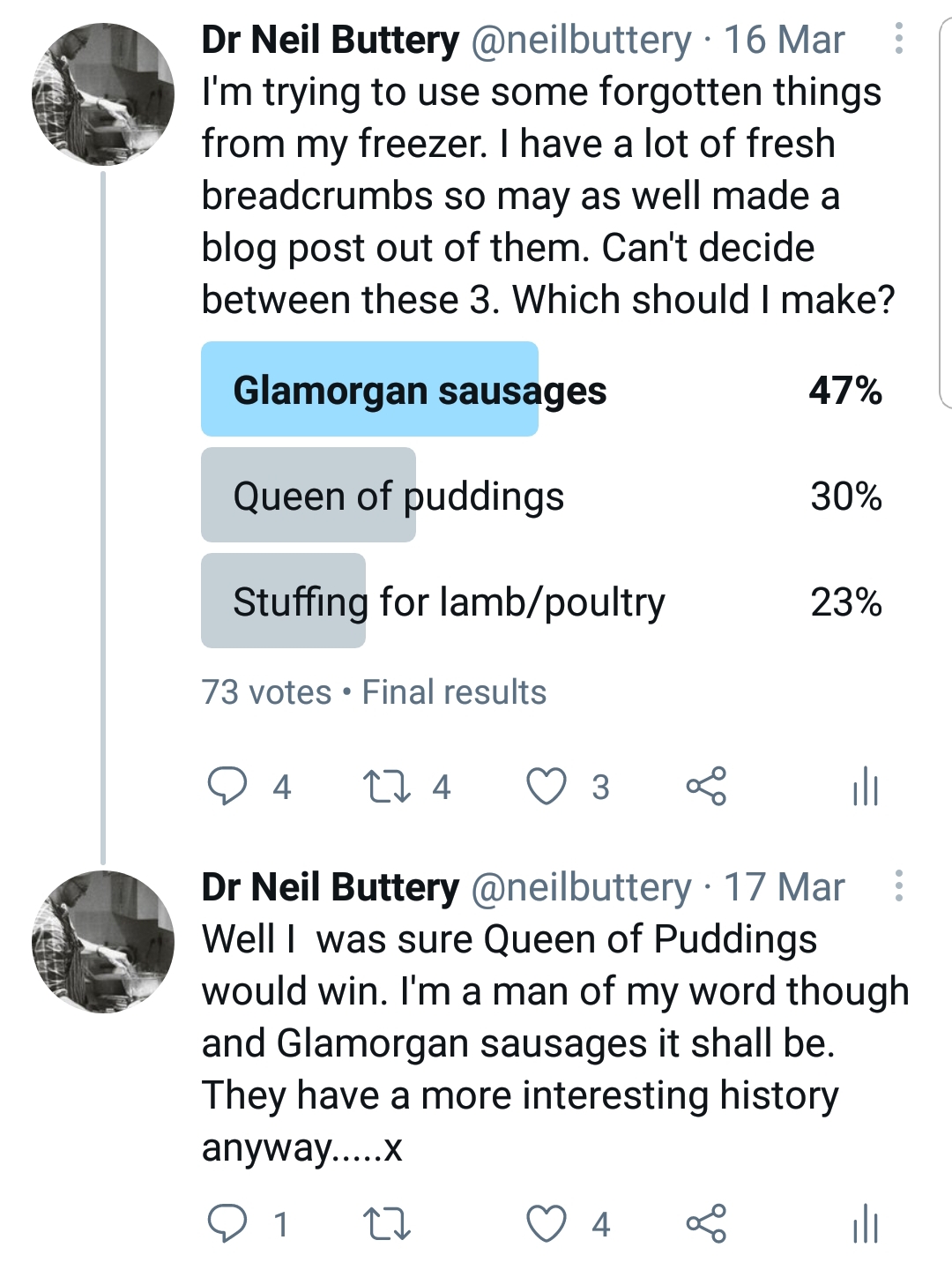
I don’t know about you, but I’m a beggar for freezing all sorts of bits and bobs left over from kitchen tasks or clearing out the fridge – carcasses, egg whites, vegetable trimmings – all in the name of frugality, and then promptly forgetting about them entirely. Because of this bad habit my freezer is full to bursting, and desperately needs emptying. The worst offender is fresh breadcrumbs: two bags full of them, in fact. As soon as I saw them, three foods flashed up in my mind: a nice stuffing for poultry, Queen of Puddings or the Welsh classic, Glamorgan sausages. Unsure which to make, I turned to Twitter, and Twitter resolutely told me it should be Glamorgan sausages. I was sure Queen of Puddings would win, but I’m always terrible at guessing the outcomes of these things.
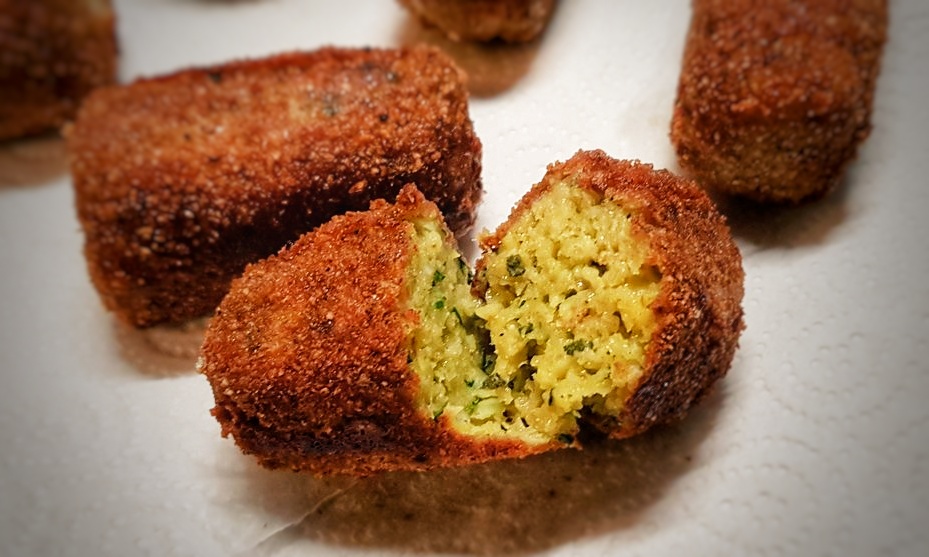
A Glamorgan sausage is “a kind of savoury rissole made of cheese, leek or onion, eggs and breadcrumbs.”1 and they hail from the Vale of Glamorgan, south-east Wales. The Vale has been excellent spot for dairy farming for millennia, says Jane Grigson: “the Iron and Roman Age Welsh were largely a pastoral people moving about and dependent upon flocks and herds.”2 The work was – and is – hard, and communities were often cut off from other for whole seasons at a time; it seems that it was worth it though because the cows were very productive, and there was often a surplus of milk and cheese. This cheese was mixed with leftover bread and flavoured with leek, spring onions and parsley. This mixture was formed into sausage shapes and fried in lard or beef dripping.
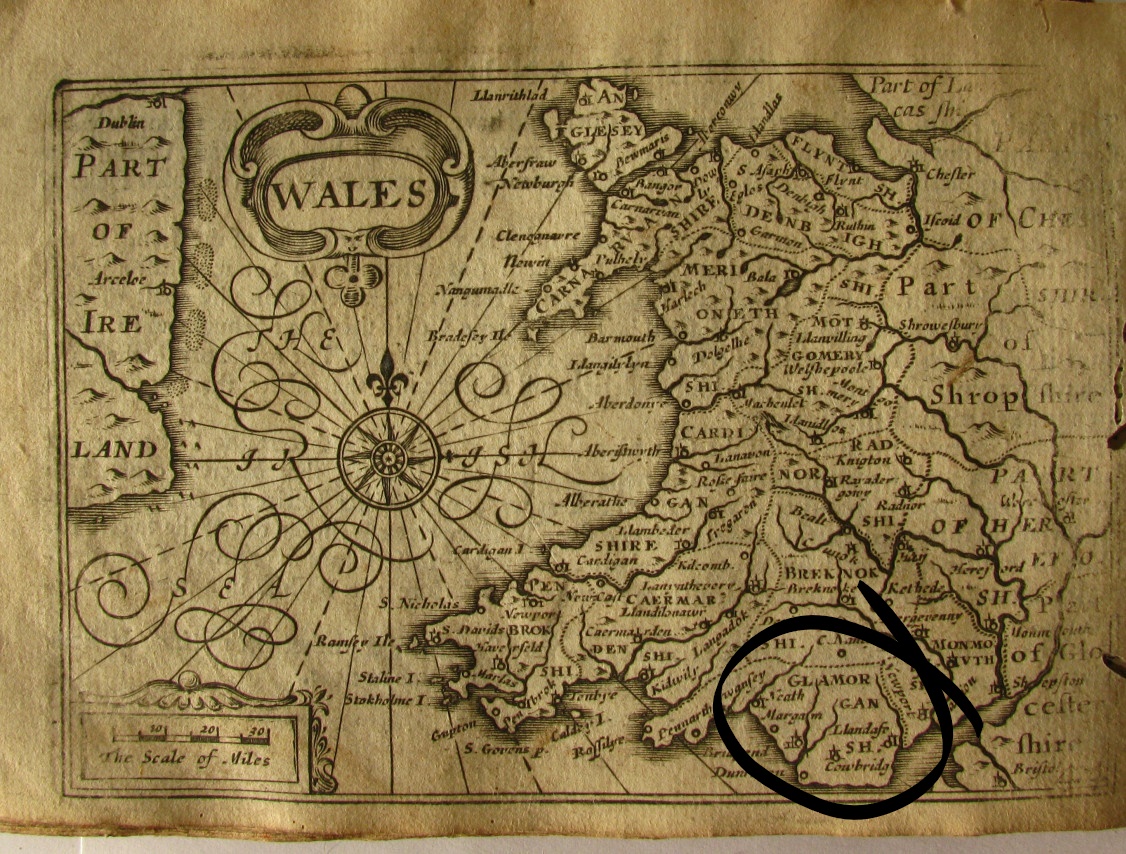
A 1627 map of Wales, the Vale of Glamorgan is circled in black
There is a myth that the Glamorgan sausage is actually a twentieth century invention, created by the Ministry of Food during the Second World War to push meat-free cooking during rationing. As the quote at the top of this post tells us, they have been around a lot longer than the 1940s.
Traditionally Glamorgan sausages were made using Glamorgan cheese from the milk of the old Glamorgan and Gwent breeds3,4 which declined to almost extinction in the twentieth century, and so a replacement cheese is used today, the best known Welsh cheese, Caerphilly. It is described by the Welsh Cheese Company thus: “Caerphilly has a lactic, fresh lemony flavour and a slightly crumbly texture.”5 They also complain – as do I – of the wan, tasteless Caerphilly cheese we find in our supermarkets today.
If you cannot find a good Caerphilly from a good cheesemonger, I would advise going for a different cheese altogether, the best substitute being Lancashire. You can, of course, use Cheddar, indeed I have used it several times in past, so I will not judge.
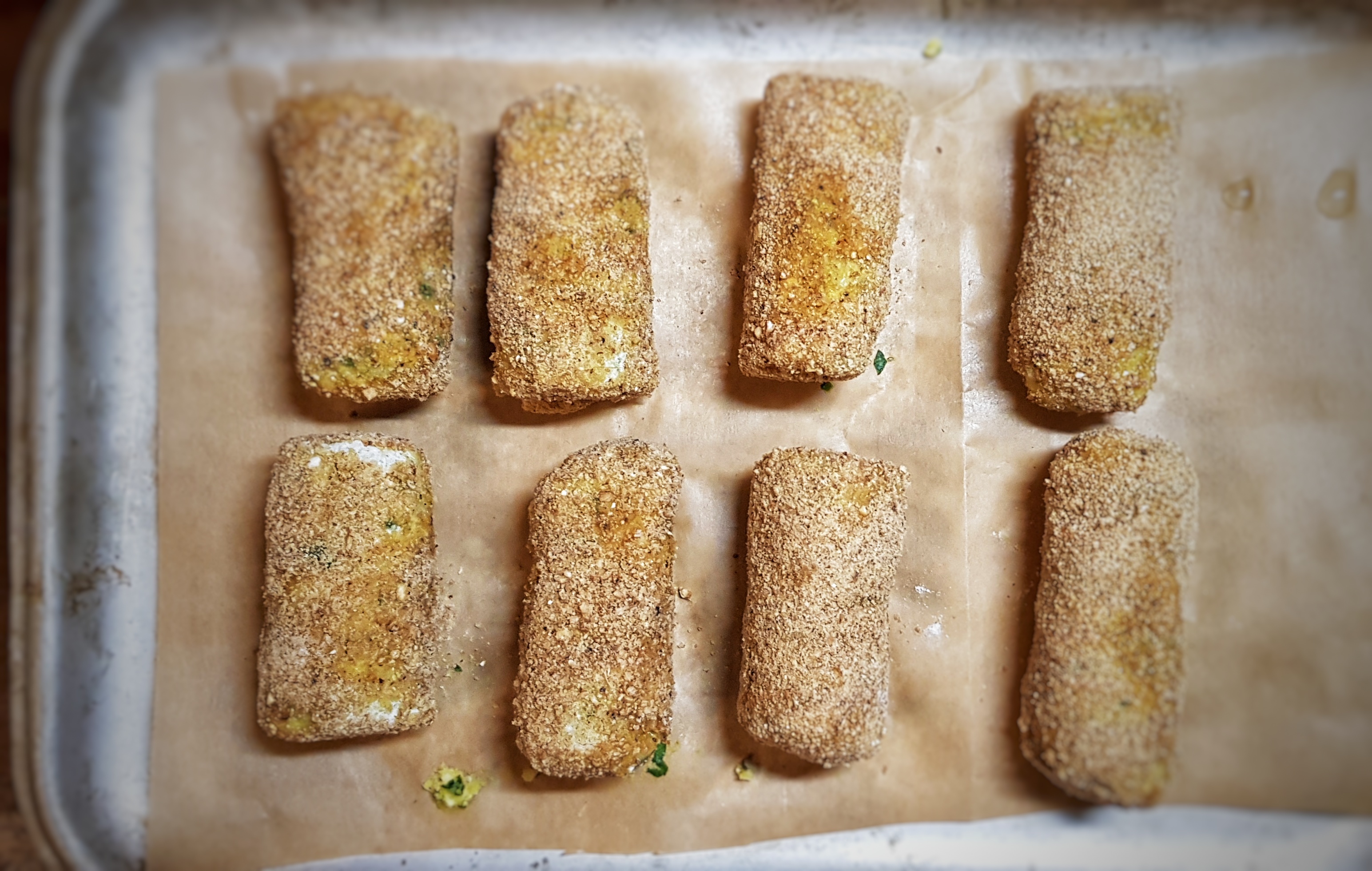
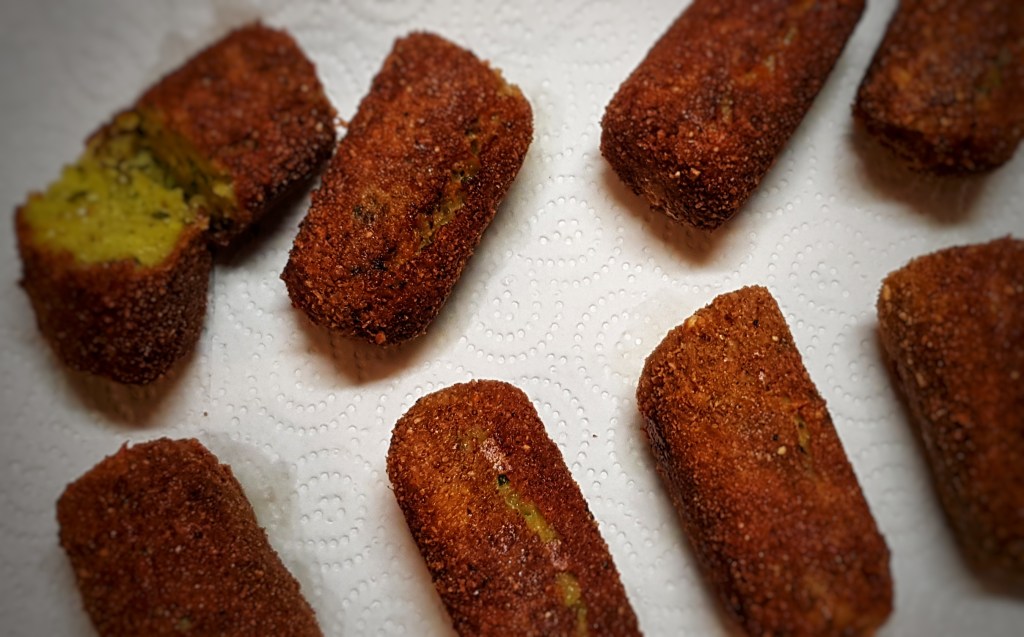
Glamorgan sausages ready for frying
If you like the blogs and podcast I produce, please consider treating me to a virtual coffee or pint, or even a £3 monthly subscription: follow this post for more information.
If you’ve never made them before, have a go because they are easy to make and delicious, and, in my mind, a much superior vegetarian sausage to any masquerading as ‘meaty’ in supermarkets’ freezer cabinets. They can also be made and kept in the fridge for up to three days until you want to fry them. They also freeze well uncooked.
The great food historian Theodora Fitzgibbon suggests eating them “hot with fried puréed potatoes [or] for breakfast with bacon.”4 I heartily agree.
Makes 8 sausages
180-200 g Caerphilly cheese (or Lancashire or Cheddar)
120 g fresh breadcrumbs
3-4 cm section of leek, finely chopped
2 tbs chopped parsley
4 sage leaves, chopped
Leaves from 2 sprigs of thyme
2 tsp English mustard (or up to 3 if using a mature Cheddar)
2 eggs
Salt and pepper
2 tsp water
2 tbs seasoned flour
Extra breadcrumbs (fresh or dry) for coating
Sunflower oil, beef dripping or lard for frying
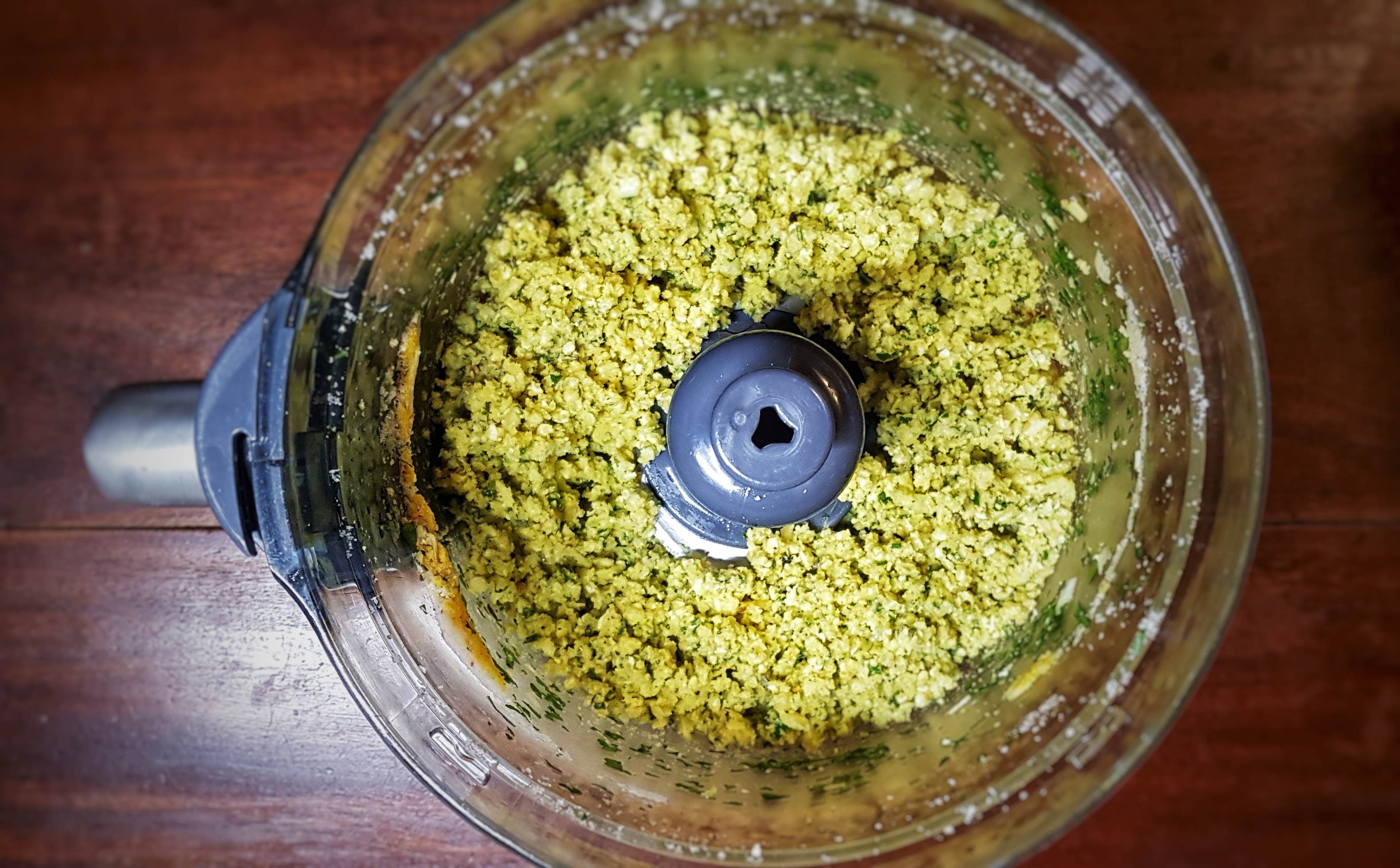
Grate the cheese and place in a food processor with the breadcrumbs, leek, herbs, mustard and one of the eggs and some salt and pepper. Pulse to a sticky rubble – the mixture should easy come together, if all seems a little dry, add the water and pulse again. This can all be done by hand, of course, if you prefer.
Bring the mixture together with your hands to form a nice yellow-green dough and divide into eight equal pieces. Wet your hands and roll the pieces into little sausages, around 1 ½ cm thick.
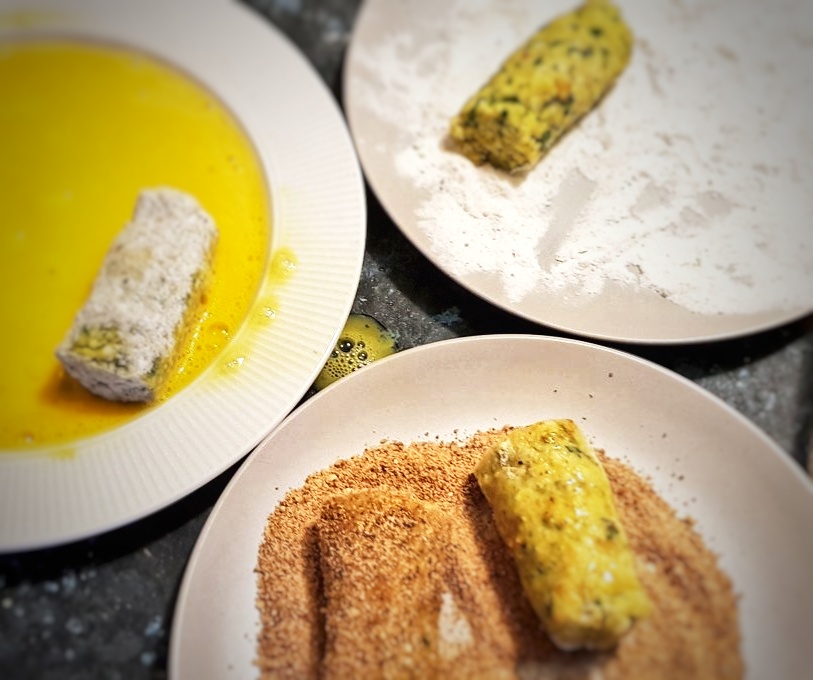
Now find three saucers, sprinkle the seasoned flour on one, beat the egg and pour that on another, then scatter your extra breadcrumbs on the third.
Now roll a sausage in the flour, tapping away excess, then the egg and then the breadcrumbs. Repeat for the remaining sausages.
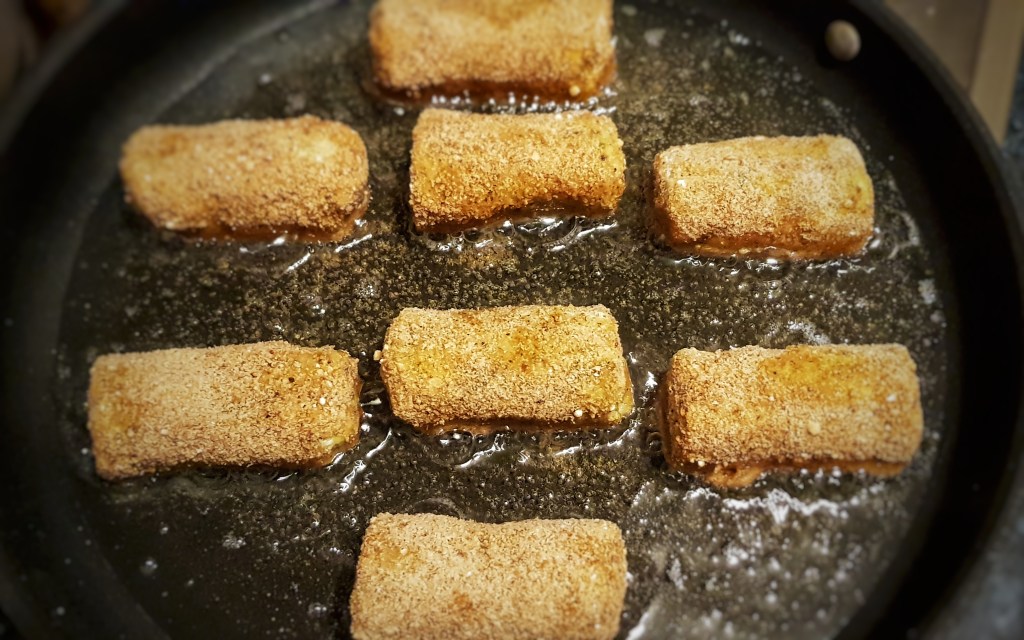
Heat a deep frying pan over a medium-high heat with the oil or lard; you need enough for a half-centimetre depth. When hot fry the sausages for around 3 minutes, then turn them all a quarter turn – use two forks for this – cook another 3 minutes, etc until they are golden brown all over.
Remove and drain on kitchen paper and serve immediately.
*This quote is taken from, A Taste of Wales by Theordora FitzGibbon. The Epping sausages referred to in the quote are a skinless type made from pork and sometimes breadcrumbed or floured before frying, hence the comparison.
References
1. Mason, L. & Brown, C. The Taste of Britain. (Harper Press, 1999).
Last post I told you all about the origins of the pressure cooker, and how it was invented by Frenchman Denis Papin in the seventeenth century. One part of his story really struck a chord with me, and that was an almost throwaway comment made by diarist John Evelyn. He attended the ‘philosophical supper’ where Papin cooked for the members of the Royal Society, everything pressure-cooked in his “Digester”. Evelyn wrote about in his diary and described how deliciously tender everything was, but noted that the pigeons were particularly delicious:
We ate pike and other fish, bones and all, without impediment; but nothing exceeded the pigeons, which tasted just as if baked in a pie, all these being stewed in their own juice, without any addition of water save what swam about the digestor
As soon as read that, I knew I had to try it.
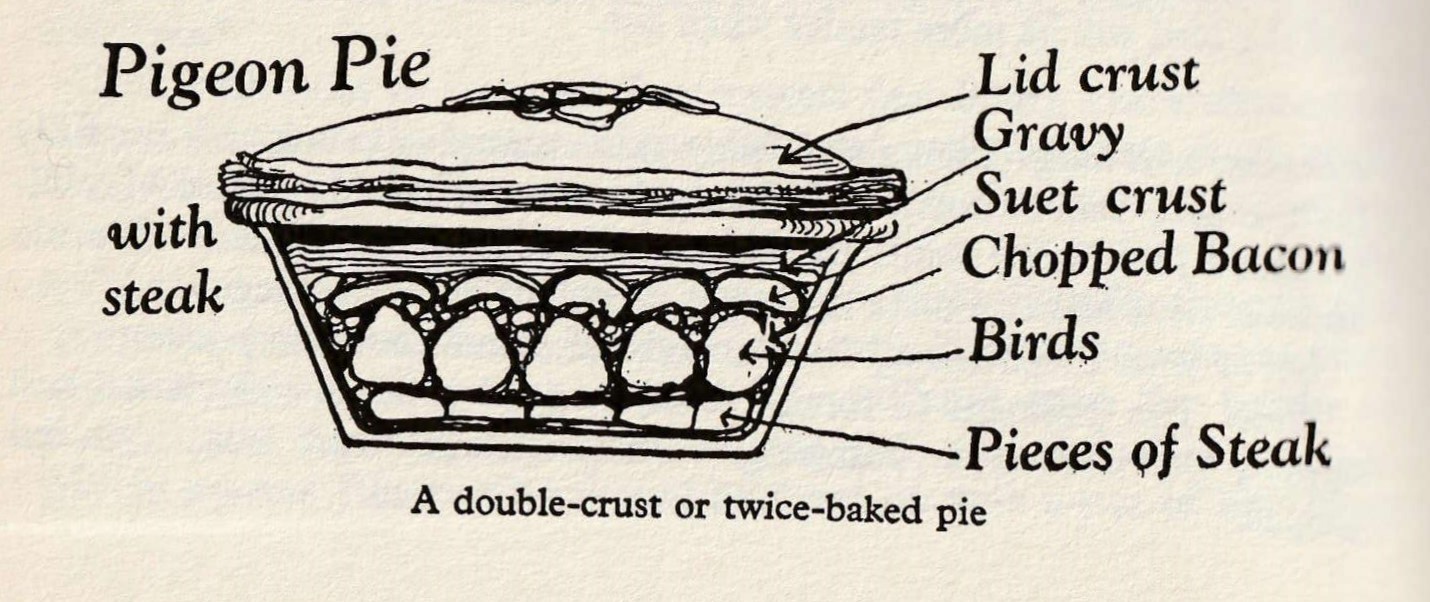
I don’t know what your mind conjures up when you imagine what a pigeon pie was like in days of yore, but I always think of Dorothy Hartley’s illustration and description in her wonderful book Food in England. Hers has a double crust and a layer of suet dumpling dough inside, but it was the interior of the pie that I was interested in here.
Dorothy Hartley’s pigeon pie
After a pie dish is lined with the pastry, a slice of braising steak is laid inside with the pigeons on top, then there is a sprinkling of bacon pieces and mushrooms. Stock or gravy is poured over them before the dumpling layer and second pastry layer are added on top. This recipe is for old pigeons that require long cooking, but if young pigeons (squabs) were used, the pies were cooked quickly and at a high temperature, the shortcrust pastry swapped for flaky or puff pastry and the stewing steak swapped for sirloin or veal. There is no definitive recipe, and there are recipes for pigeon pie from the seventeenth century that contain oysters, bone marrow, pistachio nuts and cockerels’ stones (testes). However they are cooked, pigeon pies were well regarded because of their tenderness.
If you like the blogs and podcast I produce, please consider treating me to a virtual coffee or pint, or even a £3 monthly subscription: follow this post for more information.
In my interpretation of pie-style pressure cooker pigeon, I stuck quite closely to Hartley’s description, though I added a few aromatic herbs and vegetables and good glug of red wine. I heartily recommend it, and the pigeons do come out exceedingly tender:
Serves 4
1 good knob of butter or bacon fat, around 30 g
4 cloves of garlic
1 leek, trimmed and sliced
2 sticks of celery, chopped
3 bay leaves
12 sprigs thyme
2 portobello mushrooms, sliced
Salt and pepper
2 tbs plain flour
6 rashers dry cured streaky bacon (smoked or unsmoked)
2 oven ready woodpigeons
400 g piece of braising steak (I used top rib)
125 ml red wine
250 ml beef stock
2 tbs chopped parsley
Melt the butter or fat over a medium high heat and add the garlic, leek and celery. Tie the bay leaves and thyme with some string and toss into the mixture. Season well with salt and pepper. Fry and brown the vegetables for around 10 minutes, stirring occasionally. Add the mushrooms and fry for a further 5 minutes.
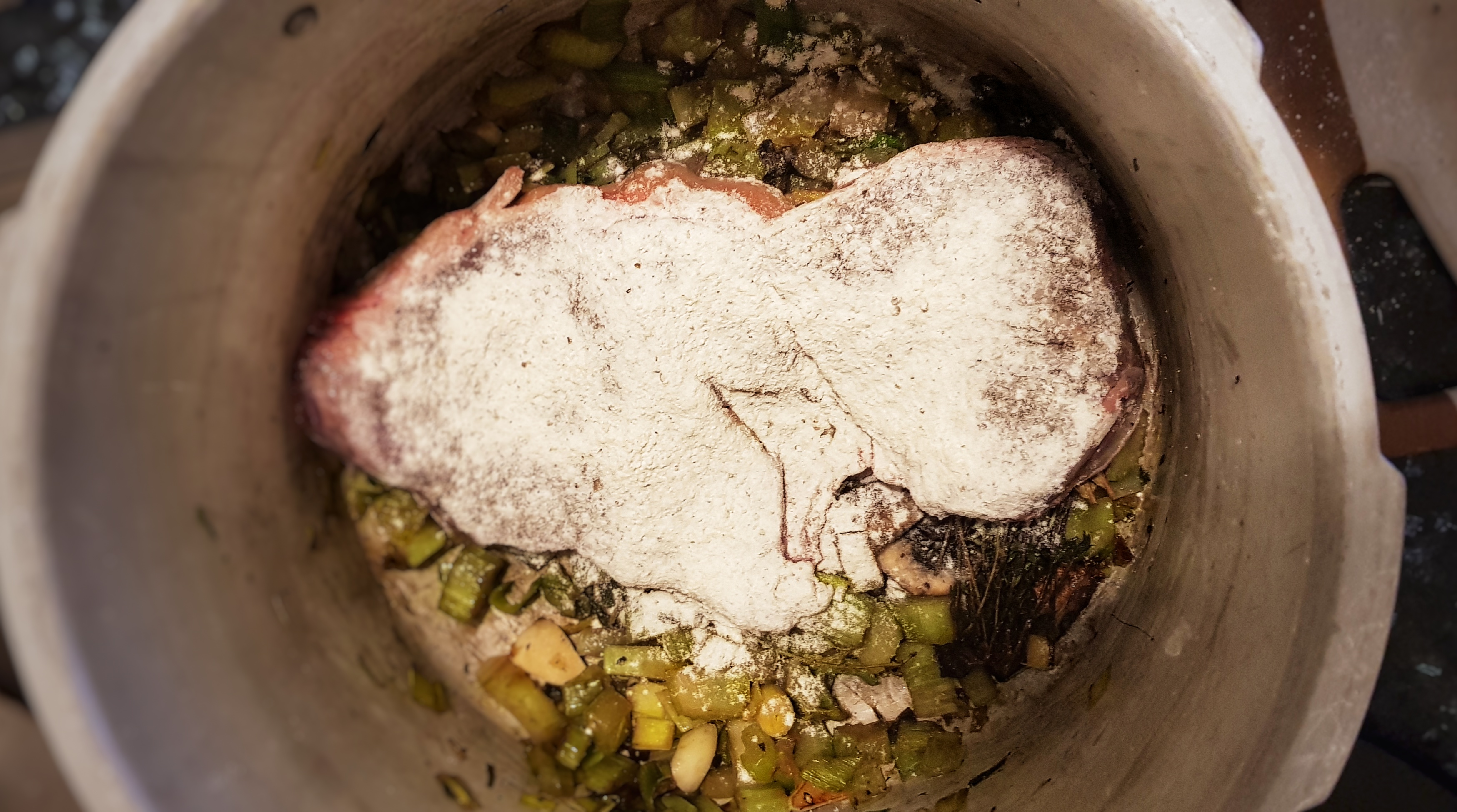
Meanwhile season the flour and scatter it over a plate. Give the steak a good coating of seasoned flour by pressing it down so that it gets a good covering of flour: make sure you do both sides.
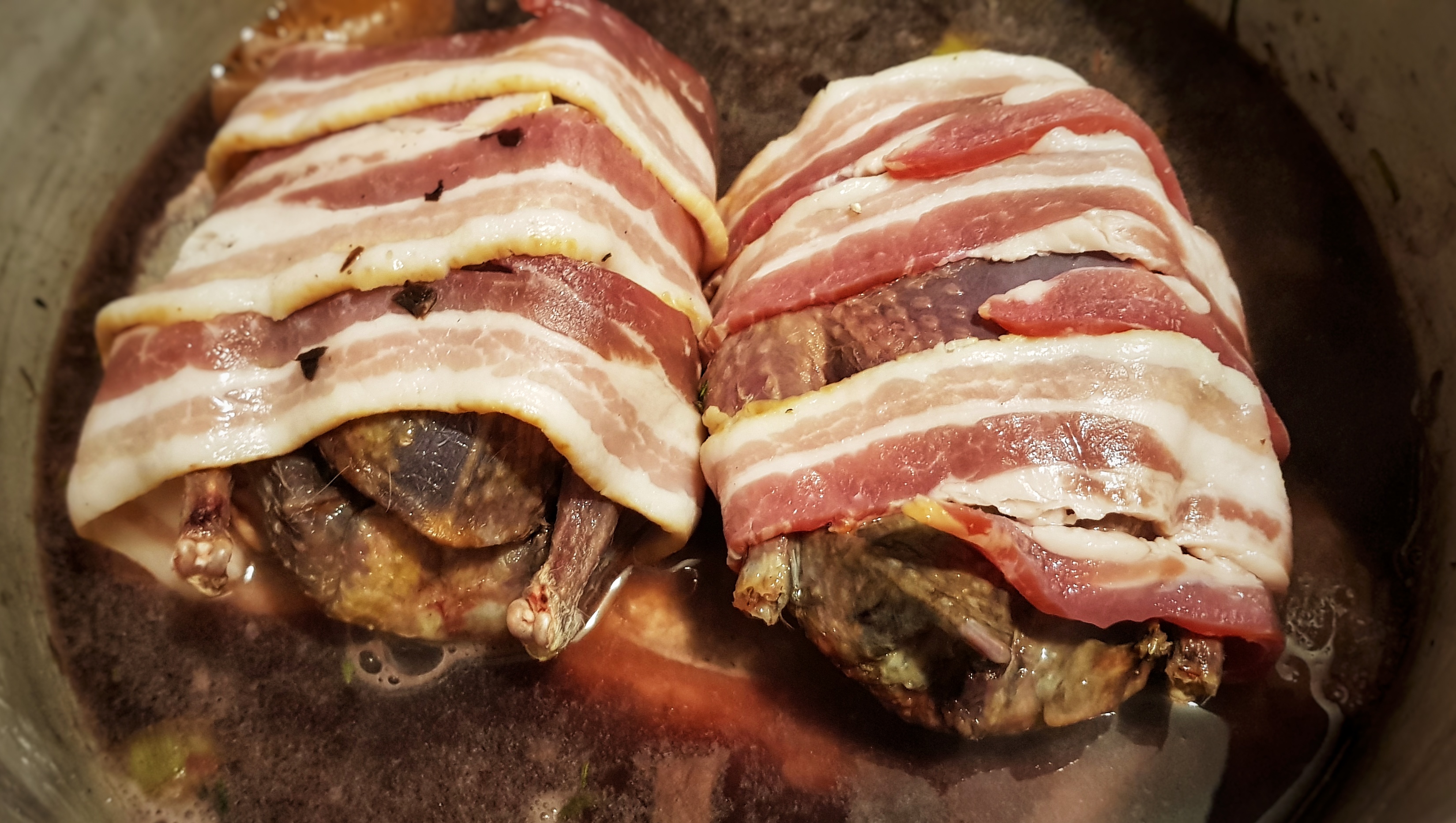
Lay out 3 bacon rashers side by side on a board, sit a pigeon at one end and roll up, tucking the rashers underneath. Repeat with the other pigeon.
Take the pan off the heat, sit the beef on top of the vegetables, sprinkling in any flour that refused the stick to the beef. Sit the pigeons on top and pour over the wine and stock. The liquid should cover the beef, but only go up around a third of the pigeons. Add more stock – or plain water – if necessary. Add the parsley and then close the pressure cooker lid.
Bring up to full pressure and then turn down to a quiet hiss for 1 hour. Turn the heat off and allow to cool enough so that the lid can be removed safely.
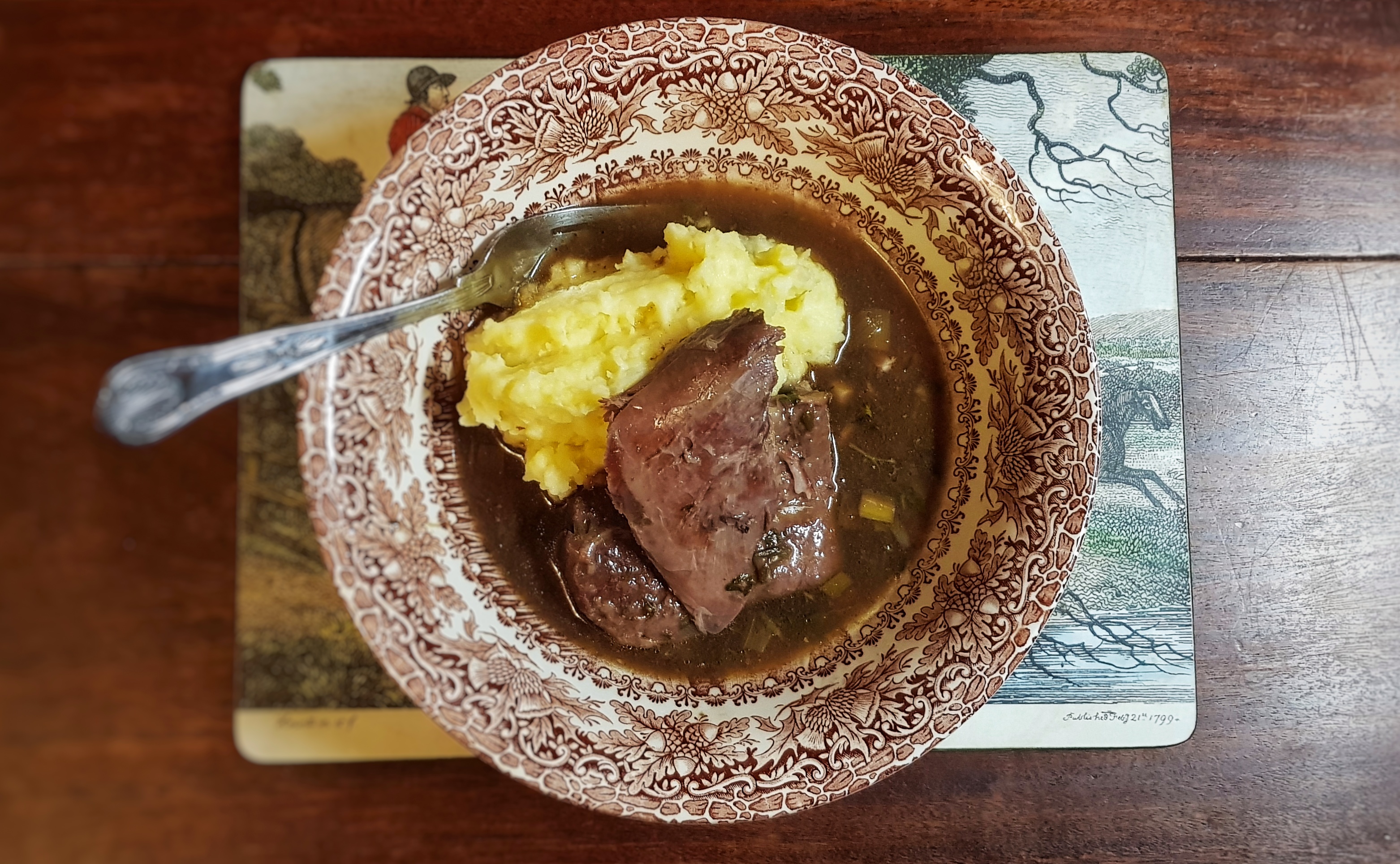
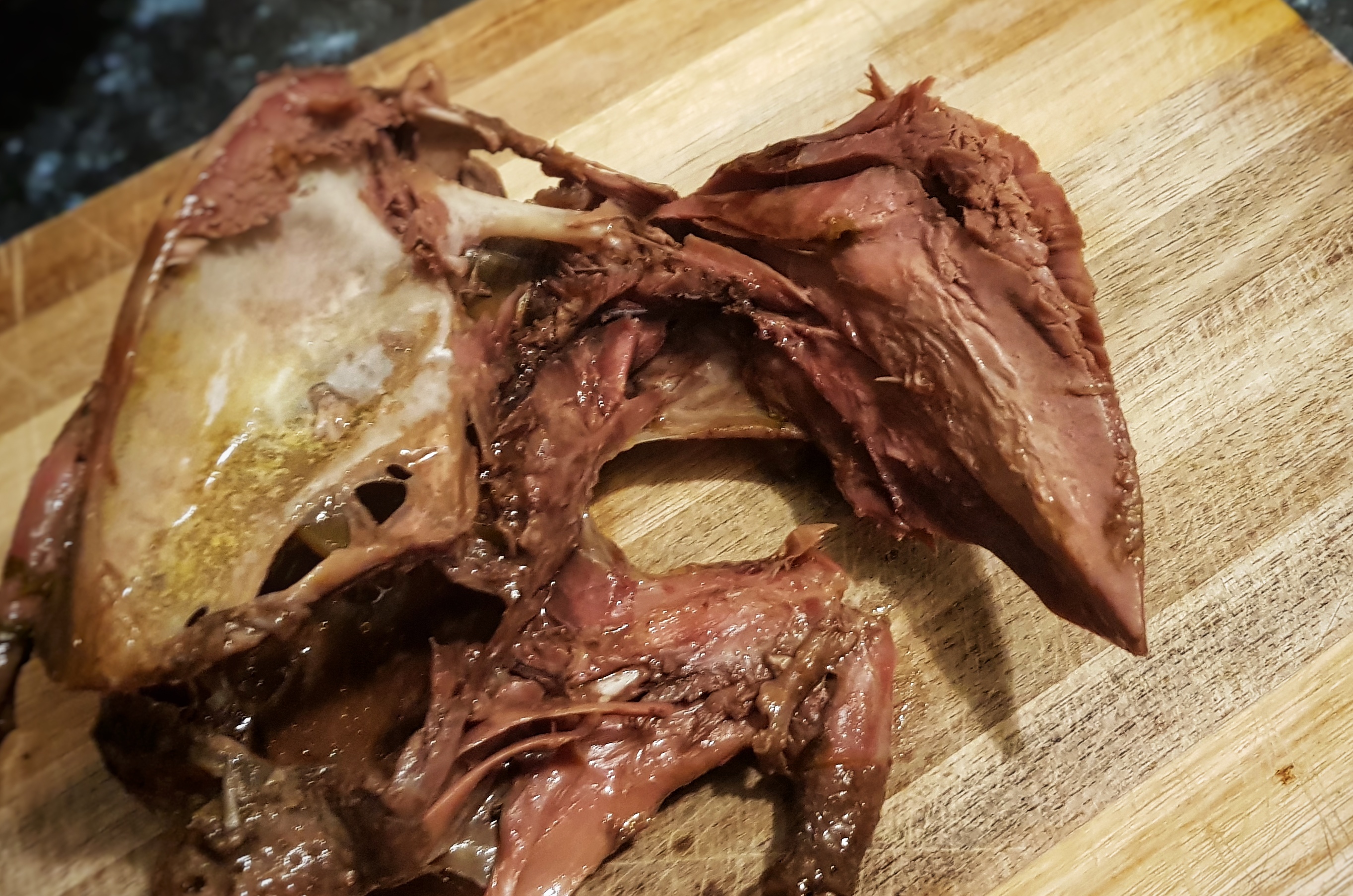
To serve, remove the pigeons from the cooker, take off the bacon and return it to the vegetables, then remove the pigeon breasts – you should be able to do this with a spoon – and divide the beef into four pieces.
Just look how clean the meat comes from the bone. Deliciousness.
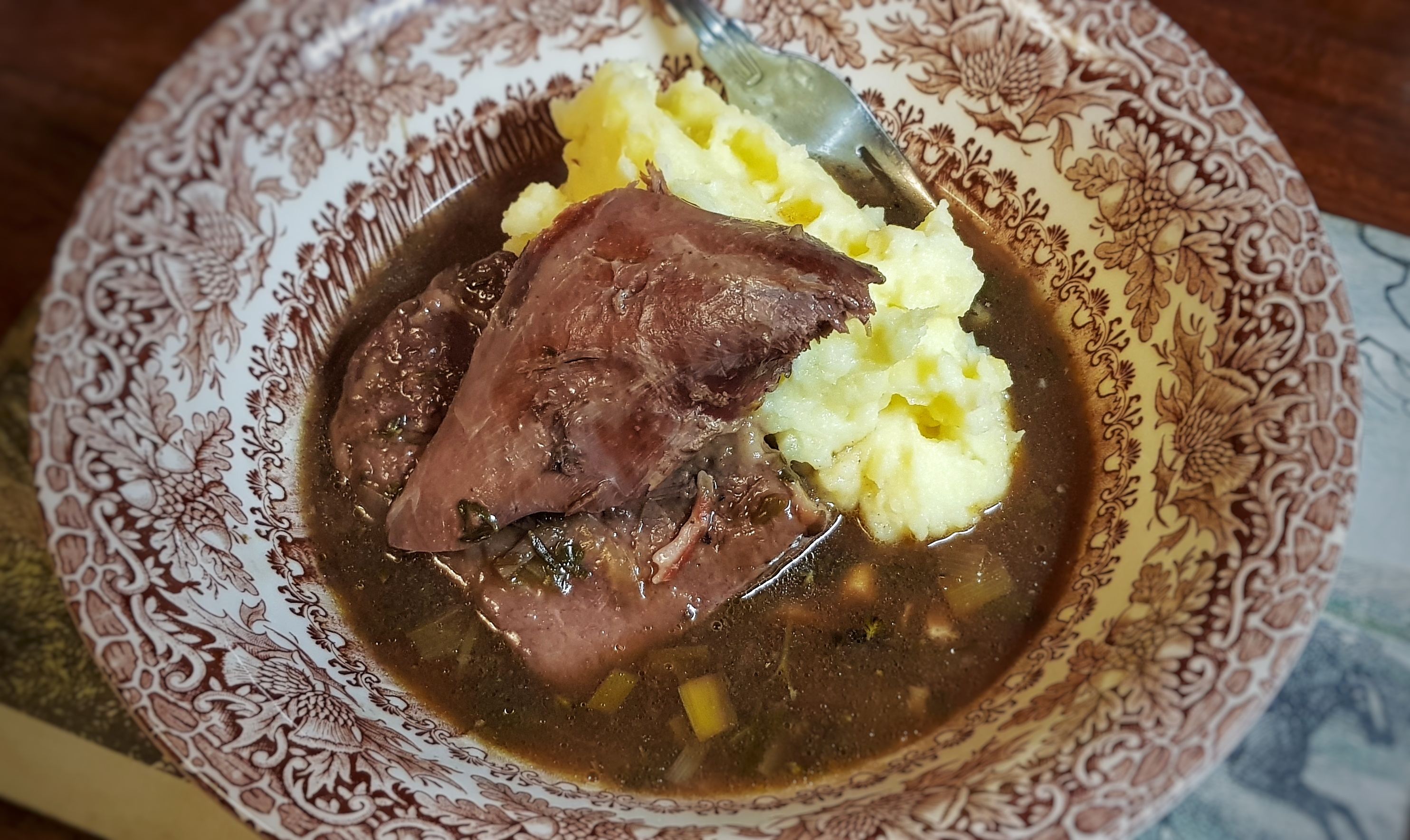
Mash the very soft bacon into the vegetables. Place a piece of beef in the centre of a plate or deep bowl, sit a pigeon breast on top and spoon over the vegetables and gravy.
If you like the blogs and podcast I produce, please consider treating me to a virtual coffee or pint, or even a £3 monthly subscription: follow this link for more information.
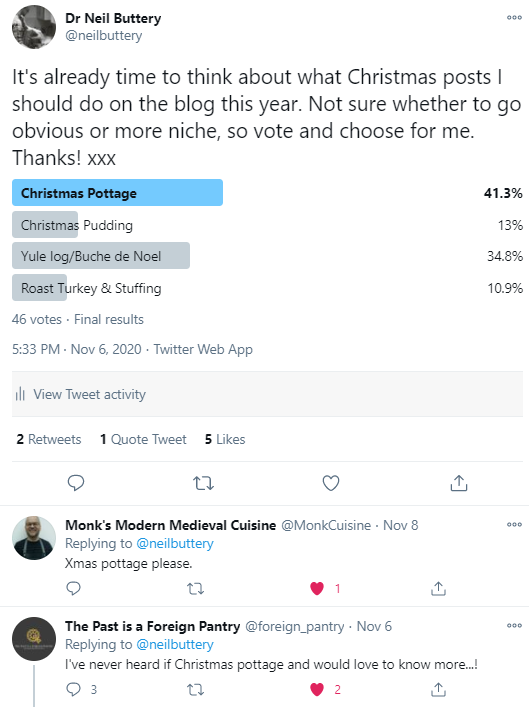
It’s getting close to Christmas and I am sure that many of you are starting to plan what food you will making for the big day. I try and give you a Christmas recipe every year and I narrowed things down to four, and then asked Twitter which I should post and Twitter answered: the traditional Christmas pottage, the forerunner to the more familiar Christmas pudding.
Then, in a strange coincidence, Channel 5 asked me to take part in their Christmas special for their Cakes & Bakes show, asking if I would do a bit on the history Christmas pottage/pudding/cake. It won’t be broadcast until Christmas 2021, but it can be viewed on their streaming service to watch right now, just follow this link. As usual it was great fun to film, though – as always – rather nerve-racking.
This blog post complements this podcast episode:
Pottages were thick soups – stews really – made from meat and vegetables, made thick with grains or breadcrumbs. The meat was omitted if it was a fast day of course. Everyone ate them; if you were poor it wasn’t much more than a thin gruel. If you were rich it was packed with meat, boose, dried fruits and spices, and at Christmas they really went overboard.
As far as I know this pottage was made from at least the Late (or, if you prefer, ‘High’) Middle Ages and it was eaten either on Christmas Day, or even better on Christmas Eve: a big steaming bowlful of it would be the perfect way to mark the end the 24-day fast that was Advent and start of the 12-day piss-up that was Christmastide.
And as all the people in the neighbourhood dine with [my uncle] at Christmas, he takes care to place those who are married at the upper end of the table with himself, and to provide them each with a silver spoon to eat his plumb-porridge, which is generally very good, while the batchelors and maidens, at the lower end of the table, are furnished only with wooden spoons, and have their plumb-porridge serv’d up in a wooden bowl.
From ‘Excursion of an Oxonian into the Country’ in The Student, Or, The Oxford and Cambridge Monthly Miscellany (1750)
Here’s the eighteenth century recipe I based mine on:
Plum-Pottage, or Christmas-Pottage. Take a Leg of Beef, and boil it till it is tender in a sufficient quantity of Water, add two Quarts of red Wine, and two Quarts of old strong Beer; put to these some Cloves, Mace, and Nutmegs, enough to season it, and boil some Apples, pared and freed from the Cores into it, and boil them tender, and break them; and to every Quart of Liquor, put half a Pound of Currans pick’d clean, and rubb’d with a coarse Cloth, without washing. Then add a Pound of Raisins of the Sun, to a Gallon of Liquor, and half a Pound of Prunes. Take out the Beef, and the Broth or Pottage will be fit for use.
Prof. R Bradley, The Country Housewife and Lady’s Director‘ (1728)
It really was quite the dish.
Often pottages were cooked in a hot water pastry instead of expensive earthenware or iron pots; these were given the name ‘coffins’ and overtime pastry and baking became more refined and produced for us the mince pie. Sometimes the pottage (or porridge) was cooked in a bag and boiled (see Cauldron Cooking). It had to be less soupy and bound with eggs but cooking it this way provided us with the Dickensian cannonball-shaped Christmas pudding.
I took a look in the excellent University of Leeds Special Collections and found that they cite this fifteenth century recipe as the first example of the dish. It is more savoury, packed with onions and herbs and died red with saunders (a dye made from cedarwood).
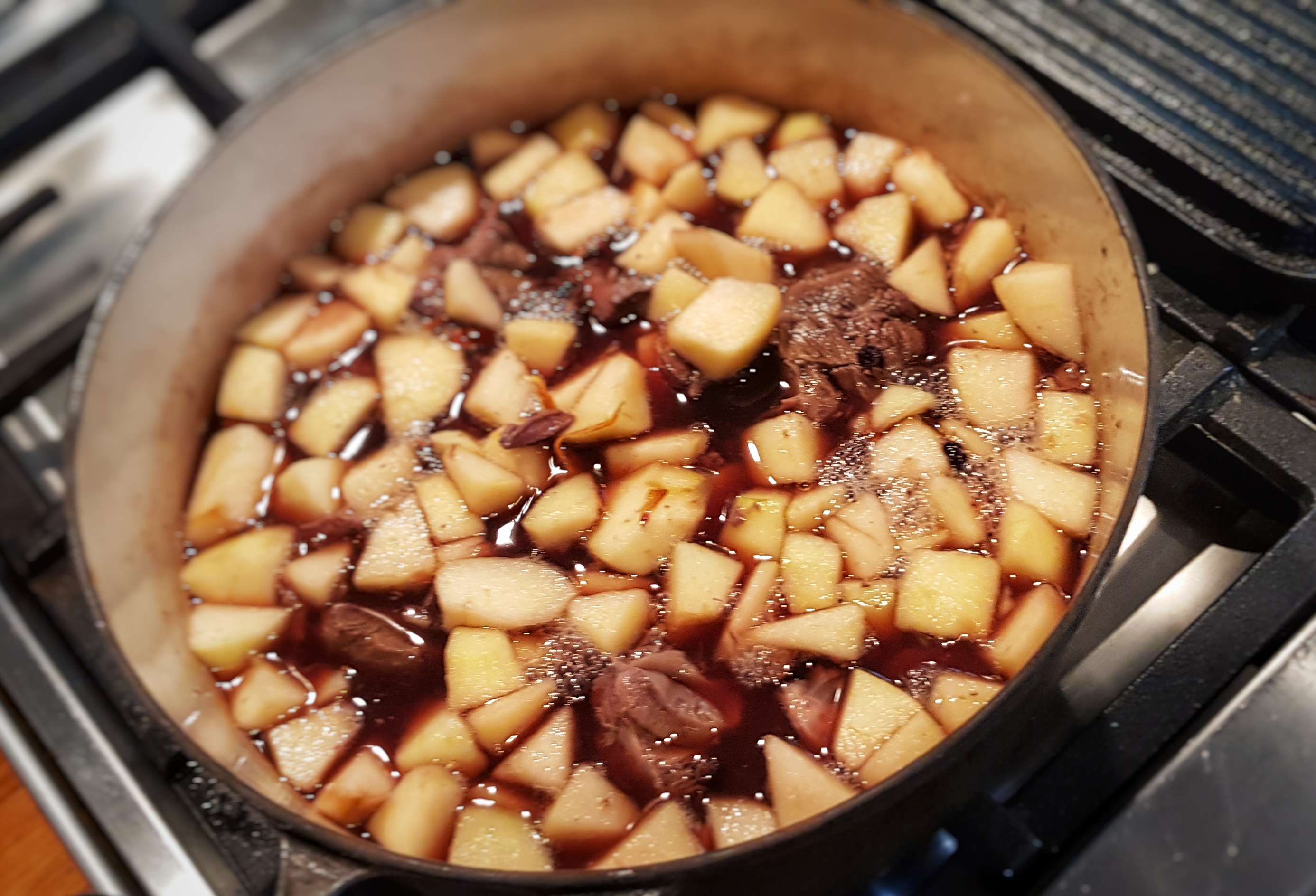
My recipe will feed the whole family, including the “batchelors and maidens” that’s for sure. If you don’t want whole spices you can use ground ones and if you don’t want to use beef (or don’t have the time) just swap the water for beef stock:
500 g shin beef, sliced
1 litre cold water
1 tsp salt
400 ml red wine
400 ml stout
2 nutmegs, cracked, or 1 tsp ground nutmeg
6 blades of mace, or 1 tsp ground mace
1 heaped teaspoon whole cloves, or ½ tsp ground cloves
2 medium-sized Bramley apples, peeled, cored and diced
200 g currants
100 g raisins
100 g prunes
2 or 3 handfuls of fresh breadcrumbs(optional, see recipe)
Place the beef shin in a large saucepan with the salt and pour in the water. Heat over a medium flame – take your time – until the wate begins to just simmer. Skim away and scum, cover and leave to simmer very gently 2 ½ to 3 hours or until tender.
Add the remaining ingredients except the breadcrumbs, bring back to a simmer and cook until the apples are tender, and the fruit has plumped up nicely, around 30 minutes.
Break up the beef (if it hasn’t already fallen apart on its own) with the back of your spoon and then add enough breadcrumbs to achieve the desired consistency: you can leave it soupy if you like and add none, though I think it was better thickened slightly. Start by adding 2 handfuls and allow to simmer for 10 minutes, and then add more if you think it needs it.
Taste, adding more salt if you think it needs it and serve.
References
The Country Housewife and Lady’s Director‘ (1728) by Prof. R Bradley
‘The Festival of Christmas’ by Joan P Alcock in Oxford Symposium on Food & Cookery, 1990: Feasting and Fasting: Proceedings (1991)
‘Stewet of Beef to Potage’ in A collection of ordinances and regulations for the government of the royal household, made in divers reigns. From King Edward III. to King William and Queen Mary. Also receipts in ancient cookery (1790) by the Society of Antiquaries of London; University of Leeds Special Collections: https://library.leeds.ac.uk/special-collections/view/811
Here we go…the third part in my trilogy of posts about muffins and crumpets.
Of the two, muffins do seem to be the most labile of the tea cakes: sometimes they are a crumpet in all but name, and other times they are somewhere in between, and because I am a total geek, I have decided to illustrate this observation in a table.
In the columns are six characteristics of muffins and crumpets and then compared old recipes and given them a score out of six for each match. Full marks means it is what we would call a classic muffin today, zero marks means it’s a crumpet and I have put these in the first two rows as controls. As you can see, muffins are all over the shop, achieving the full gamut of scores:
The oldest recipe I found appears to actually be a crumpet, but for the next one we seem to have a proper muffin – it doesn’t quite achieve full marks because plain flour is used, but 200 years ago strong flours were much less common than today, so I’m prepared to forgive that one. As we move up the table there’s a bit of a wobble, settling down again in the 1970s to become proper muffins once more.
One thing that has changed is the amount of liquid used for the dough, in the nineteenth century, it was so soft that it required a seasoned professional: “Practice and judgement are required to make one proficient in muffin-making” said Robert Wells in the Bread and Biscuits Assistant 1929.
The dough was almost batter, and it had to be deftly formed into blobs that were then set to prove inside dimples made in thickly spread flour. They were then gingerly lifted onto an iron griddle, bakestone or oven bottom.
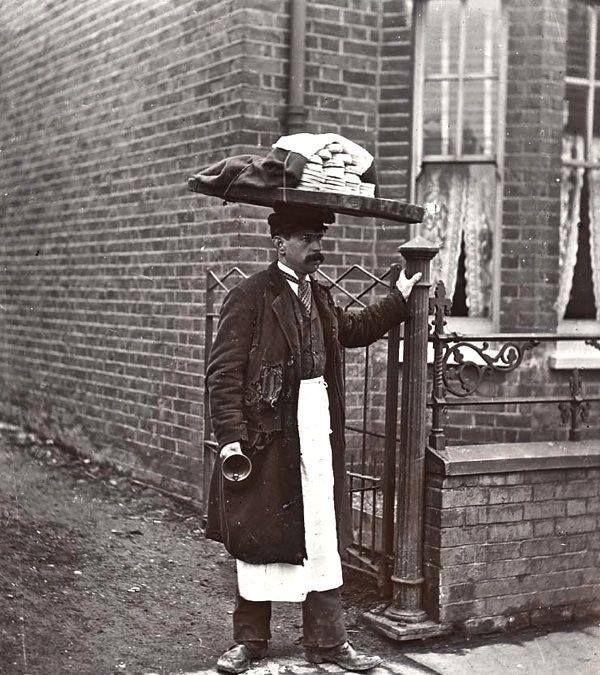
A muffin man c. 1910. Muffin men were a dying breed at this time
In the Victorian era, the muffin was the essential teacake for teatime and they often bought from the muffin man who would ring his bell a little before tea, summoning the occupants of the houses who would rush out to purchase some of his muffins (or where they crumpets!?) “well swathed in flannel” to keep them warm. Then, in the 1840s a Parliamentary Act was passed prohibiting ‘costermongering’ by the beating of a drum or ringing of a bell. I’m pleased to say that no one took a blind bit of notice and a clandestine trade in warm muffins continued unabashed. By the 1910s the muffin was seen as old-fashioned by many:
“Muffins are essentially an old-fashioned fare…They are not now regarded as essentials on the tea tables of the present generation…The ordinary baker sells so few that it is not worth his while to keep a hot-plate for their manufacture”
John Kirkland, The Modern Baker, Confectioner and Caterer, 1907
Doughs became easier to handle in the twentieth century, requiring less skill and labour, and in the days of mass-manufacture they became more bread-like.
If you like the blogs and podcast I produce, please consider treating me to a virtual coffee or pint, or even a £3 monthly subscription: follow this link for more information.
To Toast a Muffin:
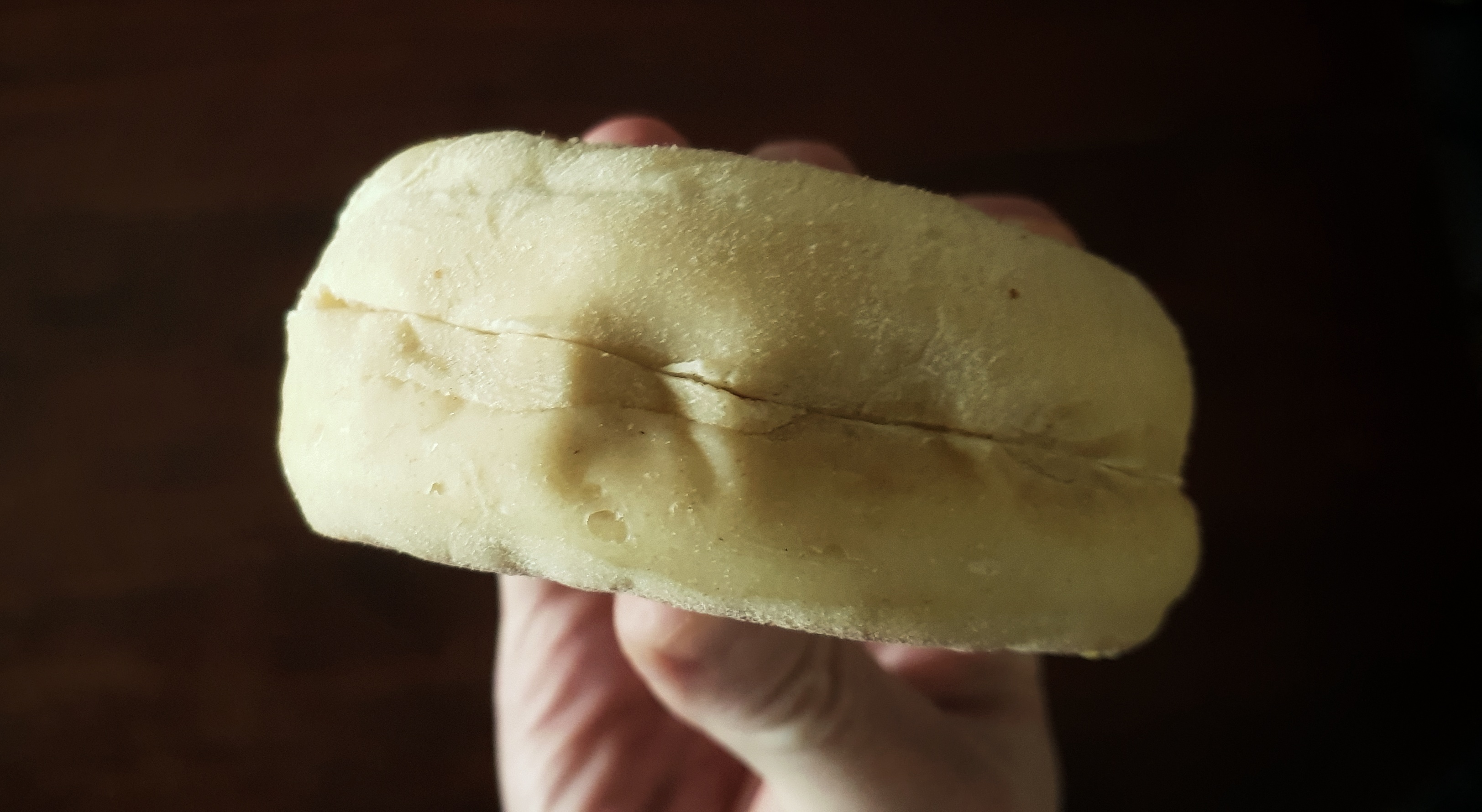
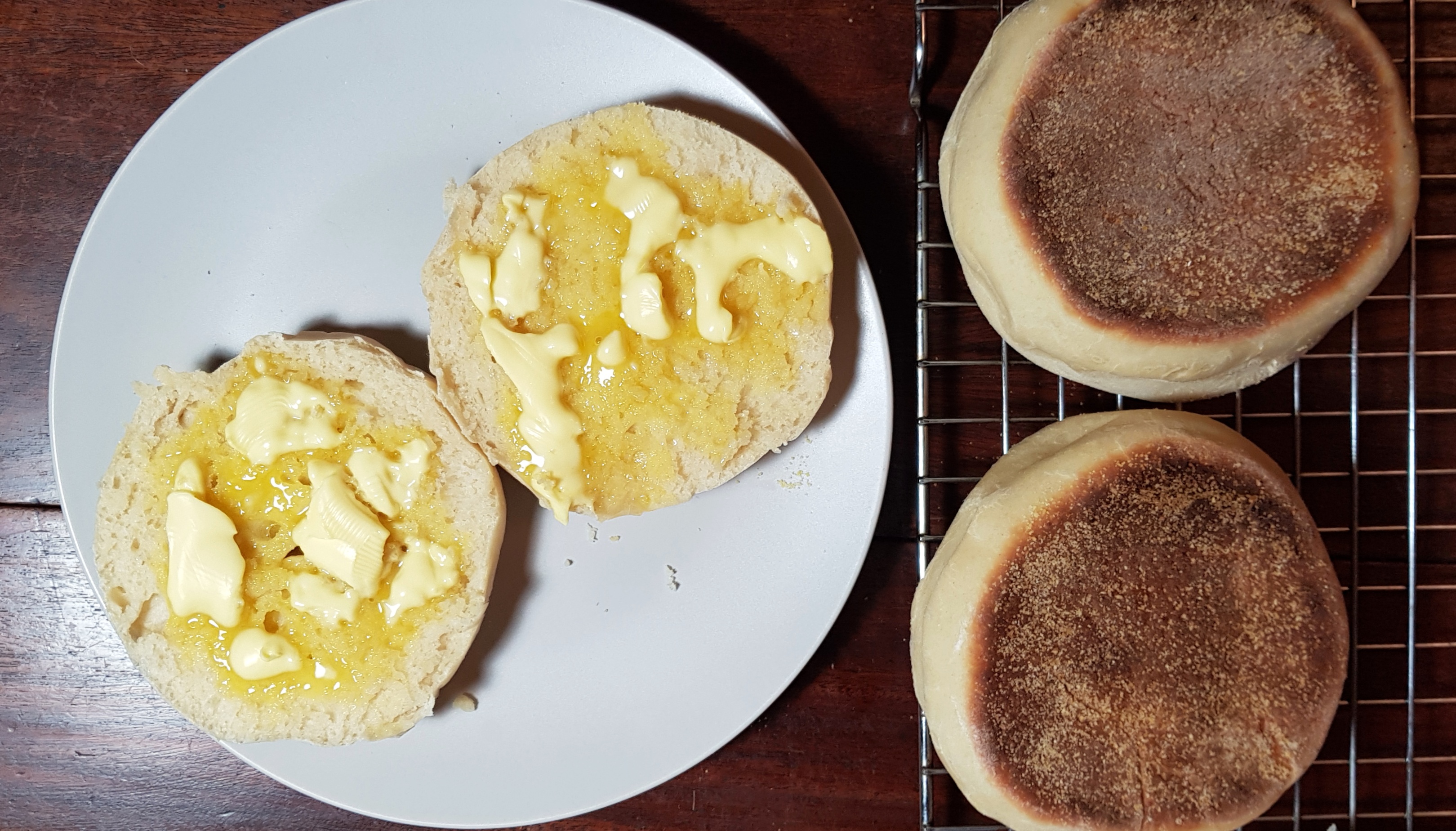
Of course you can eat your muffin as soon as it comes of the griddle, but should you wish to toast them later it is important you get it right: “I should like to draw attention to the old method of toasting the muffin in the North of England” says a Mr Dupois Brown in 1931, who suggests “slightly opening its joint all around before toasting it both front and back; then tearing open and buttering the inside halves liberally…but in all the teashops where I have ordered muffins it was toasted on the inside, thus causing it to be tough, leathery and indigestible.” You have been warned.
Circumferential incision made ready for toasting!
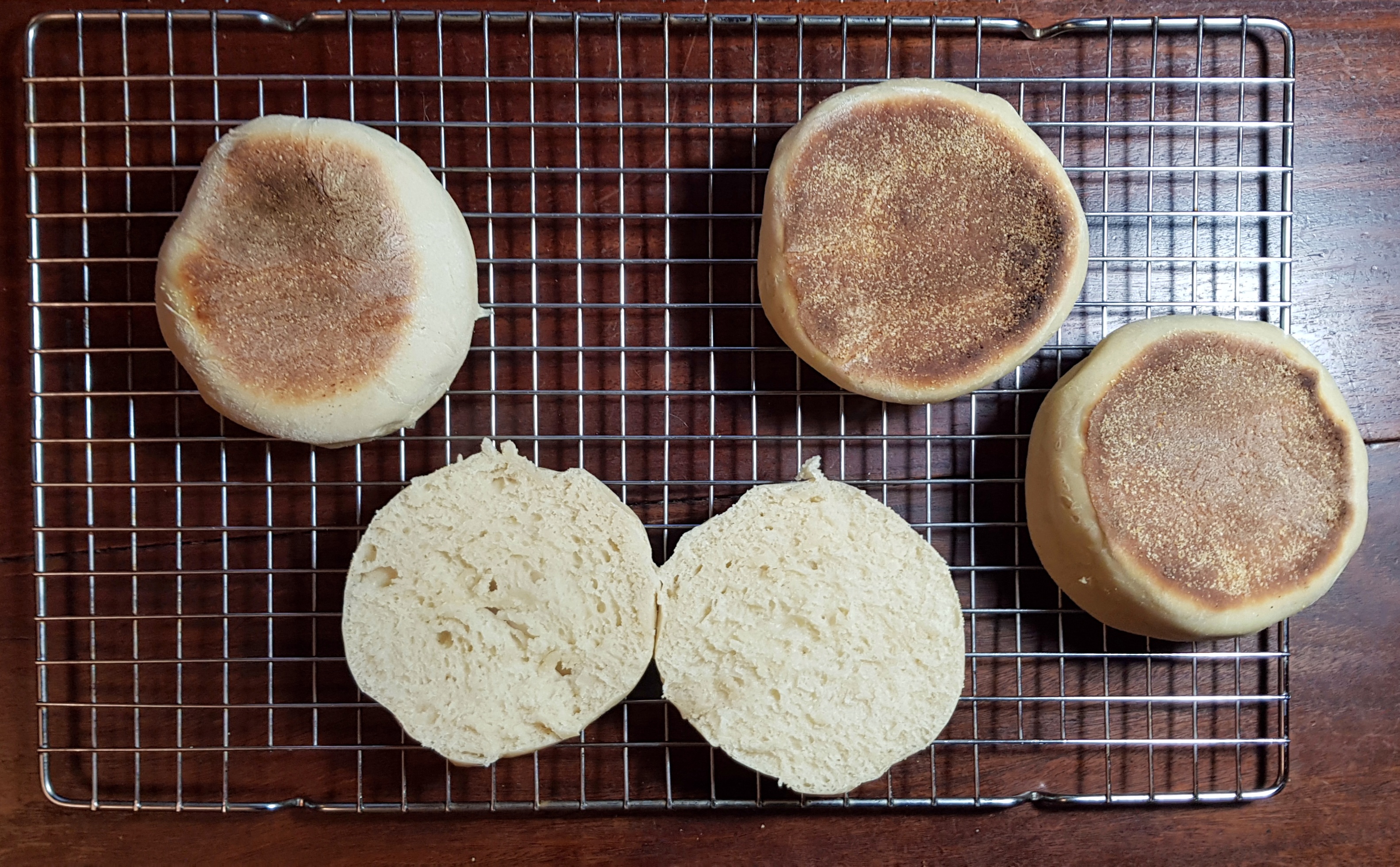
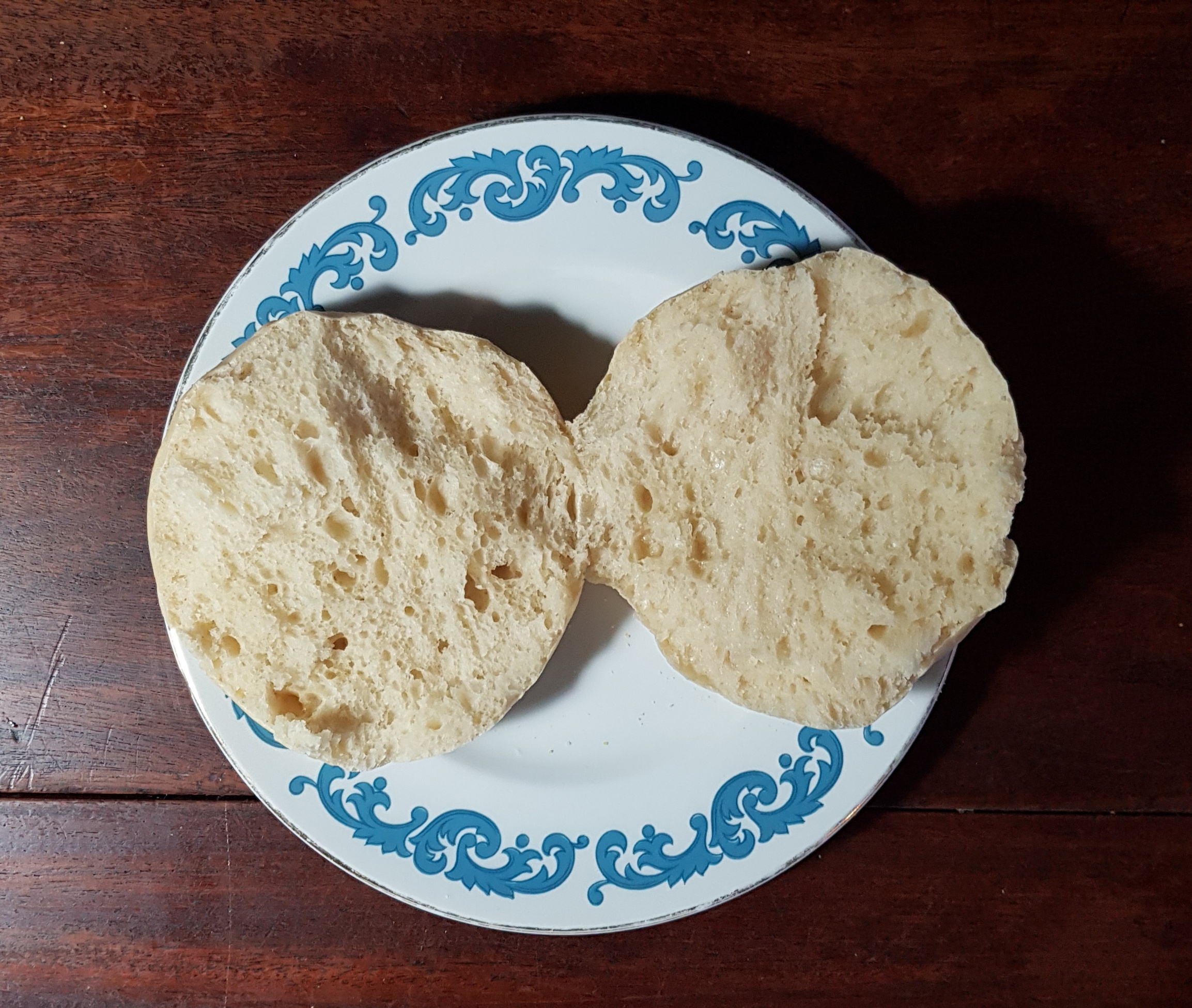
My recipe uses more liquid that other muffin recipes out there, but the dough can still be rolled and cut out with relative ease – you’ll need a mixer for kneading the dough though as it is very soft and sticky. One batch makes between 8 and 12 muffins depending upon the size of cutter you prefer. As Jane Grigson notes, it is very satisfying to watch them “rise and swell rather like a puffball fungus.”
500 g strong white flour
2 tsp instant yeast
1 ½ tsp salt
30 g softened butter
1 egg
330 ml milk, warmed
A little sunflower oil
Semolina or polenta for dusting
Mix the flour, salt and yeast in a bowl, make a well and add the butter, egg and milk. Then mix to combine. It is best to use a dough hook attachment on a food mixer for this; start on a slow speed, and then once fully incorporated, turn up the speed to knead until smooth and elastic, around 6 minutes.
Smear a little oil on the inside of a bowl then oil your hands and gather up the soft dough and pop it in. Cover with cling film or a damp tea towel and leave to rise in a warm place; because of the added butter and egg it will take a little longer than for a regular bread dough, about 90 minutes.
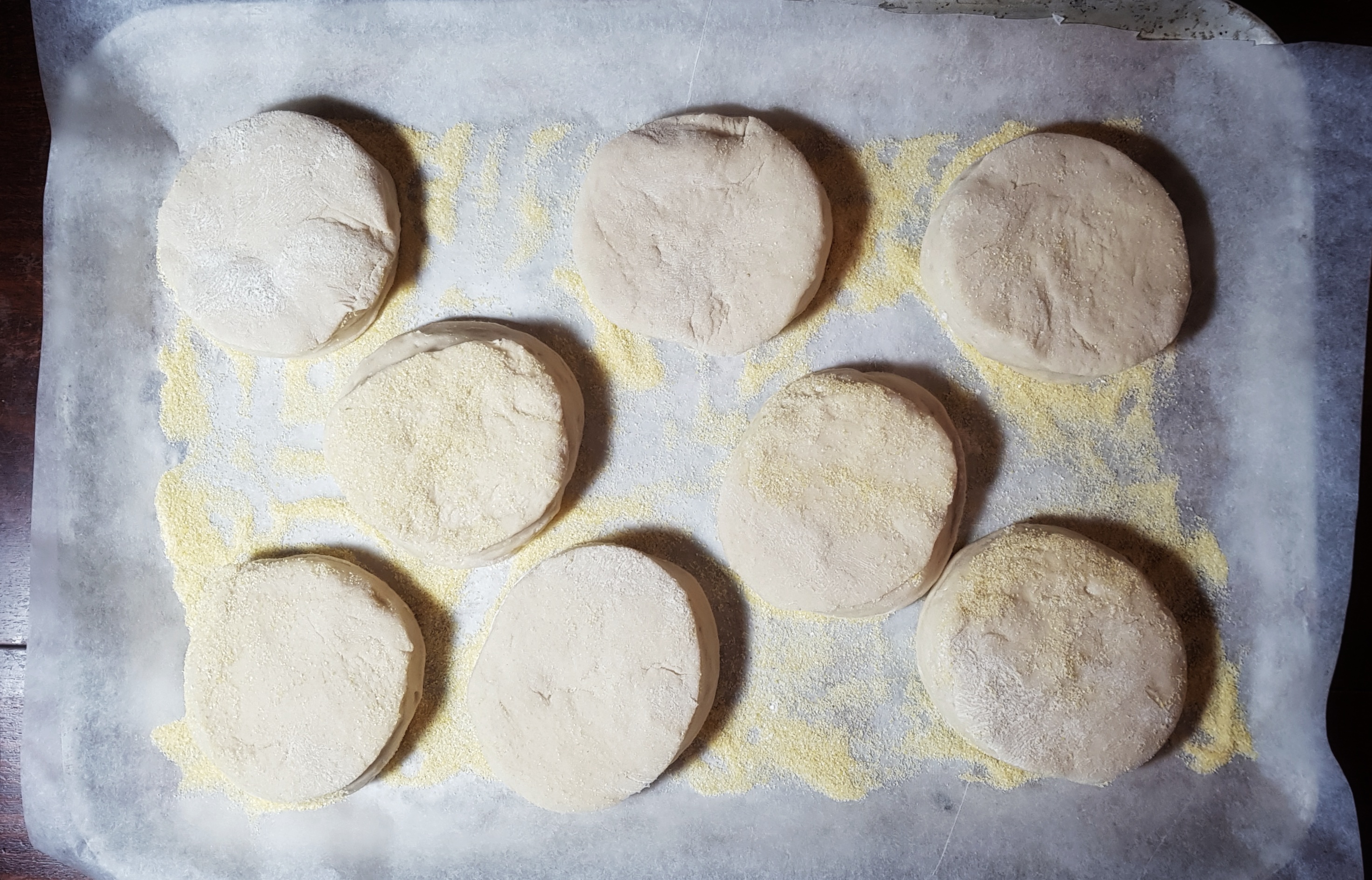
Lay out a piece of greaseproof paper or a tray and scatter with the semolina or polenta.
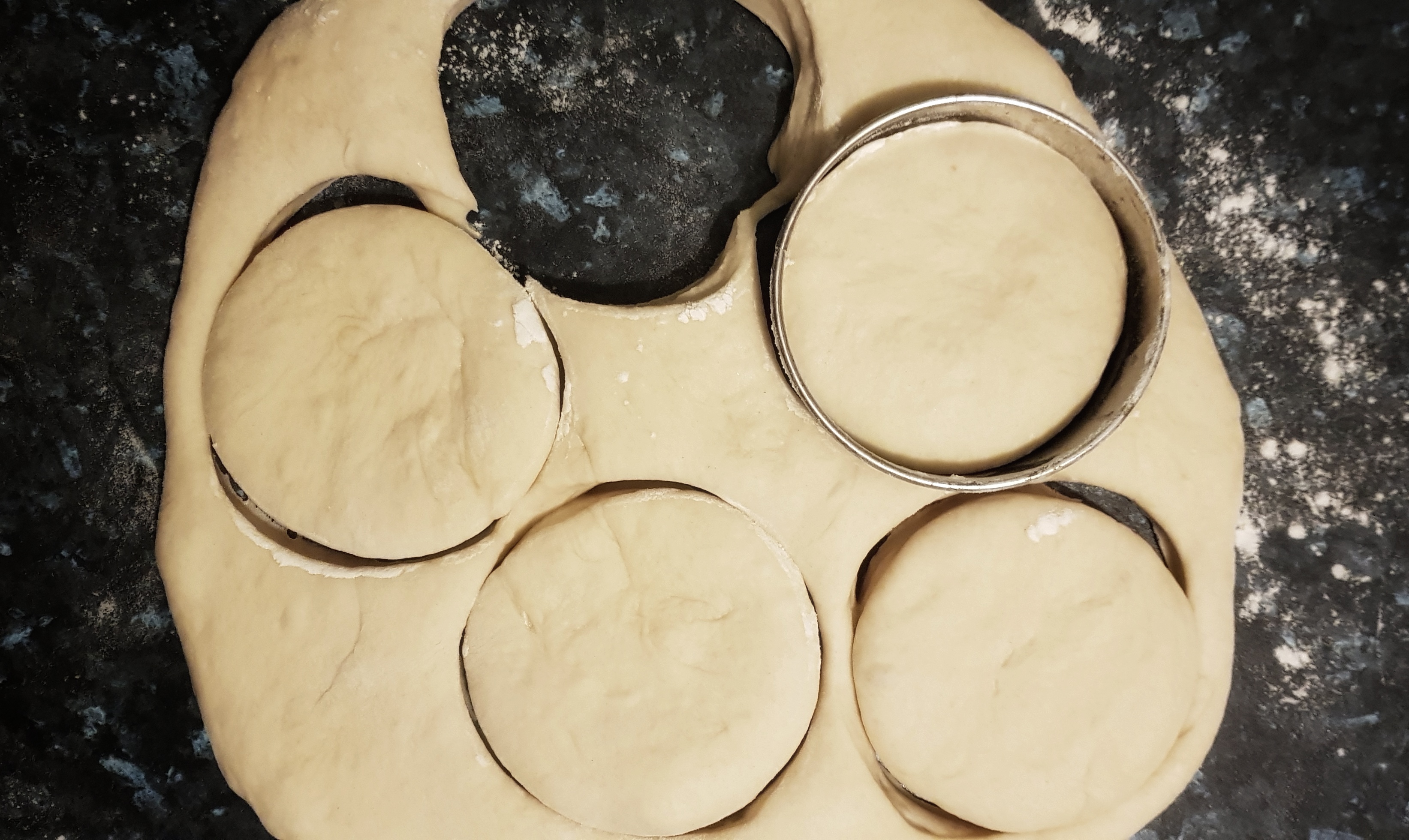
Knock back the dough and roll out on a floured surface to a centimetre’s thickness, then cut out. I wanted quite large ones, so I went with a 9 cm one, but feel free to use whatever size you like. Because the dough is soft, it’s a good idea to dip the cutter in flour between cuts to prevent sticking.
Lay the muffins on the polenta/semolina and turn them over so that both sides get a coating. Knead the trimmings together and cut out more muffins. Cover them and leave to prove for 30 minutes.
Heat your pan or griddle over a medium-low heat and cook the muffins in batches. Cook on one side for around 10 minutes until golden brown, and then turn over and cook for a further 6 to 8 minutes.
Eat straight away or cool on a rack and store in a tin or tub.
References
English Bread and Yeast Cookery (1977) by Elizabeth David
English Food, Third Edition (1992) by Jane Grigson
If you like the blogs and podcast I produce, please consider treating me to a virtual coffee or pint, or even a £3 monthly subscription: follow this link for more information.
Last week I published a post all about how muffins and crumpets lie on a rather fluid continuum when you look at the from an historical perspective: names, methods and ingredients have all changed and been swapped which is very confusing for something that is rather straight forward today.
Last post I said that a crumpet today is:
Made from a pourable batter like a thick pancake
Slowly cooked on a bakestone
Slightly rubbery in texture, especially prior to toasting
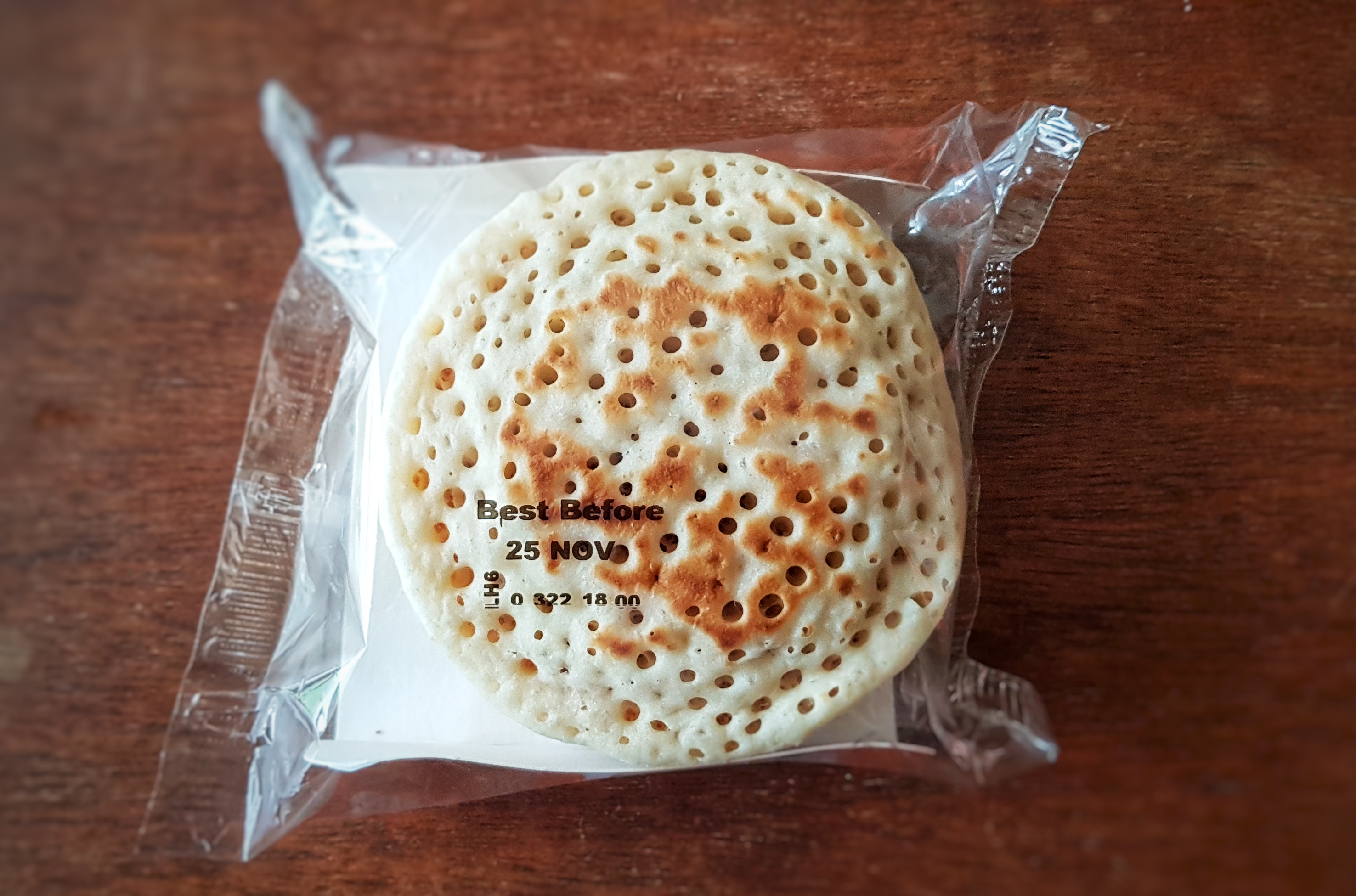
Has characteristic bubble holes on one side
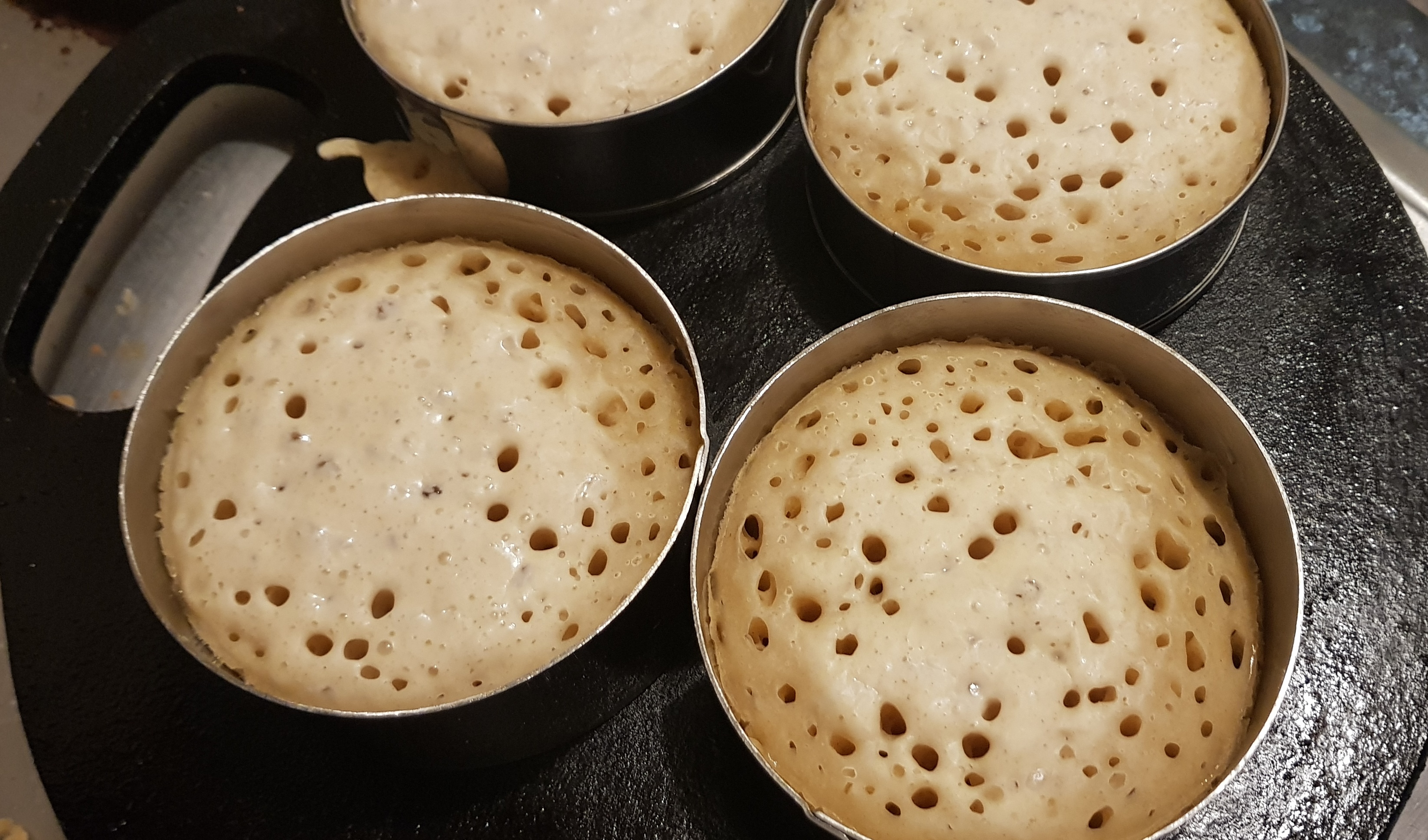
I’ve looked through many recipes and I have found that there are three things that do still vary: the liquid used is milk or water, or a mix – milk makes a soft crumpet and water makes a crisper one; plain or strong flour is used (or a mix) – the former makes a rubbery crumpet and latter makes one that’s a bit more pudding-like. The balance needs to be ‘just right’, but everybody’s Goldilocks zone is different, so feel free to alter the proportions in my recipe below, the resulting griddlecake will still be a crumpet so it comes down to personal taste. The third difference is to do with raising agents; should you add yeast alone or add some bicarbonate of soda too? Personally, I think the bicarb is a necessity because it gives you many pronounced bubbles – and therefore increased butter absorbency – which is what we have all come to expect from a modern-day crumpet.
Anatomy of a crumpet
Throughout the centuries crumpets seem to have been fairly constant: some ‘crumpets’ turn out to be pikelets from time to time, but if it’s called a crumpet you can be fairly sure it is a crumpet. This minor confusion is easy to bear but just you wait for the muffin post next week – they’re all over the shop!
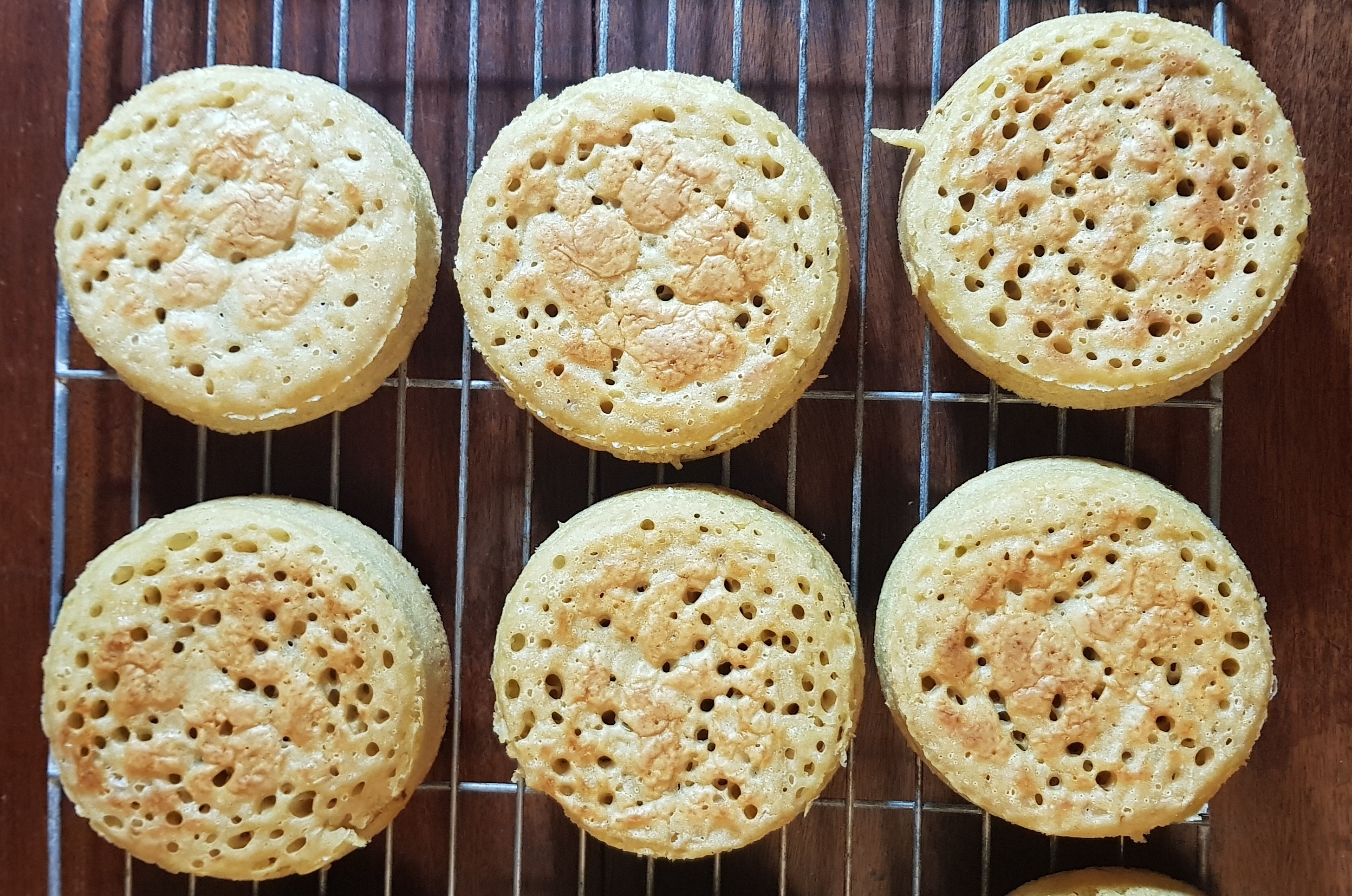
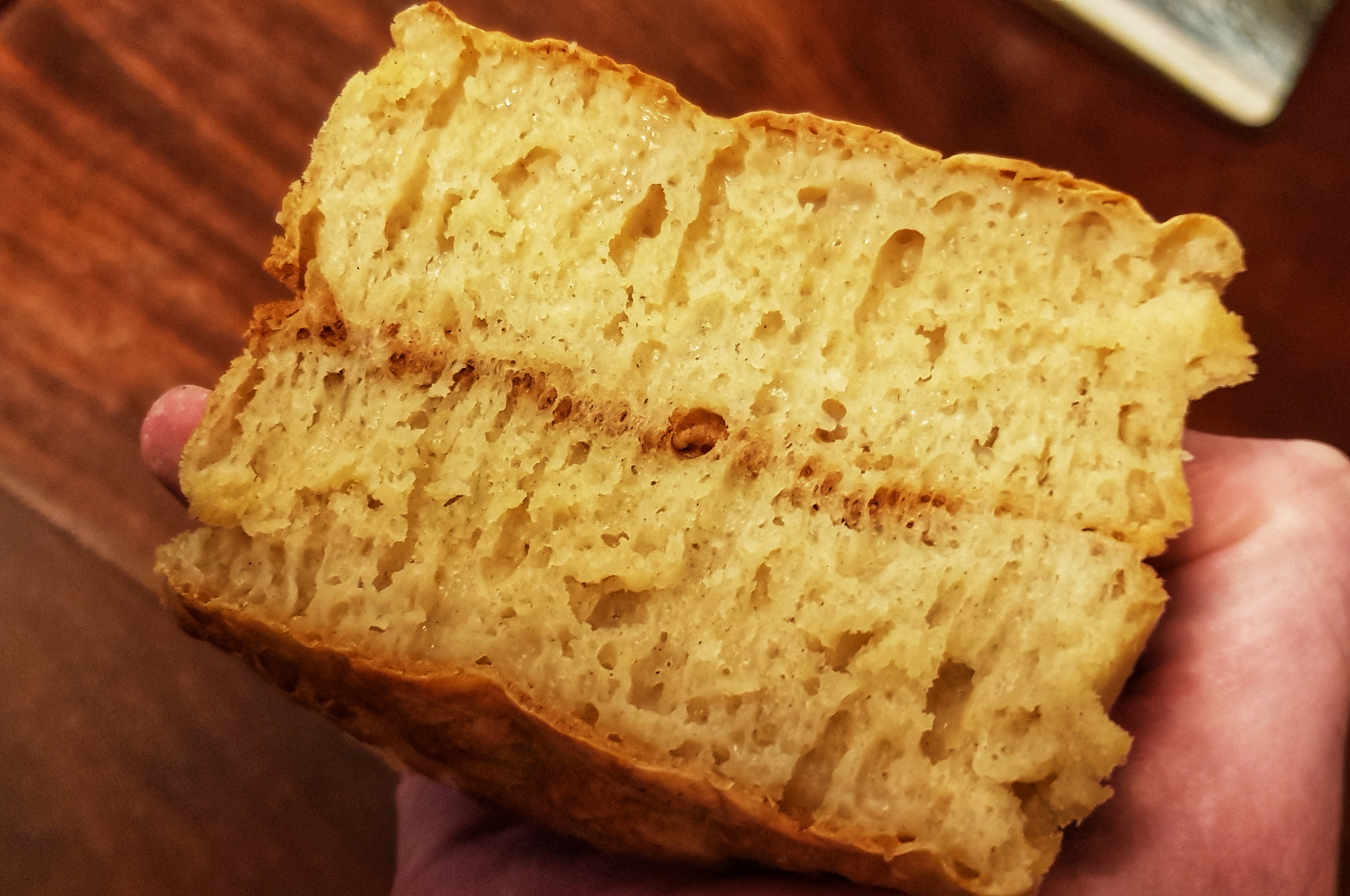
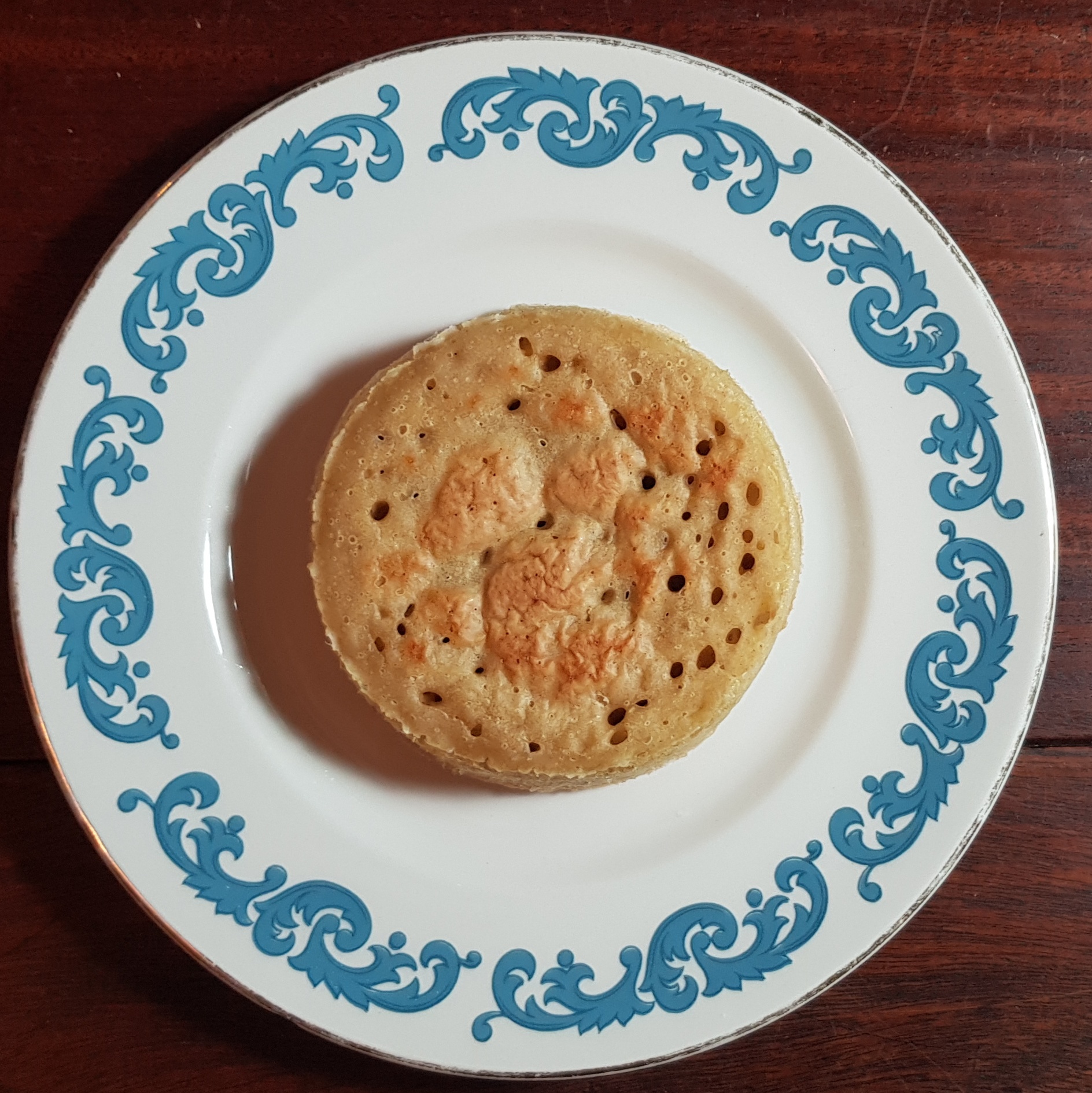
Elizabeth David called supermarket crumpets a “travesty”, but I must confess to love them dearly; home-made ones are a very different beast, more golden in colour, and more crisp on the outside and softer on the inside. They do tend to become rather stodgy in the centre, which could be because of too high a ratio of milk-to-water and plain-to-strong flour, but in my experience it comes from overfilling the rings: a one centimetre depth is all you need. Another reason they might be stodgy is that you turn them over too quickly: crumpets are griddle cakes that cannot be rushed, they need a gentle bake on the griddle and to be turned at the right time. I used to turn them too soon, but then I received some good advice from Gary Rhodes in his classic book Great British Classics; he tells us they are ready to turn when “small holes appear and the top has started to dry.” Much more helpful than timings.
To make crumpets you need crumpet rings, but if you don’t have any you can use shallow mousse/chefs’ rings, and if there really is nothing at all suitable in your kitchen cupboards, you can go free-form and make pikelets.
How to eat a crumpet
Almost every writer seems to think that to experience crumpet perfection, one needs to eat them fresh off the griddle. I disagree and firmly believe they are best cooled on a rack, then stored in a tin or tub and toasted the next day. Each to their own, I suppose. They must be toasted until crisp on the outside yet soft on the inside which occurs very rapidly compared to supermarket ones, so watch out!
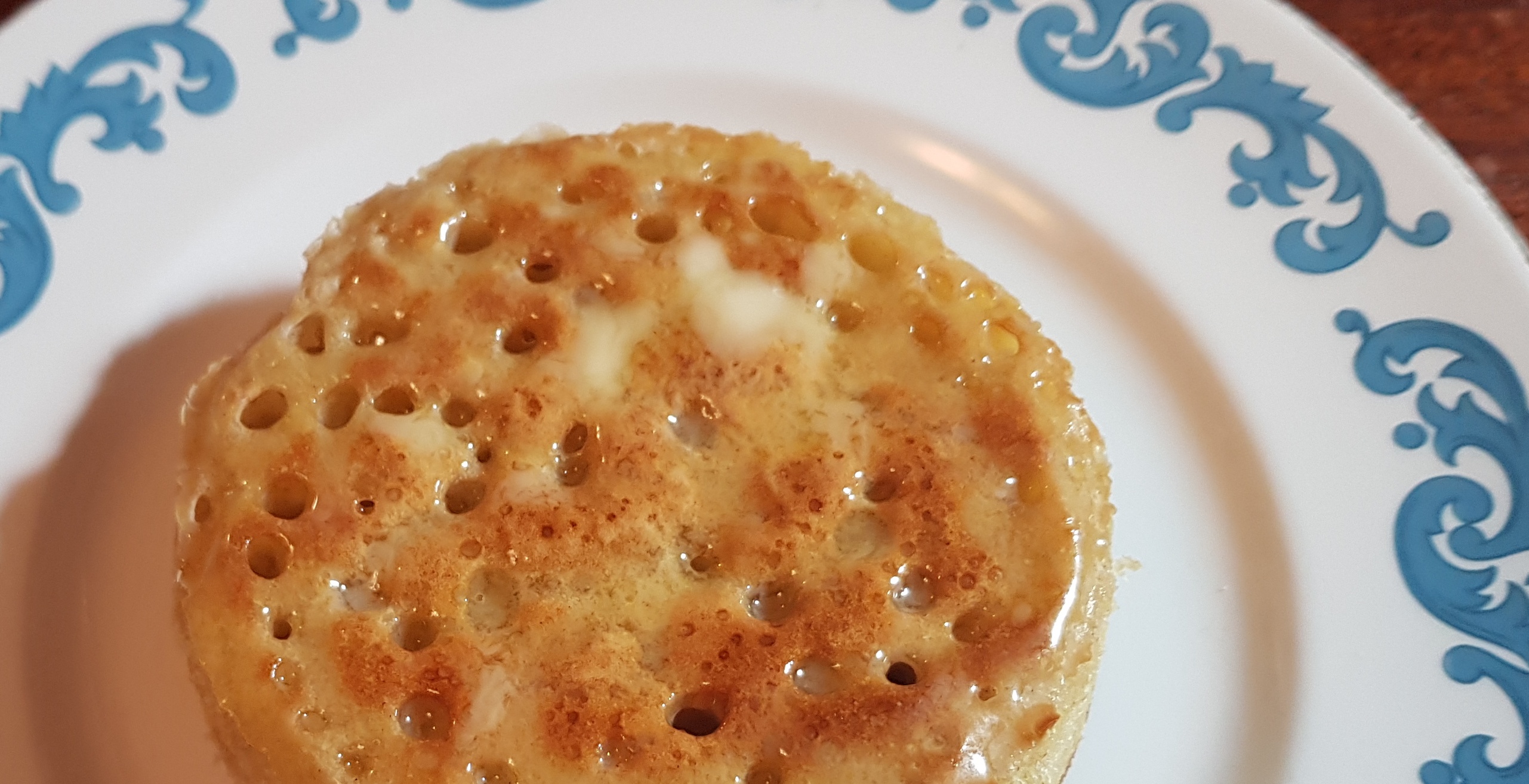
To butter a crumpet, take a knob of butter (salted, preferably) and paint the pitted surface all over with it. Home-made crumpets are always less holey than shop-bought and as a consequence the butter takes a little longer to absorb, so the best strategy is to butter the remaining crumpets – because no one ever has just one – and then return to the first for a second dousing.
The best topping for a crumpet is butter and just the tiniest trickle of honey.
Makes 18-20 crumpets
250 g plain flour
250 g strong white bread flour
2 tsp instant yeast
1 ½ tsp salt
250 ml milk
500 ml warm water
½ tsp bicarbonate of soda
A little butter
A little sunflower oil or lard
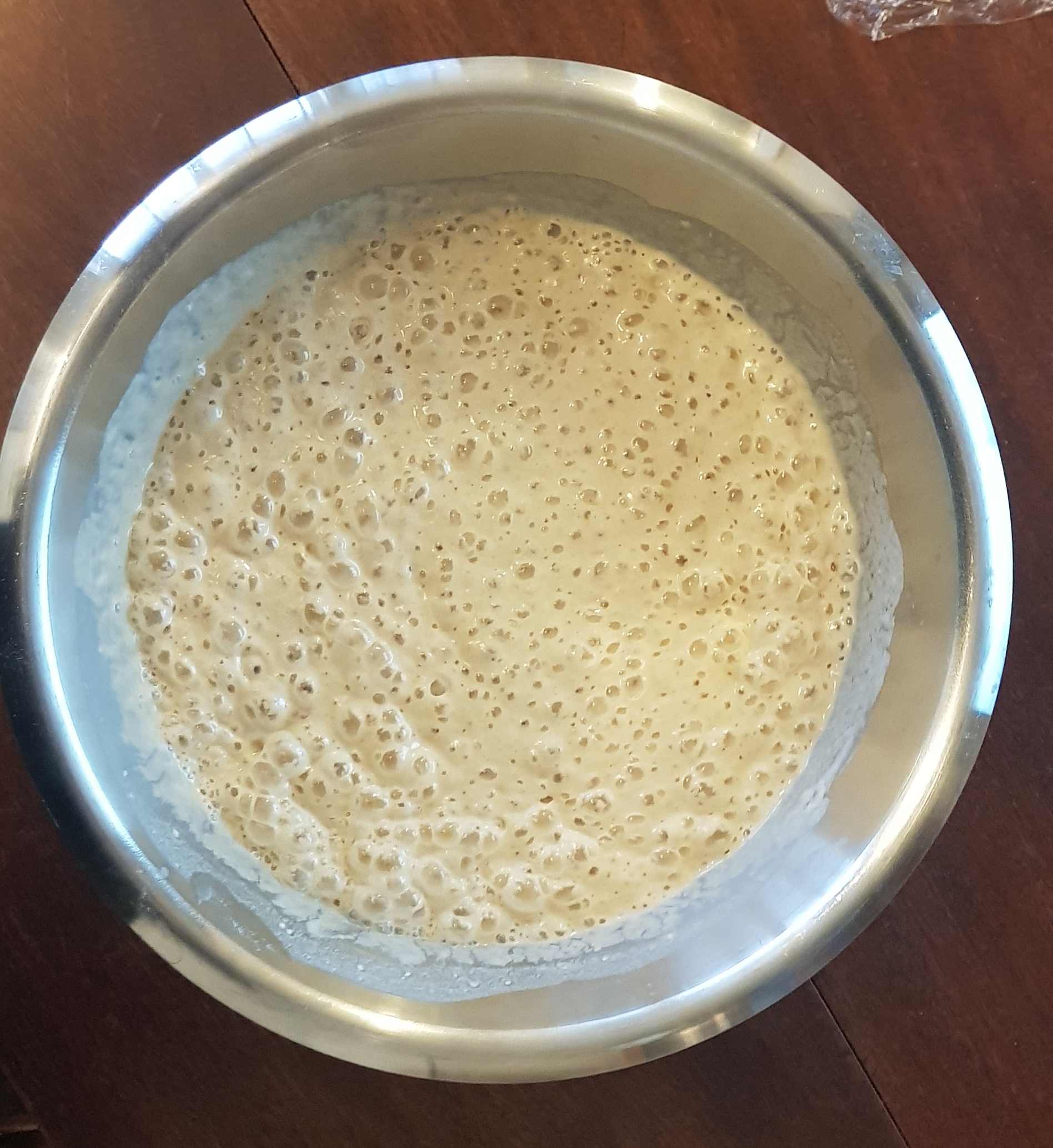
Mix the flours, yeast and salt in a bowl and make a large well in the centre of the flour. Mix the milk and water, reserving around 50 ml. Whisk the mixture well and when smooth, cover with a damp tea towel or some cling film and leave for around 90 minutes until very bubbly.
Dissolve the bicarbonate in the reserved water and whisk into the batter. Cover again and allow to bubble for another 30 minutes.
Place a thick based griddle or pan over a medium-low heat.
Grease your rings well with butter (or lard) then use just a tiny amount of lard or oil to lightly grease the griddle. Place the rings on the griddle and pour a small ladleful of batter in each ring: just a centimetre’s depth as they rise in the rings. After a while, large bubbles will appear on the top and as they pop, you will see the batter magically transformed into crumpet. Very satisfying.
Almost – but not quite – ready for turning
Allow to gently cook for around 20 minutes or until the tops have dried out, then remove from the rings (use a palette knife to help), turn over and cook on the other side for a further 5 minutes.
Remove and cool on a rack, regrease the rings and continue in this way until all of the batter is used up.
If you don’t have rings, you can instead make pikelets, which take half the time to cook due to their thinness.
References
English Bread and Yeast Cookery (1977) by Elizabeth David
How I wish I had a roaring fire; if I did it would be a great big one equipped with all of the paraphernalia; poker, skuttle and, of course, toasting fork. Pierced upon the fork would be the king of all the toasty-bready things, the crumpet. No, the muffin! It’s an almost impossible choice, and if you go back in time just a little, the decision is made even more difficult because there wasn’t a fixed idea of what either were, and they changed in name and form all across the country. Today, in a world of mass-production, standardisation and consistency I think we would all agree wherever we live in the country which is which. But just in case we’re not agreed on which is which I’ll describe the two:
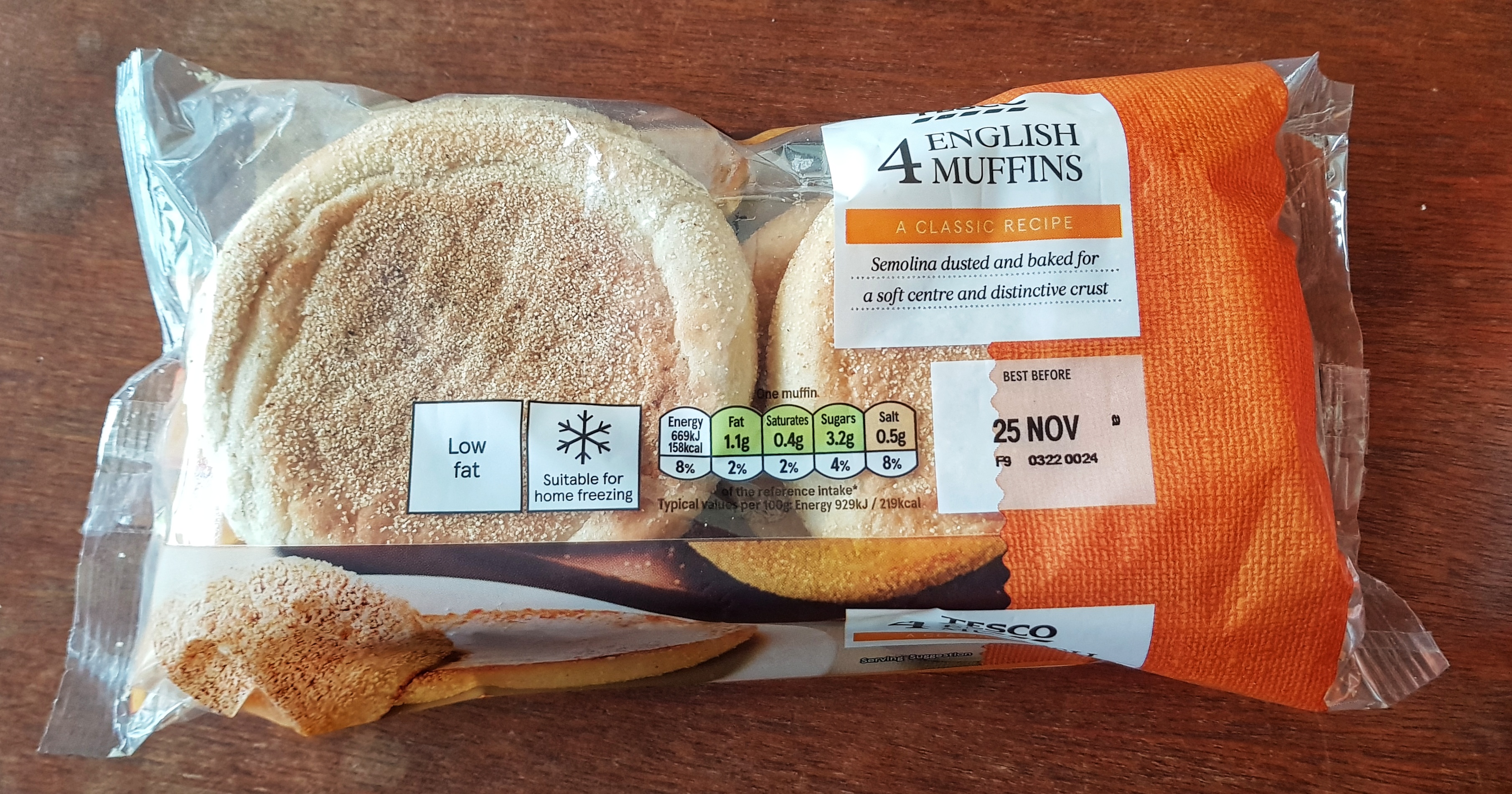
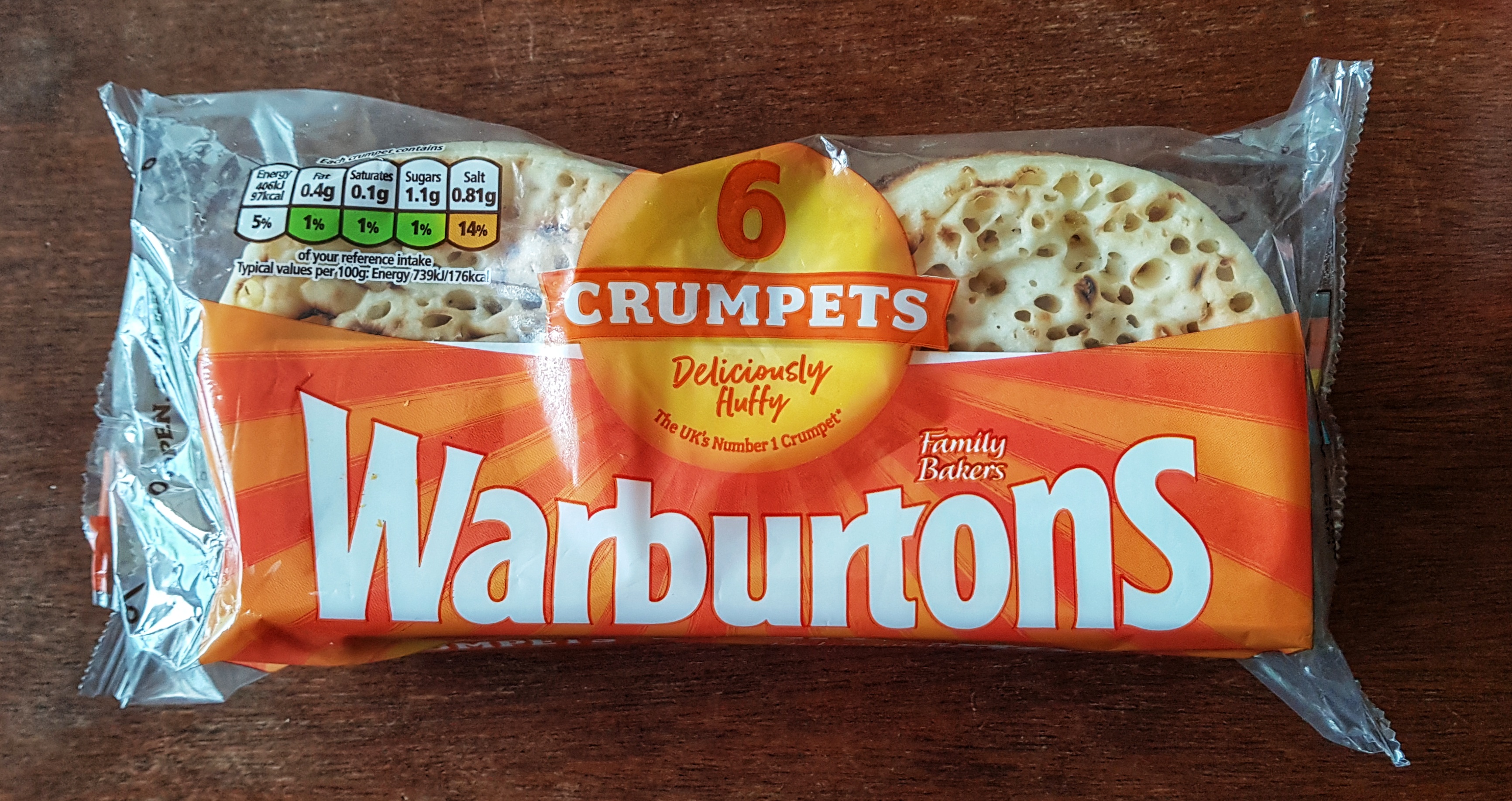
A pack of supermarket muffins
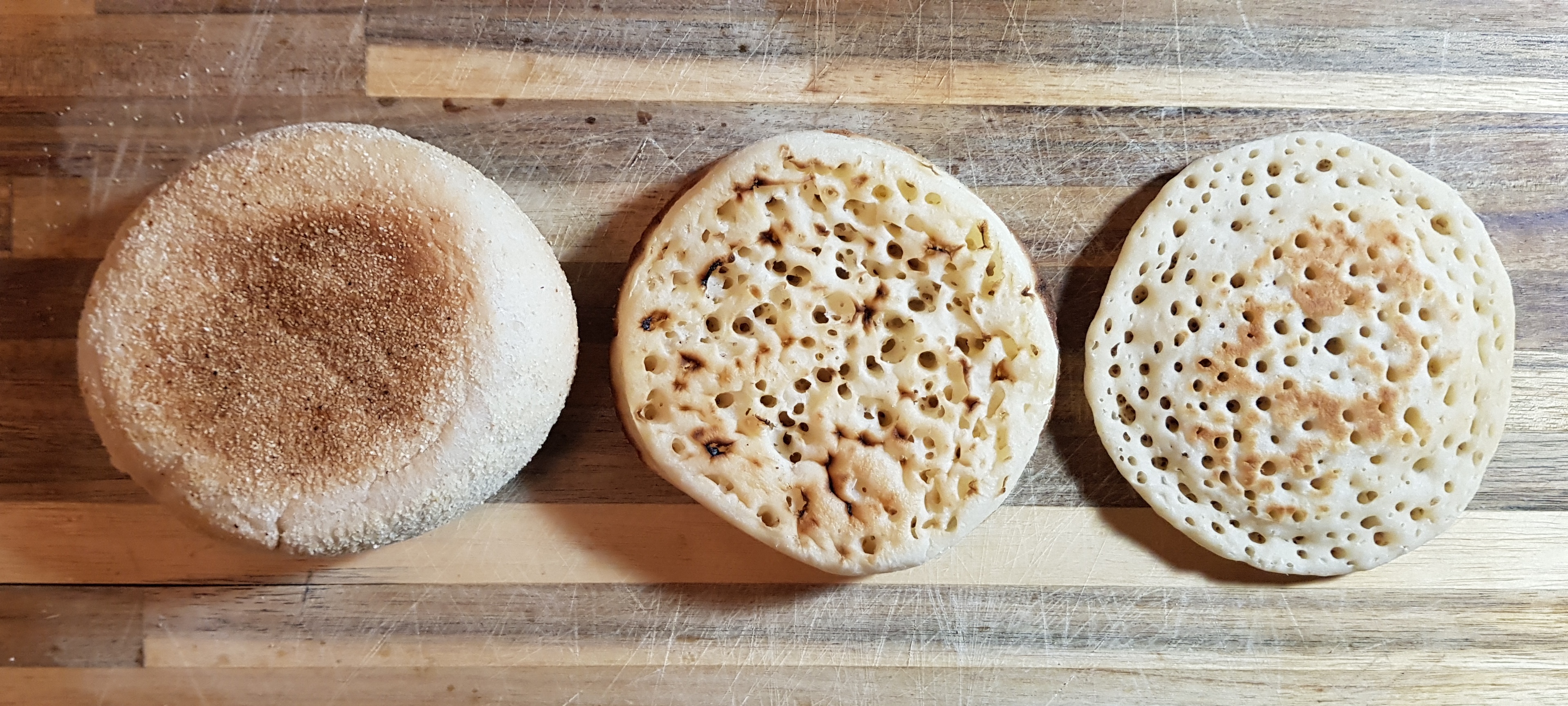
Muffins* are:
Definitely fluffy and bread-like in the centre, their name originating from the Old French word moufflet, meaning soft.
Cut out into circles or rolled into cakes
Slowly cooked on a bakestone
Dusted in semolina
There may be a few from the North-West of England saying, “Hang on, what about oven bottom muffins?” Don’t worry, I’ll get to those late. Aside from that, pretty straight-forward I hope.
Crumpets are:
Made from a pourable batter like a pancake. Indeed, the word (probably) comes from the Welsh word for pancake, crempog
Poured into rings
Slowly cooked on a bakestone
Slightly rubbery in texture, especially prior to toasting
Has characteristic bubble holes on one side
It’s very obvious by etymology and their look that the two things are very different to each other. Now I’m going to muddy the waters slightly with a variant upon the crumpet, the pikelet – it’s important for later. Pikelets are simply crumpets cooked without a ring, producing a large, flat holey pancake.
A ‘travesty’: the supermarket crumpet
Are we all on board with this? It does seem pretty cut-and-dry to me. Trouble is we are very used to factory-made products and are perhaps unaware of what either was like. This is what Elizabeth David wrote of the two in the 1970s in her classic book English Bread and Yeast Cookery: “crumpets, or at least travesties of them, can still be bought in England” and, “Sainsbury’s sell packets of a thing they call a muffin.” It seems that we are not being fed delicious traditional bakes, but pale – possibly cynical – imitations of them. But then she poses the following questions:
What is the difference between them? Which have holes, which are baked in rings? Which are made from a pouring batter, which from a soft dough…? Is a pikelet the equivalent of a muffin or of a crumpet? Should muffins and/or crumpets made from identical ingredients? If so, what are they? Flour, yeast, water and salt? Or flour and yeast plus milk, fat and eggs? Or flour, fat and eggs with a chemical raising agent?
She then goes on to say “anyone who knows the answers to more than two or three of these queries is wiser than I.” Today the answers to her questions are fairly straight-forward, but then you look at the old recipes. Take this one from 1914 for both muffins and crumpets.
To make crumpets: “Heat a girdle, and grease it with butter; drop on to it of the above [pancake] mixture, and brown first on one side and then on the other.”
That, I’m sure you’ll agree, IS NOT A CRUMPET, IT IS A PIKELET!
A pack of (rather small) supermarket pikelets
To make muffins:
“Grease some rings, and place them on a hot greased girdle; half fill them [with the same pancake] mixture, cook and brown them on the other side.”
THAT IS A CRUMPET, NOT A FLIPPING MUFFIN!
Oh lordy, I’ve opened up a can of worms here. Going through my old books, as well as the one provided by Ms David, it seems that muffins do not match the modern form at all. Some of them are at least made from dough, but one so soft it is verging on batter producing dough balls so delicate they had to be proved on layer of flour. They are so fiendishly tricky to make that they could only be made by hand, and a well-trained one at that, but in an age of machine production they have gone by the wayside, their mixture thickened into a dough that can be rolled and stamped out on a production line. Here are some instructions from Law’s Grocer’s Manuel, 1895:
“get ready a tray, spread it with flour about 2 ½ [inches] in depth, make impressions in the flour with a small breakfast cup, take portions of the light dough out with a large spoon and put them into the flour impressions to rise; make the muffin stone hot, let them cook on it a few minutes, pass the palette knife under, turn them over…and bake likewise, keeping them of a light colour.”
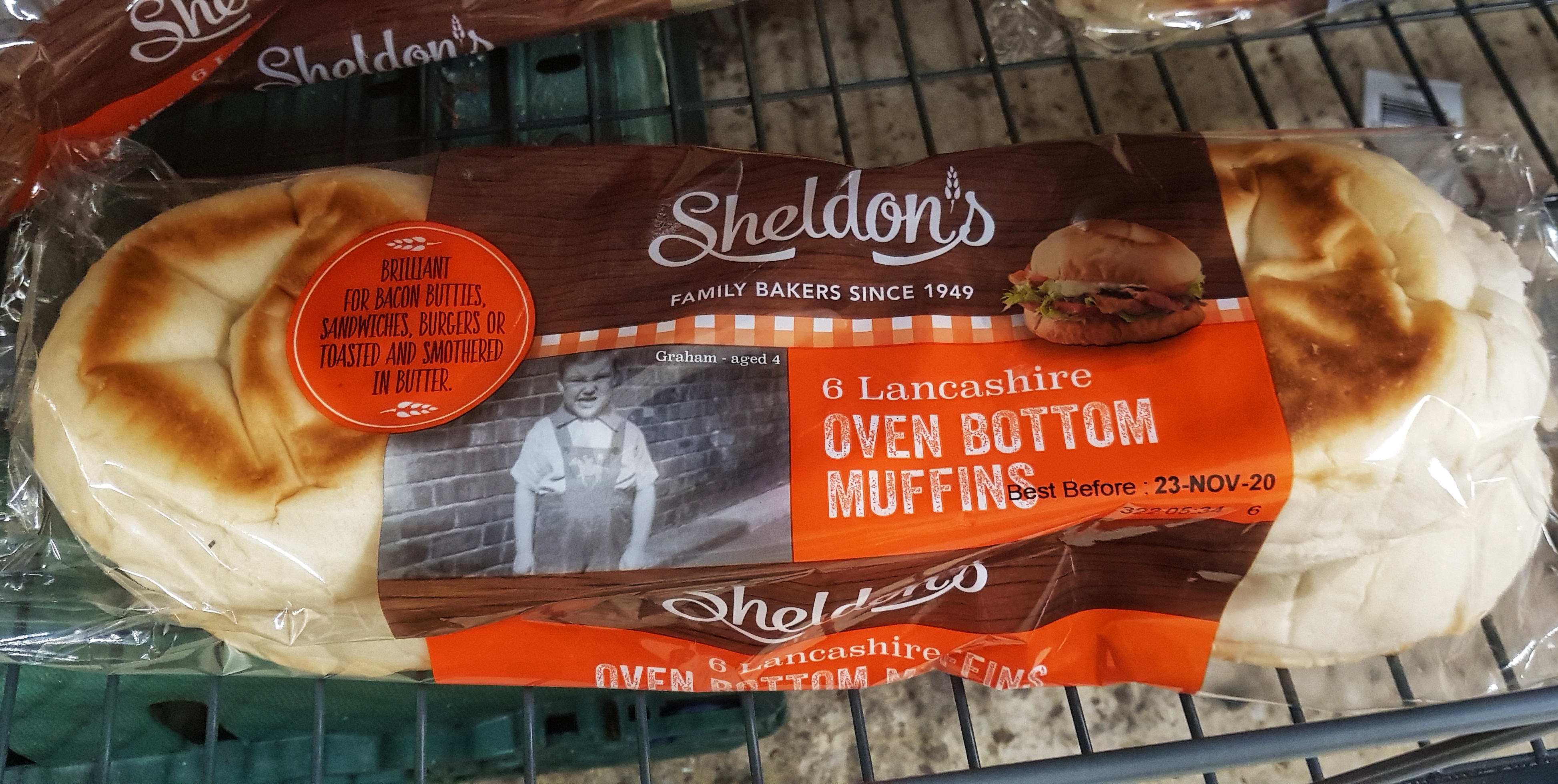
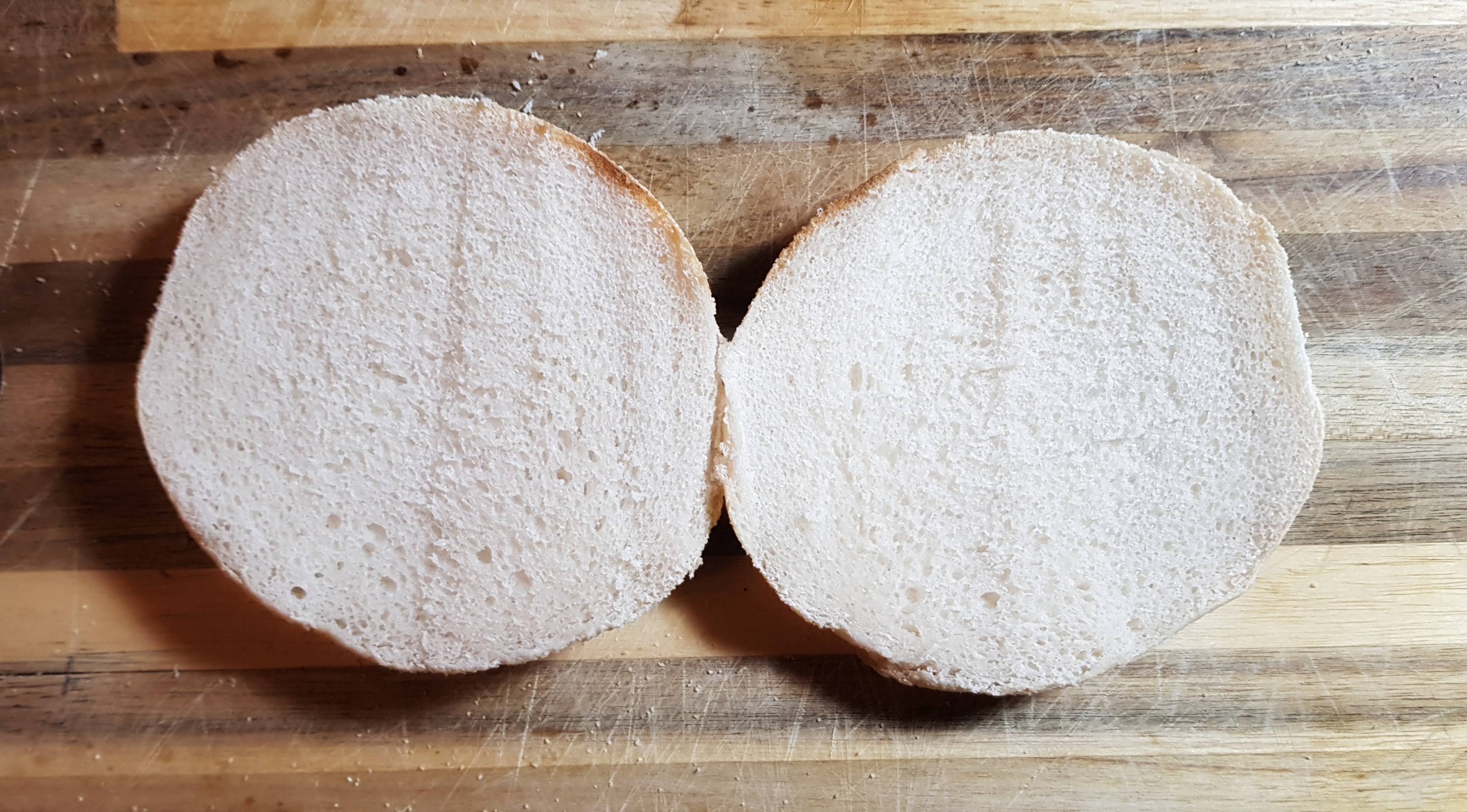
They exist today in the form of ‘Oven-Bottom Muffins’ still popular in Lancashire and Greater Manchester, but these too are pale imitations, essentially regular bread cakes** baked very pale. So really a muffin was almost a crumpet but not quite a bread, a spoonable dough hovering between two states producing a muffin filled with a honeycomb of holes, invisible until cut into. I now see why Ms David was rather terse about the supermarket variety.
Notice the lack of holes inside a factory-made muffin
In my copy of Delia Smith’s Complete Cookery Course from 1982, published just five years after Elizabeth’s book, we have a recipe for a modern muffin. Does anyone know of an earlier one?
For the next post or two, I shall continue the theme with some recipes for muffins and crumpets plus a look at some of the bakes that simply don’t know which side their bread is buttered on, as it were.
If you like the blogs and podcast I produce, please consider treating me to a virtual coffee or pint, or even a £3 monthly subscription: follow this link for more information.
References
English Bread and Yeast Cookery (1977) by Elizabeth David
Delia Smith’s Complete Cookery Course (1983) by Delia Smith
*These are known as English muffins in the United States. Annoyingly, we don’t call American muffins American muffins, just muffins. These are cakes, and not to be confused.
**aka bread rolls, bread buns, stotties or barmcakes, but let’s not get started on that one.
When we think of the meat that was eaten at mediaeval feasts, we conjure up images of huge pieces of roast ox, venison or wild boar’s head. There was, in fact, a wide variety of meats, especially wild birds. One of these was the grey heron and its meat was regarded very highly, only fit to serve at the top tables of a banquet; the only other waterfowl with a higher status was the regal swan. According to the late, great Clarissa Dickson-Wright, heron tastes like swan too: “it was very fishy”, she tells us, “rather stringy and reminiscent of moorhen…” It’s quite odd to think they were eaten at all; they’re such a lanky things – all neck, legs and wings. There can’t be that much meat on one.
Grey Heron (RSBP)
So how does one prepare and cook a heron fit for a top table? If we look in Forme of Cury – the earliest cookbook in the English language, dating from around 1400 – and it tells us: “Cranes and herouns shul be armed with lardes of swyne, and eaten with ginger.” The “lardes of swyne” are strips of backfat or fatty bacon that are threaded through the meat so that as the lean meat cooks, the fat melts and bastes it. That’s all we get though.
Wynkyn de Worde (National Portrait Gallery)
We can glean more information from another book, The Boke of Keruynge or, The Book of Carving, which was written in 1513 by the splendidly named Wynkyn de Worde. He provides a long list of different animals, along with instructions on how to carve them for the table. Curiously, there are many words for carving – a specific word for each type of animal, so for a heron, you don’t just carve it, no, you “dysmembre” it:
“Dysmembre that heron.
Take an heron, and rayse his legges and his wynges as a crane, and sauce hym with vynegre, mustarde, poudre of ginger, and salte.”
(And to “Displaye” a crane, simply “unfolde his legges, and cut of his winges by the Joints.”)
So, we get am extra modicum of information: a piquant mustard sauce or glaze, but we still don’t know how it was cooked.
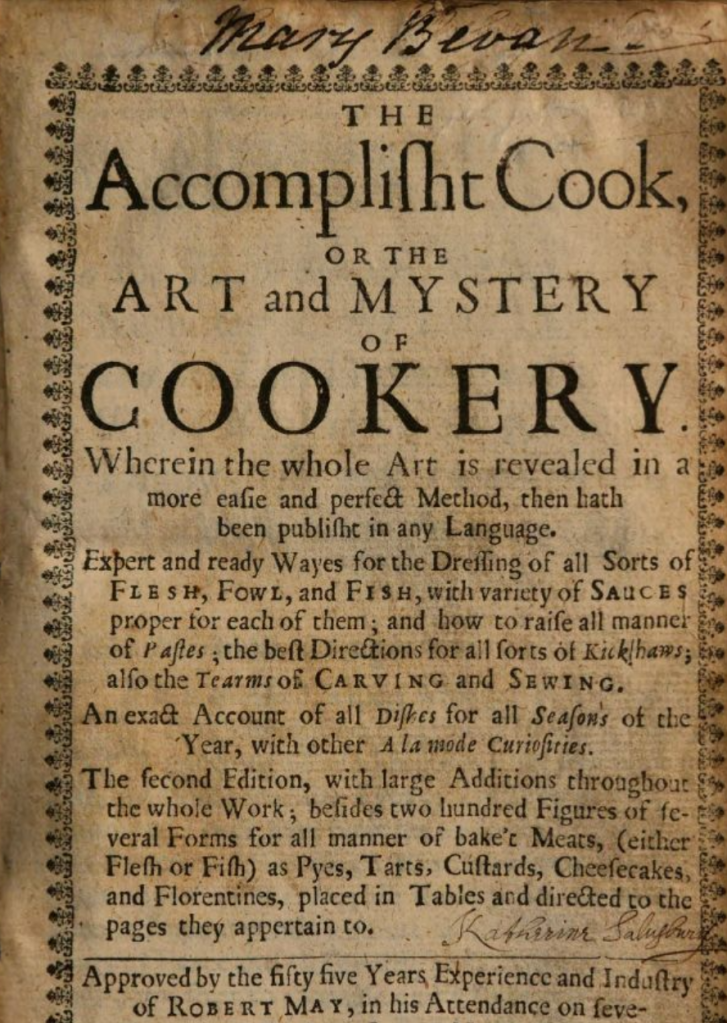
To get any detailed information, we need to go to 1660 and look at the classic tome The Accomplisht Cook by Robert May, and he had obviously read Mr de Worde’s book, because he uses the same words for carving:
“Dismember that Hern.
Take off both the legs, and lace it down to the breast with your knife on both sides, raise up the flesh, and take it clean off with the pinion; then stick the head in the breast, set the pinion on the contrary side of the carcase, and the leg on the other side, so that the bones ends may meet cross over the carcase, and the other wings cross over upon the top of the carcase.”
He also tells us that herons are not simply hunted and brought to the dinner table, but stolen from nests before they have fledged and kept in special barns
“…where there is many high cross beams for them to pearch on; then to have on the flour divers square boards with rings in them, and between every board which should be two yards square, to place round shallow tubs full of water… and be sure to keep the house sweet, and shift the water often, only the house must be made so, that it may rain in now and then, in which the hern will take much delight.”
The Accomplisht Cook by Robert May (British Library)
In these sheds, the herons were not fed fish, as one might expect, but “livers, and the entrails of beasts, and such like cut in great gobbits [bite-sized pieces].” They were not just kept for the table either, many were kept for “Noblemens sports”, specifically for training their hawks. When raised for sport, they were instead fed on “great gobbits of dogs flesh, cut from the bones”
Why dogs’ flesh? Well, this was a time when Bubonic Plague was common, and at the time it was thought that dogs carried the disease, and so any strays would be routinely caught and killed. But why catch and kill an animal that you thought had plague and then feed it your own hawks? I would have thought they’d be taken to the edge of town and burned them or something, but that’s seventeenth century logic for you. CDW makes a further point: “It’s ironic when you consider that the dogs might very well have killed the rats whose fleas did carry the plague and therefore might have prevented it.”
Indeed.
If you like the blogs and podcast I produce, please consider treating me to a virtual coffee or pint, or even a £3 monthly subscription: follow this link for more information.
May also provides us with some recipes. In general, they are boned and filled with a minced meat and suet stuffing, seasoned with spices and oysters, then poached. Sometimes they are baked in ovens.
Herons do seem to drop out of the cookbooks after that, but they were still being eaten. The most recent reference I could find is from the 1914 book Pot Luck; or The British home cookery book by May Byron and is for Heron Pudding. It uses chunks of meat taken off the bone, and the reason why is very interesting:
“Before cooking it must be ascertained that no bones of the heron are broken. These bones are filled with a fishy fluid, which, if allowed to come in contact with the flesh, make the whole bird taste of fish.”
This may explain CDW’s issue with roast waterfowl like swan and moorhen. I wonder if they boned before cooking and if that would make them taste better?
Byron goes on:
“This fluid however, should be always extracted from the bones, and kept in a medicine cupboard, for it is excellent applied to all sorts of cuts and cracks.”
You heard it here first folks.
Heron is no longer legal game and therefore no longer eaten – as far as I know. However, if you have any stories to prove me wrong, please leave a comment, I’d love to hear about it.
References
The Accomplisht Cook (1660) by Robert May
The Boke of Keruynge (1513) by Wyknyn de Worde in Early English Meals and Manners (1868) edited by Frederick James Furnivall
Forme of Cury (c.1400) in Curye on Inglysch: English culinary manuscripts of the fourteenth century (1985) edited by Constance B Hieatt and Sharon Butler
Such a mortality of men in England and Scotland through famine and pestilence as had not been heard of in our time.
The Chronicle of Lanercost1272-1346
In the autumn and winter of 1314, Britain experienced a period of extreme wet and “bizarre” weather; torrential rain flooded the fields, rotting crops and drowning livestock. The staple food of the time was of course bread, but the ‘daily’ bread was becoming more and more scarce as stored grains either went mouldy or were “innutritious”. In a good year, one might expect a good return on grain planted: for each grain sown, you could get up to seven grains back. In 1315 the return was devastating: now you reaped one grain for every two planted – had they known it, they would have been better off not sowing seeds in the spring, but of course they did not know that this spell of bad weather would devastate crops for almost two years.
Edward II
What could be causing this? Naturally at this time, all eyes turned to God – it was obvious He was punishing the English, but what could they have done to deserve this? One answer could be found in the King’s Vita. Edward II was on the throne, and at this time all kings had a running commentary-cum-almanac written about them and their times called a Vita, and his Vita placed the finger of blame directly on the English people themselves. Apparently, the English “excel other nations in three qualities in pride, craft and in perjury. All of this comes from the wickedness of the inhabitants.”
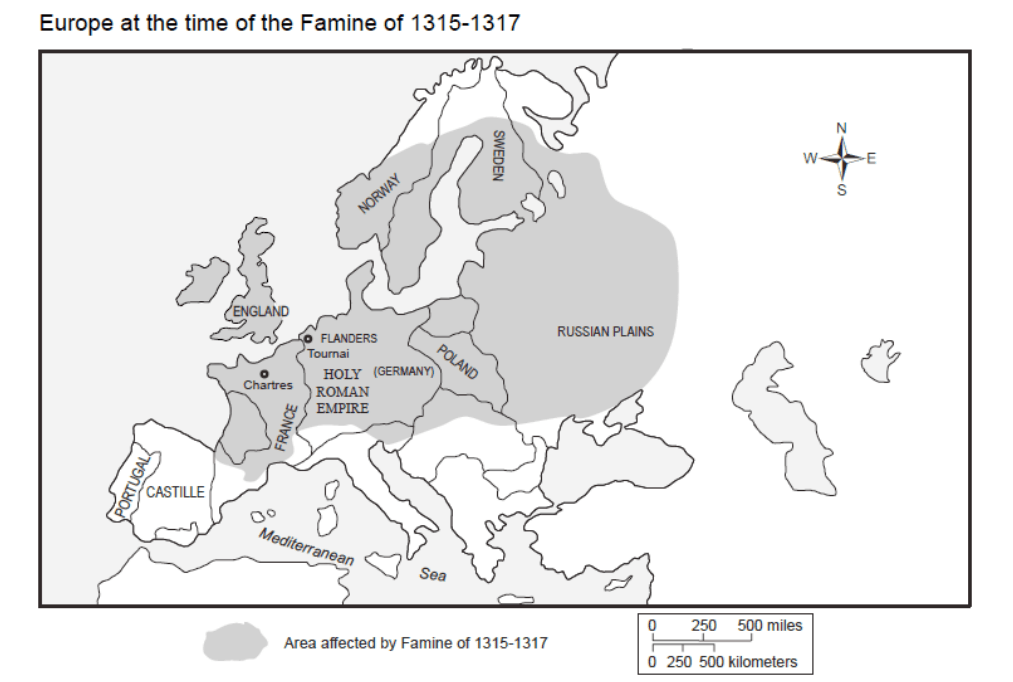
In reality, it wasn’t just the English who were affected by the weather, it was widespread, hitting the whole of the British Isles, Northern France, the Low Countries, Scandinavia, Germany and West Poland. At the time, each country seemed to think the ordeal was happening only to them, and all of them insularly blamed their own nations for their own personal famines.
A map showing the areas of Europe affected by the Famine (from Arizona Geographic Alliance)
During winter of 1314/5 people quickly realised that if they were to keep aside some of their grain to sow in the springtime there was very little spare to grind into flour for bread. This was not uncommon; England is, after all, wet and warm a lot of the time. Things usually picked up the next year and as long as there were some seed and livestock reserved for the new farming year all would be well. The problem was the weather did not change in the springtime and produced next to no crops. It was obvious a real famine was on its way.
In response to this, the Archbishop of Canterbury, Walter Reynolds, ordered Parish Churches throughout the realm to partake in some ‘solemn processions’ in an attempt to curry favour with God. King Edward and his Parliament tried something a little more practical and attempted to stave off, or at least put off, the famine by rationing and regulating food prices so that everyone could get at least something. Parliament fixed the price of wheat, sheep, cattle, chickens and eggs. It cost 12 shillings for ‘a live fat cow’ and a penny for two dozen hens’ eggs.
If you like the blogs and podcast I produce, please consider treating me to a virtual coffee or pint, or even a £3 monthly subscription: follow this link for more information.
This was a great idea in theory, but in reality, it was a disaster; there was so little food that traders’ and farmers’ businesses were no longer viable. Things really were at a stretch, even the King, when he turned up with his household at St Albans for a visit, something that kings loved to do – they would turn up with their entourage and expect their hosts to house, feed and water them opulently. It was a great honour to have this thrust upon you, and dukes and earls of the land all dreaded finding out the King was coming to them. They knew the royal party would clean them out and have them haemorrhaging money for the entire period. Well not this time – August 1315 – for his host could barely find enough bread to feed them.
As the year progressed price fixing was ditched, and prices increased hugely. Now, a quarter barrel of wheat (a bit under 13 kg) rose in price from five shillings to forty shillings, and all you were getting for a penny now was “2 little onions”. By 1216 there had been two years without a harvest and the Archbishop of Canterbury was forced to sell his holy relics to pay for food.
If you didn’t fancy your chances stealing food, you could have a stab at some foraging. The trouble was much of the undeveloped lands were boggy and filled with rotting vegetation too. People tried digging up roots, eating grass and even the bark from trees.*
Sheep and cattle were killed from outbreaks of ‘murrain’ (a highly virulent disease, probably food-and-mouth); in Berwick, starving soldiers boiled and ate the carcasses of their diseased horses for sustenance. Animals all around the country died in their thousands, and the people literally could not eat them fast enough. In a normal year when animals were killed their meat was cured in salt to preserve it, but because of the extreme weather it was too wet to dry salt, causing a shortage making it extremely expensive so they rotted.
An image showing both people starving and cattle succumbing to murrain
For England, it was worst in the north (it is ‘grim Up North’, after all). Northumbria had to deal with constant raids from starving Scots and were reduced to eating “dogs and horses and other unclean things”. There was even talk of cannibalism: “others stole new-born babies to devour.” Hopefully this story was apocryphal.
One in twenty died during the famine but for those who survived, insult was added to injury because a “great pestilence” came and devasted a population weak with malnutrition and dysentery. The next year would improve a little, and in 1318 there was bountiful harvest. However, it took years for the livestock population to recover from murrain. As for the people, they were affected by cold winters, poor harvests and disease much more than before the famine; the Great Famine had left Europe in a weakened state for several decades and “[t]here would be really no sustained growth for a hundred years.” Quite so, because little did they know that soon Europe would be hit by its first wave of the Black Death, which devasted those countries hit by the Famine even harder that the rest.
Today, we cannot imagine being at the mercy of the elements like this; with modern technology and farming methods, we reckon these events are things of the past – in the Western World at least. To some degree I am sure it is true, but today we have never been so UNaware of how our food is grown and processed. I wonder just how many narrow squeaks we have had. I expect they are not infrequent.
*this might seem a little far-fetched, but deer commonly strip and eat the bark and its inner green layer in times of hardship such as wintertime. I wonder if folk observed this behaviour and thought it wouldn’t hurt to give it a try too.
For centuries, the British were famous for their roast meat, attached to a spit before being hand-turned by some poor soul in front of a devilishly hot fire. We no longer do this, today we cook them in the oven, so technically they are baked meats not roasted ones. Searching for historical recipes for roast chicken is rather tricky: they were rarely roasted – they were a dependable source of eggs after all – so only chickens that stopped laying were eaten, those so-called ‘old boilers’. Instead, capons provided tender meat; these castrated cockerels were put to good, being otherwise surplus to requirement. Unfortunately, in today’s mass production of eggs, male chicks are killed as soon as they can be sexed.
When you do find a recipe, there is little focus on the roasting itself. Check out this recipe for ‘Chicken Endored’ from around 1450:
Take a chicken, draw it and roast it; let the feet be on and take away the head. Then make a batter of egg yolks and flour, and add to it ground ginger and pepper, saffron and salt, and spread it over until it is roasted enough.
By the eighteenth century, there is little more instruction, but we do at least get a cooking time:
To roast young chickens, pluck them very carefully, draw them, only cut off the claws, truss them, and put them down to a good fire. Singe, dust and baste them with butter, they will take a quarter of an hour roasting. Then…lay them on your dish.
We can only assume that the roasting part of the process was already in the readers’ skill set.
My recipe is below, but there are a few things I should mention first: First, never wash your chicken! It’s unhygienic and it will stop the skin crisping up. Second, do not overcook and don’t fear the salmonella; follow the times and temperatures precisely and you will be grand. Thirdly, use plenty of butter and bacon to season the bird and keep moist. I make a flavoured butter for the roasting, but using just butter will still produce great results.
If you like the blogs and podcast I produce, please consider treating me to a virtual coffee or pint, or even a £3 monthly subscription: follow this link for more information.
1 free-range chicken
100 g butter, softened
Salt and pepper
Any flavourings you like: e.g. 1 to 4 finely chopped cloves of garlic, 1 tsp chopped thyme or lemon thyme, truffle trimmings, chopped rosemary, grated zest half a lemon, chopped olives, anchovies or capers, ½ tsp smoked paprika. The list really is endless.
8 rashers of dry cured bacon, smoked or unsmoked
100 ml white wine
300 ml chicken stock
1 tbs cornflour
Remove the chicken from the fridge and hour before you want to roast it. Untruss it and preheat the oven to 190°C.
Mash the butter with the salt and pepper using a fork and stir in the flavouring ingredients, if using. Set aside.
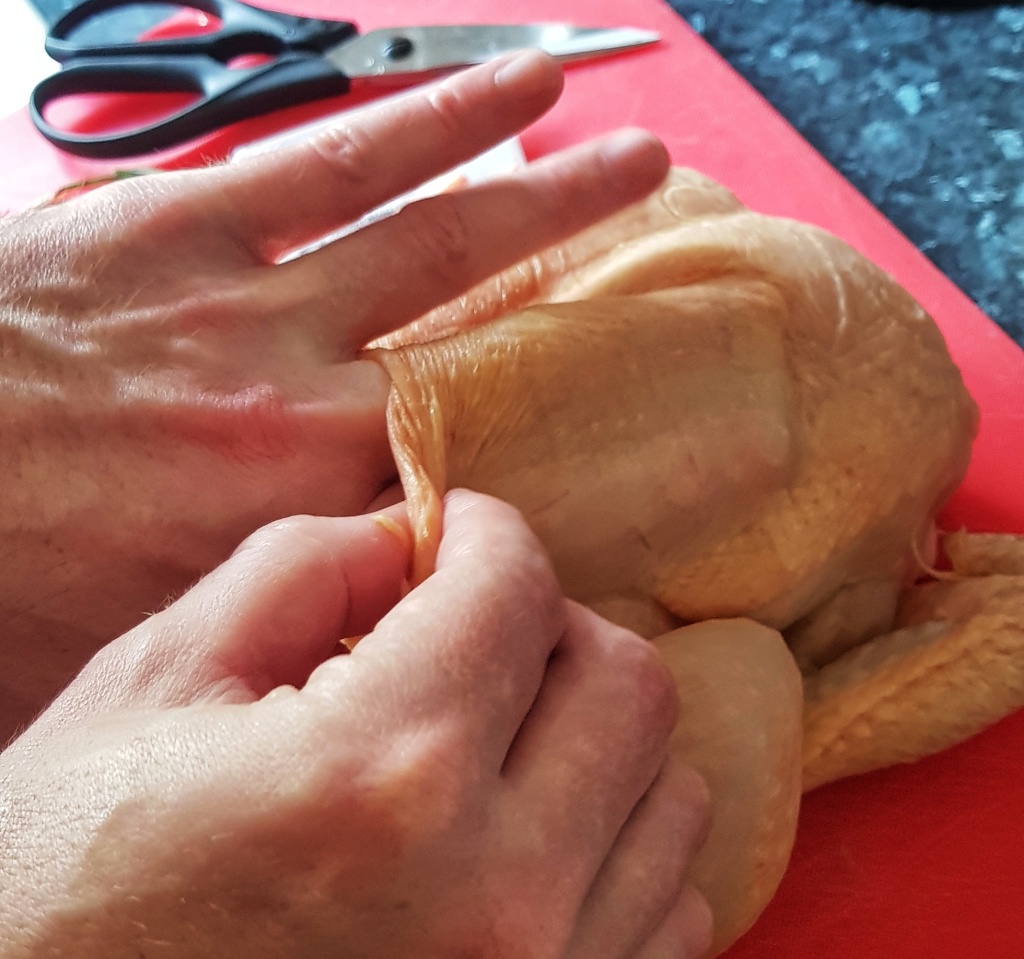
Sit the chicken on a board, untruss it and turn it so that the cavity is facing you and carefully lift the skin away from the breasts. The technique is to insert the tips of your middle three fingers gingerly underneath the skin lifting it away from one breast, using your other hand to keep the skin taught, lest it tears. Repeat for the other breast
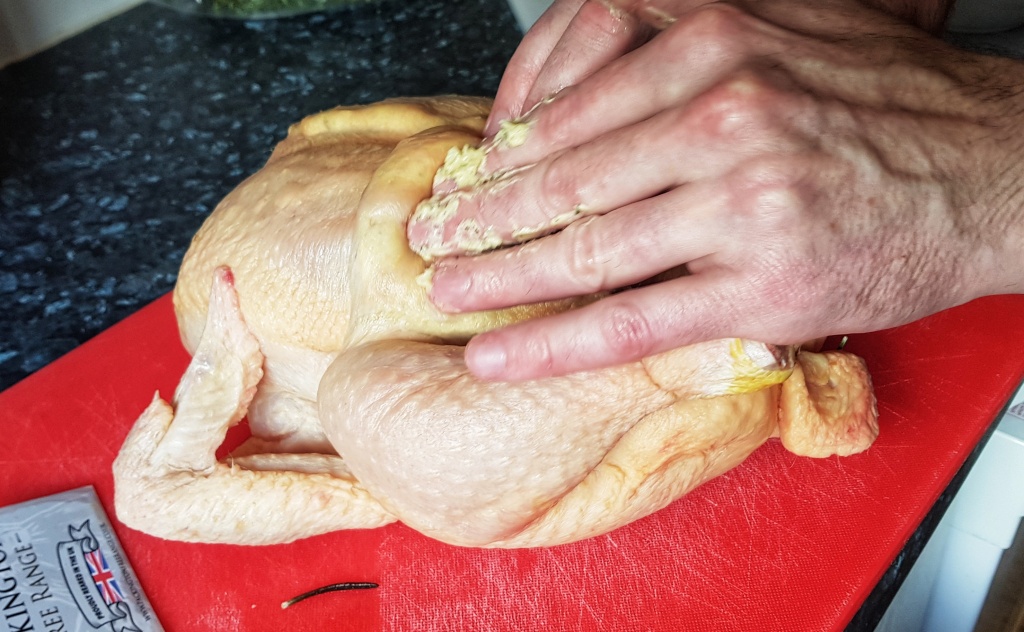
Next, place the flavoured butter under the skin, massaging it so to evenly distribute it over the breasts.
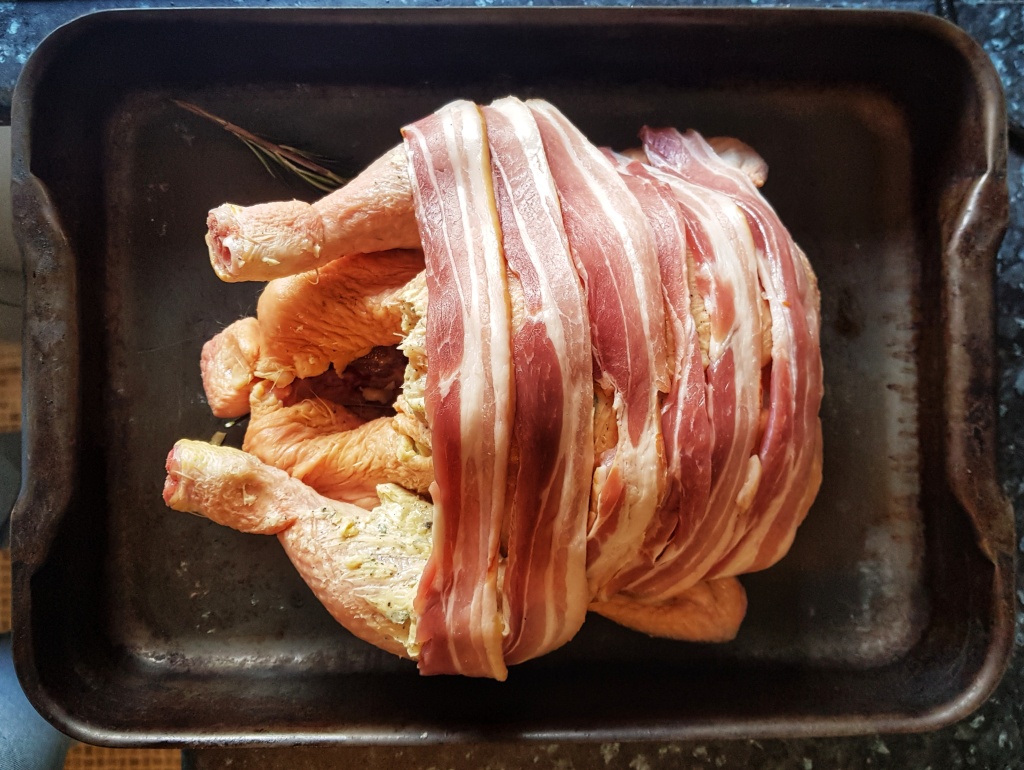
Make sure there is plenty under there, but reserve around a quarter of it to spread it over the legs. Next, lay the rashers of bacon over the bird so they overlap only slightly.
Weigh the chicken then pop it on a roasting tin. Don’t be tempted to truss it. Calculate the cooking time: 45 minutes per kilo plus 15 minutes and place in the oven.
Leave undisturbed for 30 minutes, and then baste with any butter that has melted and leaked from the bird. Tip to one side, so that buttery juices come out of the chicken. Baste with the juices every 20 minutes or so, and when the bacon is sufficiently crisp, remove it and let the bird roast without its porky jacket for the remaining time.
Remove and check its cooked all of the way through by easing the leg away from the body, it should be filled with delicious, clear juices. If unsure, use a sharp knife to test the juices are clear in thickest part of the leg. If they are tinged with pink, roast ten more minutes.
Remove the tender chicken – be careful it may start to collapse a bit, so be swift and use a fish slice and a pair of tongs to help you guide it to a board safely and all in one piece. Cover with foil to rest while you make the gravy.
Tip the juices into a jug and allow to settle for a few minutes. Place the roasting tin over a medium-high heat and brown any delicious detritus that remains in the roasting tin. Deglaze with the wine, scraping off any brown bits with a wooden spoon, then tip the whole lot into a saucepan and bring to a simmer. Meanwhile skim away most of the fat from the chicken juices and pour them into the pan along with the stock. Bring to a boil and let it bubble away for ten minutes so it reduces a little.
Now slake the cornflour with a few tablespoons of cold water and whisk it briskly into the gravy. Give it a couple of minutes to thicken, and if it seems on the thin side, slake a little more; it’s all down to preference, I prefer a thin gravy.
Check for seasoning and leave on a low heat whilst you get everything ready.
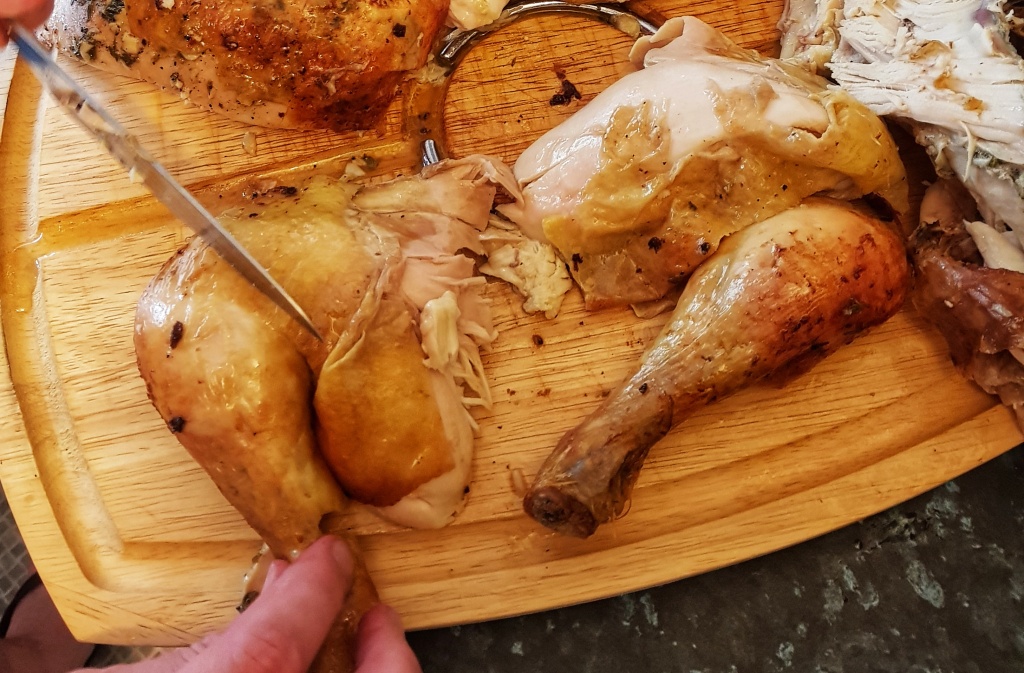
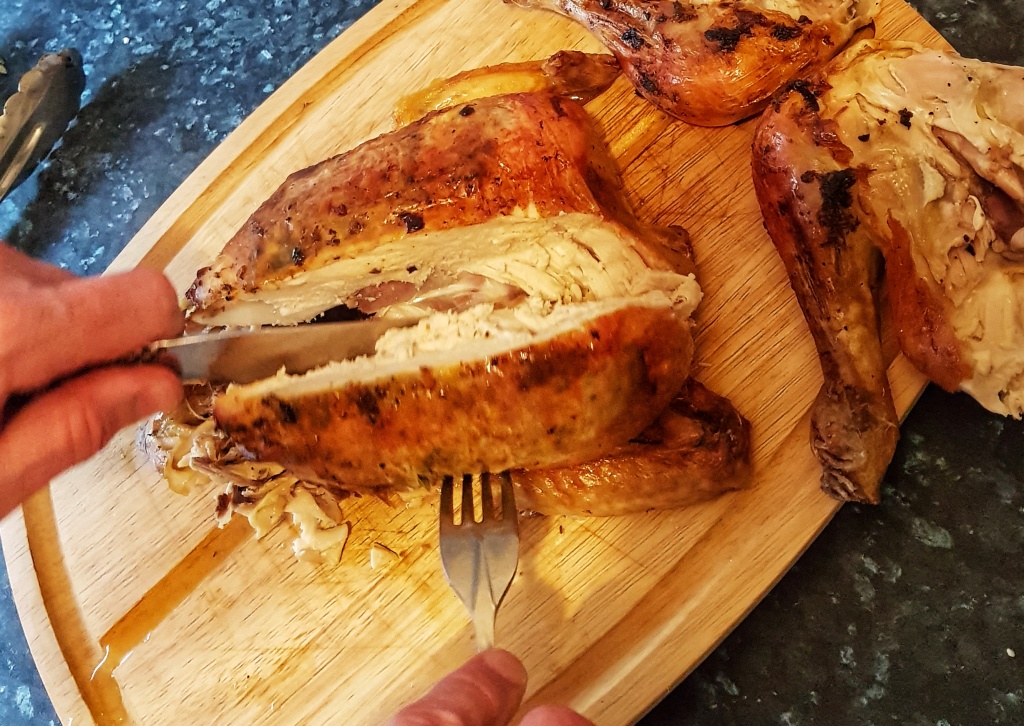
To carve the chicken I find it easiest to remove the legs first, cutting them at the knee to give two thighs and two drumsticks, and then cutting each breast away in one piece, cutting them into four or five thick pieces.
Arrange them on a warmed serving plate and don’t forget to serve the bacon.
References
The Culinary Recipes of Medieval England (2013) compiled and translated by Constance B Hieatt
The Experienced English Housekeeper (1769) Elizabeth Raffald